by Patrick Appel
Daphne Eviatar is more hopeful about Holder prosecuting CIA interrogators than Andrew was:
by Patrick Appel
Daphne Eviatar is more hopeful about Holder prosecuting CIA interrogators than Andrew was:
by Patrick Appel
Ryan Sager explains their storied history and then asks:
Judging by rumors circulating in places like Iraq, my gut says the past was worse. Paranoia and a dearth of media breed lies.
by Chris Bodenner
Kathy Griffin sits in Larry King's chair interviewing Levi Johnston about their "love igloo" and the Teen Choice Awards.
by Patrick Appel
A reader counters Reihan:
But whenever there's a move to tweak the system in some way—say, to gently nudge patients to get the approval of a general practitioner before seeing a specialist—the French go absolutely mad with rage. Doctors go on strike, massive street protests ensue, the riot police come out: it's a crazy scene.
I would submit that this says more about the nature of French politics rather than the nature of their health care. Taking to the streets of Paris is, after all, a time-honored tradition. By contrast, health care disputes in Canada tend to be rather less raucous.
But the essential point of the article is true: government insurance means that premiums, coverage and so forth largely become political questions. That's not necessarily a bad thing; political processes are subject to public pressure.Insurance companies, by contrast, are only rarely accountable to anything but the stockholders.
Another:
Striking, rioting, and street protests are pretty much the French response to everything. Unions, rail workers, education professionals, service employees, bakers, air traffic controllers, journalists, bank tellers, ski lift operators, Princess of Cleves supporters (explain that one to me), hell even Eiffel Tower employees. The people who make Post-It notes have took their managers hostage. And that's just in the last year.
Sometimes the French strike and protest just for the hell of it.
Point being, I think French striking health care says less about the relative merits of health care systems than it does about the French.
by Patrick Appel
The Economist takes aim at sex offender laws. The article begins with a case in Georgia where a seventeen-year-old girl was forced to register as a sex offender for performing oral sex on a sixteen-year-old boy. Zooming out:
Anytime I try to discuss criminal justice reform, incarceration hawks will use murders and rapists to stereotype the entire prison, parole, and probation population. Grouping together real predators with hormone saturated teenagers, like sex offender registries do, doesn't help the blurring of fairly harmless offenders and truly dangerous criminals.
by Robert Wright
While guest blogging this week, I’ll again be sharing some excerpts from my book The Evolution of God. Tonight’s excerpt shows how, more than a millennium before Muhammad’s birth, the Bible paved the way for Islam’s inclusion in the Abrahamic family.
It’s well known that Muhammad claimed that Muslims had descended from Abraham’s son Ishmael. What’s less well known is that here he was picking up on the Bible’s own depiction of Arabs as “Ishmaelites”. And what’s almost entirely unknown is that this depiction of Arabs, initially unflattering, was revised upward by a later, more Arab-friendly biblical author, who thus created a narrative that Muhammad could embrace and extend. Here's the story.
by Chris Bodenner
"We should not be cowed by the terrorists so we don’t even keep them in maximum security prisons in the U.S. We cannot allow the terrorists to be intimidating us," – Senator Carl Levin (D-MI).
by Patrick Appel
A reader corrects me:
by Patrick Appel
This IBD line is pretty great:
Alex Massie, along with the rest of the blogosphere, has some fun at the author's expense. Besides being wrong on the particular, it was pointed out a few days ago that people like Hawking, and Trig Palin, should actually benefit from the reform.

by Chris Bodenner
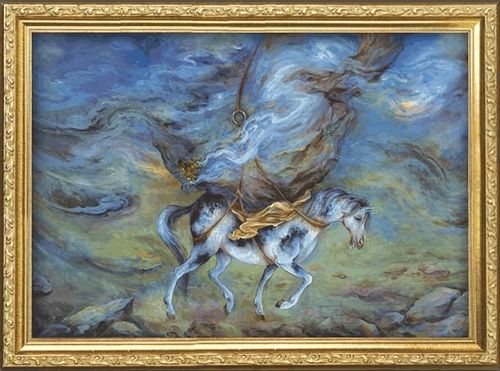
A reader recommends Mahmoud Farshchian. Wikipedia says:
Farschian is a world renowned master of Persian painting and miniatures. He was born in the city of Isfahan in Iran, a place famed for its art and artists, and it was here where he started to learn art, painting and sculpting. His masterpieces have been hosted by several museums and exhibitions worldwide. He's the most prominent modernizer of the field of miniatures, an art form which was first established in Ancient Persia and later spread to China and Turkey and other Middle eastern countries.
("Forbearance," 2003. More examples of his work here.)