DC = Disorderly Conduct

A useful column from Colby King. This statistic leapt out at me:

Residents are arrested in D.C. for disorderly conduct in large numbers: nearly 5,000 in 2007, more than 4,200 in 2008 and 4,469 this year as of Aug. 5. Many are probably arrested for good reasons: noise violations, blocking public spaces, etc.

If that's accurate, that's a vast increase in such incidents this year. Many of the charges, if challenged, are dropped. King notes:

Disorderly conduct laws apply to a breach of the public's — not a cop's — peace. As the Office of Citizen Complaint Review (its name in 2003 when this ruling was made) noted, echoing the D.C. Court of Appeals, and courts in other jurisdictions such as Massachusetts, a "police officer is expected to have a greater tolerance for verbal assaults . . . and because the police are especially trained to resist provocation, we expect them to remain peaceful in the face of verbal abuse that might provoke or offend the ordinary citizen."

Can We Pop Bubbles Before They Burst?

Bubble-pop

Alex Tabarrok addresses the age-old question:

On the way up, bubbles encourage excessive investment in the bubble sector. On the way down a bursting bubble can create wealth shocks, liquidity shortages, and balance-sheet death-spirals. For both of these reasons, it would be good to be able to identify and pop bubbles. Identifying bubbles isn't easy, however, because, especially when interest rates are low, prices can increase rapidly with small, rational changes in investor expectations. But the difficulty of identifying bubbles is reasonably well known. What I think may be less appreciated is that bubbles are hard to pop even when you know that they exist.

Daniel Indiviglio joins the discussion:

Alan Greenspan is widely blamed for exacerbating the housing bubble, after leaving interest rates too low for too long. The poor guy just can't win: either he's raising rates too quickly (popping the internet bubble) or keeping them too low for too long (creating the real estate bubble). One possible solution to this could be for the Fed to only use monetary policy to control inflation and never attempt to affect business cycles. Yet, that probably would not fly politically, which is one of the problems in having a quasi-public central bank.

But either way, I'm not sure it matters. I asserted before that investors tend to be too emotional, and that helps to make bubbles worse. That's partially true, but the flip side is that investing in the asset of the day during a bubble is wholly rational. If you don't, you will fail to reap the returns that everyone else will enjoy.

[…] Unfortunately, this is a problem that I'm not sure can be solved. You would have to essentially discourage that rational behavior. One possibility would be forcing long-term investment only. Then investors would certainly be less apt to take part in inflating a bubble, since they can't count on getting out before the crash. I just worry that such a policy would do more harm to the market through creating inefficiency than good though only allowing smaller bubbles.

(Photo by Richard Heeks. Find the rest of his series here.)

Murdoch And Sirius

A reader writes:

Sirius XM is probably the best model of what happens when you start charging for what people are used to getting for free. It fails. Sirius has invested billions of dollars into amazing technology, but without a partnership that gives new car buyers a free subscription for a limited time, they would have failed years earlier. They make the same argument, that they've got exclusive content, but just like Times Select, walling off that content just made it less relevant. Howard Stern was going to be the man who made Sirius a must have for millions of fans, but when was the last time you heard anybody mention the man?

How did he go from a must-hear personality who was constantly in the news for his antics or his outrageousness to a "whatever happened to?" has been? Simply, he was put behind a pay wall. Oprah has her own channel, but I've never heard it mentioned. If the King of All Media and a woman who has enough influence to swing a national election can't get people to pay, why on earth does Murdoch think he can?

Fact-Checking Palin

A reader notes that Sarah and little Trig would never appear before any “Death Panel”, because they are entitled to free federal health care. Palin’s own record of treatment of the elderly and disabled can be explored here. And you may remember this odd lie:

At one point, trying out a debating point that she believed showed she could empathize with uninsured Americans, Palin told McCain aides that she and Todd in the early years of their marriage had been unable to afford health insurance of any kind, and had gone without it until he got his union card and went to work for British Petroleum on the North Slope of Alaska. Checking with Todd Palin himself revealed that, no, they had had catastrophic coverage all along. She insisted that catastrophic insurance didn’t really count and need not be revealed.

Notes From The Fury

A reader writes:

I just want to share a sad story with you. Tonight I was at my regular Friday night AA meeting in LA that I have been attending for 18 years – I am a 48 year old woman. One of my oldest friends, a male with 30 years sobriety, is a Republican. I am a Democrat. Every week he talks politics with another like-minded friend. Tonight he arrived a bit later than usual, so as I gave him a hug, I said, “Thank goodness you arrived because I am sure Betty* (name changed) did not want to discuss politics with me!”

He then turned around and started screaming at me. I was so taken aback, I didn’t even know what he was screaming about at first. When I finally tuned in, he was yelling that Obama “sent the SEIU thugs to beat up the senior citizens” protesting at the health-care town hall meetings and that Obama had instructed the SEIU “if they come at you, you go at them twice as hard.”

When I tried to reasonably protest this statement, he just spewed forth a tirade of vile invectives.

We were outside and there were about 30 people milling about. I was shocked, embarrassed and literally frozen in place. I managed to turn and walk away. This is a man I have known and respected for the entire length of my sobriety. I am fairly certain this friendship is over. Reasonable discourse is over. The lies and hate spread by the right-wing have won. As a side note, his wife, who is one of my best friends would not talk to me for over a month after the election in November. I am just heartbroken. Sorry, I know this is not the most well-written account, but I am so shaken, I can barely wrap my head around it.

A Defense Of Colonialism

K-Lo interviews George Gilder:

During this 20-year period under Israeli rule [starting in 1967], some 250,000 Israelis settled in the Territories. These were the supposedly predatory settlers. They supplied the infrastructure of power, water, education, and medical care that attracted nearly ten Arab settlers for every one Israeli. During this period, the economy in the territories grew some 25 percent per year, nearly the fastest in the world, and far faster than that of Israel itself, which was still bogged down in socialism. Arab life expectancy rose from 40 to around 70. Their incomes tripled while their population soared. Seven universities and 2,500 factories were established. It was the golden age for Palestinian Arabs.

Ackerman fumes. Jamelle articulates his anger:

Ackerman is right to compare this to the contention – occasionally made by retrograde conservatives/modern-day confederate-sympathizers – that American slavery wasn’t so bad, as it brought Africans to America, which is so much more awesome than Africa, or something.  In fact, you can extend this argument to almost any instance of oppression; British domination of India wasn’t a complete wash, after all, Indians benefited from British education, British industry and British culture.  Yes, a few million Indians had to die for “civilization,” but really, higher prices have been paid for less.

That said, I wonder if George Gilder – or any other American neo-colonialist – would make the same argument in support of Britain’s control over the American colonies.  Again, the United States owes much of its early prosperity to British industry and British markets.  Indeed, it goes far deeper than that; the entire American tradition of self-governance grows out of British conceptions of representative government.  It’s always worth remembering that before the American revolutionaries were revolutionaries, they were Englishmen qua Englishmen fighting for their God-given rights as British citizens.  The logic that Gilder uses to justify Israeli occupation of Palestinian territories almost certainly applies to British occupation of the American territories, and I’m honestly curious as to whether he would have opposed revolutionary efforts to sever America from the crown.

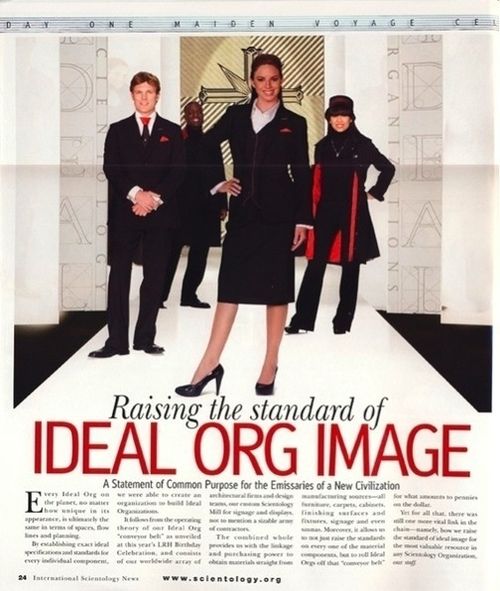
Join Now And Get A Free Cape!

SAC-capes

Gawker describes the latest marketing strategy from the Super Adventure Club:

Want to work in one of Scientology's fresh new "Ideal Org" churches? Then get ready to put on your 20-piece uniform, mandatory for all cult staff. […] The uniform is intended to unite staff on "six continents" and help them look the part of "emissaries of a new civilization."