A useful reminder of a previous occasion on which the Republican base called the president a communist. The president was Eisenhower. Eventually, the Birchers were kicked out of the party; today, the Birthers are 70 percent of the party. It will take a helluva civil war to kick them out.
Month: August 2009
Back In The USA
Fallows notices a whole bunch of interesting things after three years' away in China. Among them:
The NYT, for all its travails, is a recognizable version of the publication I'd previously known. Personality, depth, world-view, tone. The poor Washington Post is not. Laying off — that is, buying out — so many reporters who knew so much about their topics has had a more profound effect than I would have guessed. (Locus classicus: Tom Ricks on defense.) And the resulting paper seem more obviously desperate to try anything that will draw attention in this new age.
Martinez Quits Early
This is becoming a pattern among Republicans. No idea why at this point. But to have a leading Latino figure – arguably the most prominent Hispanic-American in the GOP – to resign the day after Sotomayor ascends to the Supreme Court: well, the combo can't be a good news cycle for Republicans among Hispanics, can it?
Super Adventure Club News
Newly declassified files from the British government reveals L. Ron Hubbard's fraudulent claims of a degree. And then my favorite headline in quite a while: "The Battle For East Grinstead."
Paying For Online News
The Murdoch announcement may be the most significant for the web in years. My own paper, the Sunday Times, will be the first guinea-pig. It is the last stand of the newspaper industry as we've known it. And who better than its pre-eminent champion in the last few decades? The editor of the FT:
"I confidently predict that within the next 12 months, almost all news organisations will be charging for content."
Reuters chief demurs:
The Internet isn’t killing the news business any more than TV killed radio or radio killed the newspaper. Incumbent business leaders in news haven’t been keeping up. Many leaders continue to help push the business into the ditch by wasting “resources” (management speak for talented people) on recycling commodity news. Reader habits are changing and vertically curated views need to be meshed with horizontal read-around ones. Blaming the new leaders or aggregators for disrupting the business of the old leaders, or saber-rattling and threatening to sue are not business strategies – they are personal therapy sessions. Go ask a music executive how well it works.
So what happens to blogs if this happens?
My bet is that bloggers will pay up and then use fair-use quotes to convey the gist to readers. So there's a danger that this could actually empower aggregators even more. We'd become briefers of what's in the MSM – and save you the trouble of subscribing. I have no idea how this works out in the end, but I wouldn't want to be the first general interest news website to put up firewalls around content. I guess that's why Rupert Murdoch has such large cojones. He'll need them. In Britain, he has to compete with a free publicly-funded Internet news service, the BBC. NPR licks its chops in the US:
It’s almost like there’s mass delusion going on in the industry — They’re saying we really really need it, that we didn’t put up a pay wall 15 years ago, so let’s do it now. In other words, they think that wanting it so badly will automatically actually change the behavior of the audience. The world doesn’t work that way. Frankly, if all the news organizations locked pinkies, and said we’re all going to put up a big fat pay wall, you know what, more traffic for us. News is a commodity; I’m sorry to say.
How Not To Court Hispanics
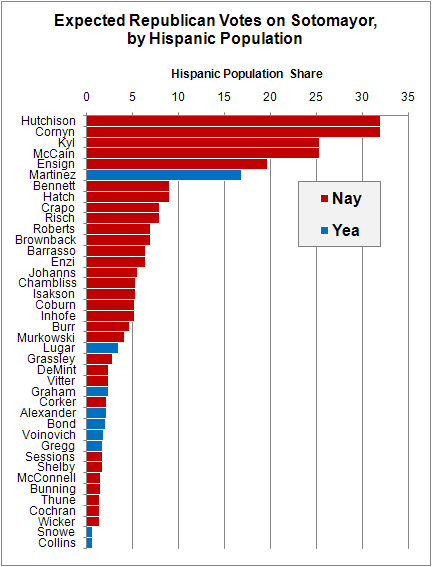
Nate Silver notes:
In some formulations […] a higher Hispanic population actually turns up as a statistically predictor of a vote against Sotomayor. I suspect that is probably a fluke; among the five Republicans in the states with 20%+ Hispanic populations planning to vote against Sotomayor, Kyl and Ensign are very conservative, Cornyn is in a leadership position in his caucus, and Hutchison may have to bolster her conservative credentials in anticipation of her primary against Rick Perry. John McCain's nay vote is more surprising, and he seems to being a thorn in Obama's side.
Gog, Magog And The Bushes II
Here's the source of the story – a religious scholar called up by Chirac to explain Bush's weird invocation of Gog and Magog to defend the Iraq war. Again, what amazes me is not that Bush – in the grip of a fundamentalist psyche if ever there was one – would believe this. It's that he thought it would persuade Jacques Chirac. More fascinating detail here from Wayne Dynes.
Malkin Award Nominee
"[Gibbs' gaffe] reflects what the administration wants in Iran. It wants [Ahmadinejad] in power. It did not want the demonstrations," – Charles Krauthammer, Fox News.
Seriously: it was Krauthammer's buddy Daniel Pipes who wanted Ahmadinejad in power, like many other neocons. They wanted him in power so they could get a pretext for bombing the country. Mousavi would have been a far better interlocutor – and might, with Obama, have changed the dynamics of the region. The idea that Obama was not encouraged by an outpouring of support for reform – which he specifically called for in Cairo – is partisan nonsense.
Gog, Magog And The Bushes I
Maybe it all comes down to Skull and Bones:
The name Magog is traditionally assigned to the incoming Bonesman deemed to have had the most sexual experience, and Gog goes to the new member with the least sexual experience. William Howard Taft and Robert Taft were Magogs. So, interestingly, was George Bush [Sr.].
Ignoring The Torture
Ambers finds an unsettling new study:
[N]ew research from psychologists and criminologists suggests that jurors tend not to discount evidence obtained from rough interrogations even though there’s plenty of evidence to suggest that those claims aren’t reliable. Writing in Psychology, Crime & Law, 2009, the authors conclude that jurors’ expert bias — their penchant to view expert testimony as more reliable — overrides their perceptions and evaluations of the situation under which an interrogation was conducted. Indeed, even when given hints that confessions are false, jurors tend to put some weight in them. This finding, which replicates others in the field, has some important implications for any federal trials of terrorist suspects. Jurors tend to put themselves in the shoes of people under duress and project upon them their own principles, such as — if they were innocent, they’d never give in to torture.
One should also remember the role Cheney and Bush have played in legitimizing torture – in America and the rest of the world. Once a moral authority like the United States president endorses this evil, uses it, celebrates it, and threatens to use it again, the influence is wide and deep.
 The Dish