And does his best to undermine the foreign policy of the elected president. Because his foreign policy is not identical to Israel's.
Month: August 2009
Should We Sanction Iran?
Juan Cole says sanctions wouldn't work:
You may have noticed that just last week, and despite Iran's political crisis, Russia and Iran conducted joint naval exercises in the Caspian Sea. You really think Russia is going to vote at the UN for crippling sanctions on Iran? What would happen to the value of Russian (and Chinese) investments in Iran? Even a US ally such as the UK, which is seeing depletion of the North Sea fields, is increasingly interested in Iran as a source of natural gas. In part, this interest derives from a desire to avoid being hostage to Russia. Draconian sanctions on Iran would have the effect of actually strengthening Russia's near-monopoly position with regard to supplying natural gas to Western Europe.
Moreover, the Iranians can play spoiler for the US withdrawal from Iraq, both in the Shiite south and in Kurdistan. They helped rein in Muqtada al-Sadr, they can unleash the special groups of the Mahdi Army. As the US military draws down over the next year, it becomes more and more vulnerable in Iraq. Moreover, Iran has plenty of clients in Afghanistan and can make lots of trouble for US and NATO troops there. Obama could go into the 2012 election season with two quagmires on his hands if he provokes Iran too much.
And, Shiite-dominated Iraq would not go along with a gasoline embargo on Iran. In fact, Iraqis would line up to smuggle gasoline into their neighbor, both on economic and ideological grounds. And Venezuela among other potential exporters would not cooperate. Since gasoline is easily transported and transformed into cash (what the economists call 'fungible'), a gasoline embargo would be among the more difficult policies to implement that you could imagine, especially if much of the world is against it.
Romney’s Nationalism
He's honing the line from the Cheney far-right, just as he promised to "double Gitmo." Alex Massie explores Mitt's latest pander to the Dolchstoss base.
Would The Birthers Go After Jindal?, Ctd
Aziz Poonawalla disagrees with Larison:
[T]he simple fact that the Birther meme is nothing more than a sanitized outlet for pure unadulterated racism at its heart seems impossible to deny. As Daniel notes, we wouldn't be seeing this movement if John McCain were elected (even though McCain's birth in Panama could theoretically be subjected to the same conspiracy mongering) – but neither would we be seeing it were it John Kerry who had won in 2004 and had a similar asterisk next to his birth credentials.
Perhaps, though Kerry was certainly pegged as "foreign" – if only French-loving. And McCain's POW experience – presumably sacrosanct for any Republican – was nevertheless smeared in 2000 by some who saw Bush as the more authentic Christian conservative. Austrian-born Schwarzenegger would be a formidable force on the national stage regardless of his heritage (his pro-choice stance would be a bigger burden in the primaries). And in the case of Palin, her nationalist supporters last year didn't bat an eye at incontrovertible proof that her husband was a member of the Alaska Independence Party (not to mention one-quarter Yup'ik Eskimo).
Prejudices are rarely "unadulterated." Residual racism from the '60s certainly resides in the Republican rump, but partisanship usually trumps it. Larison says as much in his response to Poonawalla:
Assuming that racism is the central or overriding element behind this obsession, as Aziz does, is the easiest move in the world, but it is not necessarily accurate. It is a ready-made answer that in this case relies on a number of prejudices about Southerners, conservatives and attitudes towards race that are largely outdated, and it is an answer that fails to take account of the potency of political ideology, partisan attachment, and a particularly assertive, aggressive post-9/11 nationalism that took over much of the right in the last eight years. The insistence that Obama was born outside America, or that he must be in some way foreign, may be the only way for extreme Americanists to account for how someone born here and raised for almost his entire life in the U.S. could come to have views that they regard as un-American and anti-American.
To circle back to Jindal, consider this evidence: a recent straw poll of 250 members of the Young American Foundation – who are among the most fervent Republican activists – selected the dark-skinned Indian-American as their second choice for '12. (And lily-white, "Real America" Palin? "[B]uried among the also-rans.")
“Your Toryism Is Showing!”
A reader writes:
As a Canadian, where our "Tory streak" has provided us with a larger gamut of "conservatism" I find it funny to hear our health care system described as the product of
"socialism" or "liberalism". The reason public health care has been so successful here has been because there is support across the spectrum for the policy: our streak of Toryism has engendered a type of Burkean approach that values "the social order" and therefore conservatives from Bennett to Diefenbaker to Joe Clark and Jim Prentice have come to see safety nets and public health care as tools that help maintain "order", stability and peace within the nation. Our constitution has enshrined the words "peace, order and good government". Our conservatives may not want to go as far as our "socialists" or even some of our big "L" Liberals want to go on some facets of social policy but the fact is that there are plenty of self-described conservatives up here who support the minimum level of social spending necessary to keep inequality from getting so bad that the spectre of class revolution becomes manifest.
Your sentence: "and I've begun to worry that the last few decades have opened up too big an inequality gap in America for political stability in the long run," sounds distinctly Tory to my ears. Your upbringing in Britain has perhaps imbued you with a "Tory streak" of your own I think.
Now its true that in recent decades Canada has seen its conservative party more closely approximate a typical Republican approach but I am forever thankful that we have a more diverse conservatism up here that helps build consensus across party lines on critically important policies like health care. I look south and see what comes from an ideological environment that purified itself into different strands of classical liberalism, where Toryism died out with the Whigs and where the idea of a conservative supporting social policy is nearly unthinkable nowadays, and thank my lucky stars I was born a few hundred kilometers north of the border.
I do think my inner Tory has re-emerged these past few years (if you're interested, The Conservative Soul is my best attempt to explain where I'm coming from). I remain proud of being a Thatcherite and Reaganite back in the day – but I supported them in large part because they addressed the practical problems of their day with courage and clarity. And they also were pragmatists. Thatcher didn't tackle the coal unions until her second term; privatization was an experiment that became something much more; and Reagan, recall, raised taxes and came to a grand bargain with the Soviet Union. My belief in 2008 was that Obama represented the best practical way forward. And although I'm going to criticize him when warranted, I stand by that 1000 percent. We're lucky to have him.
Game Theory And Healthcare Reform
A blogger scores a succession of quick tactical victories for Obama. But he's long been about strategy on this. And I wouldn't count him out.
Cambridge’s Cops
New context from another black Harvard professor, who, like Gates, was asked to come out on his front porch and summarily arrested on charges of assault and battery on which he was subsequently acquitted. He was never told what he was being arrested for at the time, collapsed at the police station from a heart condition, and was taken to hospital where he was cuffed to his bed. He learned a lesson – do not step out of your door if a you are black and a Cambridge cop is knocking:
“The word around Harvard is never step outside your house with these guys,’’ Counter said in a phone interview. “We advise people not to step out.
You call an attorney and stay in your house.’’
Cambridge police would not comment on Counter’s arrest yesterday. But a spokesman said that police have a right to enter homes without a warrant if there is probable cause.
“We don’t bait people to come outside,’’ said Officer Frank Pasquarello, the police spokesman. “All across America, people step outside their houses and meet us on the porch. We don’t go in if they come out. But once we’re in there, we don’t have to take you outside to lock you up.’’
So the cops reply to a complaint with a threat. That tells you something, I'd say.
Like Taking Cookies From A Brownie
Goldblog exposes Walmart's latest scheme.
125 – 4
That was the size of the majority as the American Psychological Society Association voted to condemn so-called "reparative therapy" to turn gays into straights. This is not a new position, but the statement is strong and the vote overwhelming. Since this therapy is central to the Christianist claim that gay rights are invalid because gayness is a choice, the views of the experts matter. But not, of course, to Christianists. Money quote:
“Both sides have to educate themselves better," Ms. Glassgold said. “The religious psychotherapists have to open up their eyes to the potential positive aspects of being gay or lesbian. Secular therapists have to recognize that some people will choose their faith over their sexuality.”
That seems totally right to me. Pressuring anyone into anything is not the role of psychologists. And pressuring anyone to be gay should be anathema as well. The point of the gay rights movement is not to encourage people to be gay. It is to enlarge the scope of freedom so that more people, gay and straight and bi and trans, can be themselves. With dignity and respect.
I wrote a long and detailed essay on reparative therapy, Freud, and homosexuality in Love Undetectable, the book I'm proudest of. It's the second chapter: Virtually Abnormal. I defend Freud from his successors and offend a few gay absolutists at the same time.
How Important Is Climate Change?
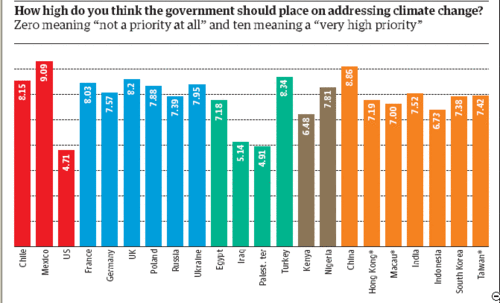 Jesse Zwick points to this chart from a new University of Maryland study and writes:
[Seventy-three] percent of respondents worldwide want their government to place a high priority on climate change. It's worth noting that China and India, two countries whose governments have thus far adamantly opposed binding reduction targets for greenhouse gases, had some of the most enthusiastic publics [94% and 59%, respectively] In the United States on the other hand, only 44 percent thought that climate change should be a major priority. The only other two countries in the 19-country study that couldn't muster a majority? Iraq and the Palestinian Territories.
Ryan Avent recently touched upon China and India's reasons for concern. But today, pace Mark Steyn, the Chinese seem to be taking the issue very seriously:
In a briefing at China’s Foreign Ministry, Mr. Yu presented a list of Chinese achievements in limiting carbon emissions, including claims that Beijing is the world’s foremost user of nonpolluting hydropower and solar power, and fourth in wind power. By 2020, he said, 15 percent of China’s energy will come from renewable sources. Mr. Yu also said the nation had made impressive strides in energy efficiency, reducing the amount of energy used per unit of gross domestic product by a tenth since 2005. The government has said it will achieve a total reduction of 20 percent by 2020, a goal Mr. Yu called “a binding target.”
But here's the money quote:
“Not a single country in the world will be able to stay out of trouble,” he said. “Not a single country can say that it can keep safe and intact from global warming. So the only way out is cooperation — global cooperation.”
PR or what they really think? We'll see.
 The Dish