by Andrew
What else is there to say?
by Andrew
What else is there to say?
by Patrick Appel
McSweeneys separates healthcare myths from facts.
by Conor Friedersdorf
On his Twitter feed, talk radio host Mark Levin has asked for feedback on “A Conservative Manifesto,” the epilogue to his bestselling book Liberty and Tyranny. Some time ago I borrowed the book from my grandfather, so I thought I’d skip ahead, read its final pages and offer my thoughts.
This isn’t mere pique. Despite my criticism of Mr. Levin’s radio show, where the host does premeditated violence to public discourse and appeals to the most juvenile impulses of the conservative base, I find his book length work much more worthy of engagement. Its tone is more measured, it regularly proceeds via logical argument, and certain points are stated with enough clarity that productive rebuttals are possible (especially since they proceed without anyone’s finger on the mute button).
As I reflect on Liberty and Tyranny’s final pages, however, I find myself unable to respond without addressing a larger feature of the book that I regard as its most consequential flaw: Its every section, including the Epilogue, references few if any concepts as often as “Statism.”
The term, as used by Mr. Levin, is introduced in the book’s initial chapter, “On Liberty and Tyranny,” where he asserts, “For the conservative, the civil society has as its highest purpose its preservation and improvement.”
He goes on:
The Modern Liberal believes in the supremacy of the state, thereby rejecting the principles of the Declaration of Independence and the order of the civil society, in whole or in part. For the Modern Liberal, the individual’s imperfection and personal pursuits impede the objective of a utopian state. In this, Modern Liberalism promotes what French historian Alexis de Tocqueville described as a soft tyranny, which becomes increasingly more oppressive, potentially leading to a hard tyranny (some form of totalitarianism). As the word “liberal” is, in its classical meaning, the opposite of authoritarian, it is more accurate, therefore, to characterize the Modern Liberal as a statist.
It is difficult to overemphasize how important that paragraph is to the balance of Mr. Levin’s book, and his entire intellectual oeuvre. The United States that he comments on isn’t one that pits Republicans against Democrats, or conservatives against liberals, or the center right against the center left, or where citizens of complicated political persuasions — mixing ideology, pragmatism and ignorance — do some combination of participating in politics and ignoring it. Instead Mark Levin’s America is one where the conservatives are pitted against the Statists, or to put things as he would, where liberty is pitted against tyranny.
Certainly there are times when abstractions as dramatic help to elucidate important points. Indeed this happens in Liberty and Tyranny: Mr. Levin does a capable job setting forth numerous aspects of historically informed, principled conservatism in language that is notably accessible. Though abstraction helps Mr. Levin to define conservatism, however, it leads him so far astray as he attempts to talk about non-conservatives as to render his analysis utterly useless in understanding more than half of the American political landscape.
Before I back up that assertion, allow me to cite a small example of how Mr. Levin’s oversimplified view of America leads him astray. After quoting the Federalist Papers, he writes:
For much of American history, the balance between government authority and individual liberty was understood and accepted. Federal power was confined to that which was specifically enumerated in the Constitution and no more. And that power was further limited, for it was dispersed among three federal branches—the legislative, executive, and judicial. Beyond that, the power remained with the states and ultimately the people.
He proceeds to point out that the Framers made amending the Constitution very difficult to safeguard its status as a lasting social contract. “But in the 1930s, during the Great Depression,” he writes, “the Statists successfully launched a counterrevolution that radically and fundamentally altered the nature of American society.”
Does anything seem notable about this narrative? It seems that when one frames all American history as a contest between conservatives and Statists, it is easy to gloss over events like the Whiskey Rebellion, the rise of judicial review, the Alien and Sedition Acts, slavery, and the Civil War, among many other events, by breezily writing, “For much of American history, the balance between government authority and individual liberty was understood and accepted.”
Was it really?
But let us be charitable. Perhaps Mr. Levin, writing with an eye toward current events, began the conflict between liberty and tyranny in FDR’s America because he regards it as when the particular threat to liberty that the United States today faces began.
It is viewed through this lens that Liberty and Tyranny fails due to Mr. Levin’s decision to label non-conservatives from FDR forward as Statists, a term that is defined with more and more precision as the book progresses. The Statist “has an insatiable appetite for control… is constantly agitating for government action… speaks in the tongue of the demagogue… veils his pursuits in moral indignation…. and is never circumspect about his own shortcomings” (page 8). Qualities antithetical to the statist include “initiative, self-reliance, and independence” (page 9). “The Statist often justifies change as conferring new, abstract rights, which is nothing more than a Statist deception intended to empower the state and deny man his real rights” (page 14). “The Statist is dissatisfied with the condition of his own existence… he is angry, resentful, petulant, and jealous.” (page 15) “For the Statist, liberty is not a blessing but the enemy” (page 16). “The Statist urges Americans to view themselves through the lens of those who resent and even hate them… The Statist wants Americans to see themselves as backward” (page 18). “
That gets us most of the way through Chapter 2, and the book goes on like that, with “The Statist” as its villain – he is vexed by the Declaration of Independence in the chapter "On Faith and the Founding," falsely promising utopianism in the chapter "On the Constitution," and in the chapter "On Federalism" he takes advantage of the 14th amendment as “a pathway to his precious Utopia where, in the end, all are enslaved in one form or another” – unlike the right-thinking reasons Mr. Levin offers for supporting the 14th amendment, which he accurately casts as affording tools to address “intransigent state racism against African Americans.”
Terrible as he sounds, The Statist that Mr. Levin describes—his ill deeds keep growing as the book winds down–would at least play a clarifying role in American politics if he actually existed. Imagine how useful a blueprint Mr. Levin’s book would prove if the primary opponents of conservatives were actually cunning Statists with malign motives and hatred of liberty in their hearts. But re-read all the attributes that describe the Statist. Does anyone in American politics fit that description, let alone a plurality sizable enough to enact their agenda?
In fact, the main antagonists that the American conservative vies with in politics are the independent, the liberal, the center left Democrat, the progressive, even some among the apolitical. The average people who support “Statist” President Obama’s domestic agenda are apolitical African American women who work in cubicles, law firm associates who earn six figure salaries, and working parents who fret about being uninsured—not utopian radicals bent on advancing a counterrevolution that destroys the freedom won by the Founding generation.
By arguing against The Statist, Mr. Levin can attract a huge radio audience, and sell lots of hardback books, but the consequence is an inability to accurately understand what it is that motivates the people who support President Obama’s liberal agenda – and ultimately a failure to effectively oppose that agenda. One hears a lot about how President Obama is a secret radical, but even granting the truth of that assertion — which I do not — would hardly explain why so many Americans voted for him, or why so many Congressional members share his legislative priorities.
Even if Mr. Levin succeeds in vilifying Mr. Obama himself, his popular legislative priorities will merely arise in a future Democratic administration unless someone convinces Americans that their actual reasons for favoring some liberal policies are wrong.
The enduring power of writing by Milton Friedman and Friedrich Hayek, and their success advancing their ideas over decades rather than news cycles, is owed in part to their sophisticated understanding of why liberalism is seductive, the valuable insights it offers, and how to persuade its adherents that some positions they hold are counterproductive or wrongheaded. Liberty and Tyranny will be forgotten, along with the Da Vinci Code and other tomes by right-wing talk radio hosts, because it doesn’t understand or grapple with the best version of its opponents’ arguments, or even the mainstream version. It instead erects terrible straw man and very capably knocks down.
That isn’t to say that there aren’t any Mark Levin-style Statists in America, though among the many liberal Democrats I’ve interacted with in the course of my life I’ve yet to meet one. I’m sure there are a few out there, no doubt eating arugula, and insofar as Mr. Levin’s book keeps us on guard against them, good on him. But spending so much of one’s time fighting straw men—and convincing one’s sizable audience that those straw men are your political opponents, and that your every sword swipe is dispatching them— is how one wins a battle while losing a war.
Liberty and Tyranny at its best is a Cliffs Notes refresher on conservatism for the reader too busy to read the Federalist Papers and Edmund Burke. At its worst, it is a counterproductive tome that misleads conservatives about the nature of their fellow Americans, distracts from the actual disagreements and differing priorities that separate us, and in so doing exacerbates the hard right’s present tendency to cede all reality based arguments about governance by never engaging them at all.
by Chris Bodenner
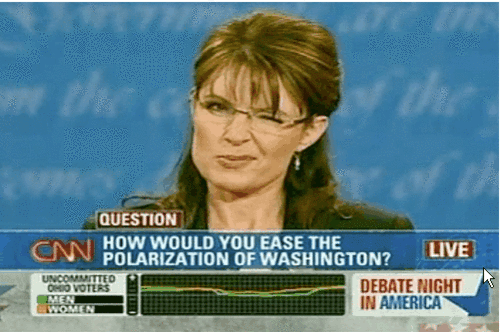
Alaska Dispatch launches a section commemorating the one-year anniversary of Palin's arrival on the national stage. Craig Medred writes the first of five essays:
Now the world knows not only Sarah but Todd and many of the rest of the players in what has become the Palin Family Soap Opera: Bristol, the teenage daughter who has become a national spokeswoman for teen abstinence. Levi Johnston, Bristol's ex-fiance and the daddy of the baby she had because she couldn't abstain. Sherri Johnston, the mother of Levi, and a convicted drug dealer. Meghan Stapleton, the former television talking head who became the bark-at-the-media attack dog for Sarah, who was in turn the attack dog for Republican presidential contender John McCain.
And those are only the main players. Throw in the bit players — people like Palin's Fox News buddy Greta Van Susteren; Levi's handler, Tank Jones, and flamboyant attorney, Rex Butler; the gaggle of photogenic Palin children; Sarah's plain-spoken father, Chuck Heath; even comedian Kathy Griffin, who dragged Levi along as her date to Nickelodeon's Teen Choice Awards in August — and the show really gets weird.
(Screen shot by Flickr user Jenn Hsu)
by Patrick Appel
Christina Davidson profiles the owner of the first medical marijuana shop in Colorado:
Most of the farmers Kathleen works with have been cultivating their product illegally for many years–the oldest has been in the illicit business for 35, more than half have grown marijuana for over two decades. Now that they sell their product to a legal commercial enterprise, weed farmers will have to register their income and pay taxes on it, just like anyone growing tomatoes or tobacco. "To have these people coming out of the closet after so many years, that's the really heartening thing about what's happening right now," Kathleen says.
Since marijuana farmers have begun selling exclusively to legitimate dispensaries, the underground market for illegal weed has been quashed, putting drug dealers out of business for lack of available stock.
One such dealer I talked to in Boulder, who I will call Quark at his request, told me that with the supply of high-quality Colorado hydroponic weed redirected to dispensaries, he has only been able to procure cheap Mexican schwag for the past few months. Since the implications of indirect association with brutal Mexican cartels unsettles him, Quark is currently seeking a regular job so he will have money to pay tuition this year. Though it has negatively impacted his own solvency, Quark has nothing but praise for the new phase in Colorado's marijuana industry. His only concern is that the change in employment status will burden his study time as he nears completion of his advanced degree in astrophysics.
A Dish reader once wrote that medical marijuana will do for decriminalization what civil unions have done for marriage equality. I'm starting to agree.

by Hanna Rosin
From the e-mails I've gotten, I can see that you are a smart, thoughtful, highly informed bunch. Also obnoxious sometimes. I'm sure you know that. Here are some of the issues I've written about that Dish readers have moved me on.
1. Katie Roiphe. I've had several friends and strangers write to tell me that their experience of early motherhood was nothing like hers. The baby was collicky, they were bored, and Roiphe presumes a certain common experience that does not exist. I can sympathize with that, more than I can sympathize with complaints that she is unfair to feminists.
I'm also a mother of a six-week old baby. I don't feel what she feels. I've had a handful of days where I've gone back to work for a half-day and it's been wonderful, like returning to myself. ..Now, here's the thing about my description of my days with my baby that I just gave. I used "I" and "me" and "my." Katie Roiphe uses "you" and "one" just as much as she uses personal pronouns. She is making her experiences universal to all mothers and that is a huge problem.
2. Circumcision. The number of responses has been overwhelming, and I am still sifting through them. I am certianly not convinced that this is a trauma for babies, or that it ruins your sex life. I get that some men feel about this the way 1970's feminists felt about abortion – It's my body, hands off. I always found that particular pro-choice line crass and unconvincing but hey, men can use it too. On the question of whether it helps prevent the spread of HIV and STD's, and particularly whether the Africa studies are applicable to the U.S. – I have to confess, I'm not sure yet. I will do my homework and address the subject on my own site, Doublex.com.
3. Kennedy and our prurient minds. From a reader.
Actually, I think the reason there are so many searches for Kopechne and Chappaquiddick today is that for many younger people, the TV obituaries for Kennedy are the first time they have heard about this, or certainly the first time they had some reason to look into it. And many older people, even those who lived through it, may want to refresh their minds about it. I don't think it shows some prurient secret personality of the public. Perhaps that exists, but this is not proof of it.
4. Caster Semenya, the South African runner. Here, I've gotten only incoherence about testosterone in sports and proper roles for the sexes. Well, gender roles are changing, and sports and religion can't stop that, sorry.
5. The cats. I've received several love poems to cats. I can only respond with the damage my own have caused so far: scratched up my two favorite rugs, ripped the curtains, decimated the local bird population. But my daughter does so love them.
That's all for now. It's been a thrill interacting with such a live, vibrant organism.
As an English professor who specializes in American lit and American Studies, I have to say that your query is both the most inviting I've ever seen on a blog and the most daunting. I could really, really go on, but I'm gonna be good and restrict myself to my favorite American novel, and still a very under- or even un-read one: Charles Chesnutt, The Marrow of Tradition (1901).
If all this novel did was draw attention to the 1898 Wilmington (NC) Massacre, perhaps the least well-known major event in American history–it's an actual and our only coup d'etat, for crying out loud!–that would probably be enough. But instead Chesnutt's narrator's masterful ability to move, with harsh honesty but also generous sympathy, inside the perspectives of a wide variety of characters (of every race, class, generation, and worldview) in his fictional post-Reconstruction Southern community provides the most complex and compelling picture of race, region, and nation yet produced by an American novelist. And the final chapters are both devastatingly tragic and yet offer a glimpse of hope for our shared future.
Mike LaHaye:
Who killed Healthcare (and the consumer-driven cure)? By Regina Herzlinger. I read two books about health care this summer, Herzlinger’s and a book by Tom Daschle called critical. Obama blurbed Daschle’s book, but Herzlinger’s is far more comprehensive and technical. Daschle covered the legislative history of health care. Herzlinger explained everything, from the birth, rise, and fall of Kaiser Permanente to the big hospital’s effort to have smaller, more efficient specialty hospitals legislated out of agenda. It was a tremendous book, and I am sure that Obama would have to take a second look at a consumer centered reform.
I'd recommend that President Obama read the article on healthcare in the current issue of The Atlantic.
The first title that came to mind was "One Day in the Life of Ivan Denisovich" by Alexander Solzhenitsyn. Sometimes one needs to abandon theory and understand the personal.
Quoth Jason Vines:
My suggestion to President Obama would be The Road to Serfdom by Austrian economist and Nobel laureate Friedrich Hayek.
Originally published in 1944, The Road to Serfdom is a concise yet illuminating description of how socialism in the Kaiser's Reich and the Weimar Republic laid the groundwork for the ascendance of the Nazis. Unlike Jonah Goldberg in his ridiculous equivocation of liberals to fascists, Hayek doesn't claim that left-wingers are Nazis or that we will precisely mimic Nazis by following left-wing prescriptions. Rather, Hayek issues and supports a more measured warning: that increasing central control and collective responsibility has unintended consequences dangerous to liberty. As Obama contemplates trying to solve our problems by expanding government, The Road to Serfdom could give him valuable perspective on the wisdom of such an endeavor.
Reinventing Collapse by Dimitri Orlov
Russian-American software engineer and Peak Oil theorist Dimitri Orlov draws parallels between what he witnessed during the collapse of the Soviet Union and how a similar economic and societal collapse might play out in the United States. Orlov puts forward a very pessimistic view about our petroleum-dependent economy and how it is likely to fare when large quantities of cheap oil are no longer available. This book would serve two purposes: a wake up call about the house of cards that a foreign oil-based economy rests on, and food for thought on how our government might be able to prepare for a worst case scenario. It's also a fun and quick read, depressing subject matter not withstanding.
Raphael Laufer:
I've been reading David Kennedy's Freedom From Fear and after every page I say to myself, "Obama should read this book.". It isn't so much that there are parallels between the Depression era and now (though I'm sure Rush and Hannity would have loved Gerald Smith and Father Coughlan) — rather it's that FDR, during his first term especially, wasn't afraid to lead the country in directions that his opponents were loathe to go.
And Iris Oleske writes from Wyoming writes:
I nominate "Pushed off the Mountain, Sold Down the River: Wyoming's search for its soul" by Samuel Western (2002). Moose, WY: Homestead Publishing. This book is a fairly quick read, but it is a totally captivating and persuasive view of the modern-day mountain West, not just Wyoming. At the same time, it explicates why Wyoming is the way it is, and why President Obama should not let himself be thrown off stride by the likes of Sen. Enzi, Sen. Barrasso, and the rest of their ilk. It's a great beach read. In fact, I may read it again myself just for fun.
More to come…
by Patrick Appel
A reader writes:
I don't know whether visible guns make it easier or harder for Secret Service agents to do their job, but I do know that standing next to an angry person who is carrying a gun tends to be an uncomfortable experience for an unarmed citizen like me. Even though I've lived a relatively quiet life, I can think of at least half a dozen shooting incidents that have affected people I know, sometimes fatally. And not one of them was a deliberate, thoroughly planned, I'm-gonna-get-that-asshole type of shooting; all of them were impulsive or even accidental, occurring in a moment of fury, despair, machismo or simple clumsiness.
People who are angry don't always think clearly. I suspect that most protesters go to townhall meetings determined to speak out forcefully and eloquently, like Jimmy Stewart in an old movie; they don't actually plan to scream obscenities at total strangers, embarrass themselves on camera and maybe hit someone with a chair, but in the heat of the moment bad things can happen. Carrying a gun to a public event is, beyond anything else, an act of rudeness. I don't see that it amounts to anything other than an attempt to intimidate other citizens and stop the conversation in its tracks.
Another reader makes the same point:
Is the person bringing the gun afraid for his life? No. Is he hunting game? No. Is he looking to fend off terrorists? No. Is he going to start a revolution at that moment? No. Is he hunting for quail? No. In short, did the protester bring a gun to the protest with any intention of firing it? Not at all.
He brought the gun for one purpose- to scare and intimidate people who disagree with him. It is an implicit threat that, if health care comes to this country, him and his friends may have to get violent. Or put another way, he’s hoping that by exercising his second amendment rights, he can scare people out of using their first amendment rights. Even if this is legal, can’t we all agree that this is somewhat dickish?
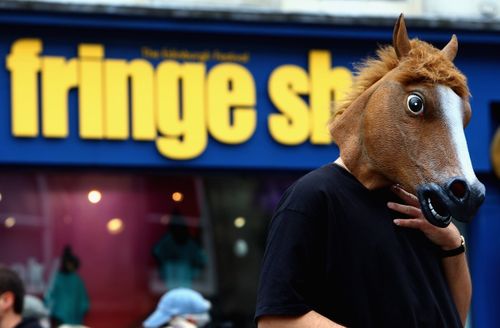
Edinburgh street artists perform on the Royal Mile on August 28, 2009 in Edinburgh, Scotland. The three week long Fringe festival features thousands of performances at venues around the city. By Jeff J Mitchell/Getty.
 The Dish