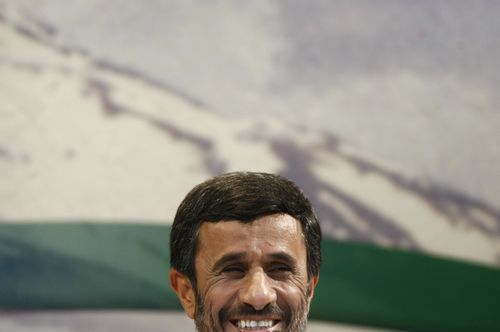
On the one hand:
I would hope by now that the murderous crackdown on Iran’s mass democracy movement by the country’s oil-funded ruling cartel would have removed the last scales from the eyes of those Iran watchers who think this is simply a poor, misunderstood regime that really wants to repair its relations with the West, and we just have to learn how to speak to it properly. This is a brutal, cynical, corrupt, anti-Semitic regime that exploits the Palestinian cause and deliberately maintains a hostile posture to the West to justify its grip on power. A regime that relates to its own people with such coercive force is not going to be sweet-talked out of its nuclear program. Negotiating with such a regime without the reality of sanctions and the possibility of force is like playing baseball without a bat.
On the other, as Tom Friedman also argues, the deep unpopularity of the regime, and the divisions within the elite, may make economic sanctions more potent. Juan Cole notes:
Further unilateral U.S. sanctions and collective UNSC measures should be taken more seriously than they are by Iran.
Ahmadinejad defiantly told NBC, “We think for one or two countries to think that they own the world and they are the ones that make the major global decisions and others should follow — that period has come to an end.” But Iraq’s economy was ruined by U.S. and U.N. sanctions in the 1990s, and the lack for some period of time of chlorine for water purification and of some medicines is thought to have been responsible for the deaths of 500,000 Iraqi children.
Targeted sanctions on North Korea interdict military and technological equipment, exclude luxury goods, and constrain the country’s finance system. This summer, the UNSC went further and urged member nations actually to board suspect North Korean ships. China, which had earlier blocked such moves, agreed to this resolution because its leaders were furious about North Korea’s underground nuclear test. The Khamenei-Ahmadinejad regime risks making Iran a pariah on the North Korea model if it goes on defying the international community. Iran’s people will be the real losers if that happens.
All one can say is that this is an extremely delicate and difficult balancing act for the US. On the one hand, the US has to prevent Israel detonating World War III in the Middle East; on the other, the US has to ensure the security of Israel. On the one hand, Obama has no choice but to talk to the regime to address the nuclear issue; on the other, if he only addresses the nuclear issue, then the Green Revolution might feel slighted. On the one hand, sanctions might tip the balance toward revolution and regime change; on the other, they might isolate the regime – and entrench it – on the North Korean or Saddam’s Iraq model. God knows the coup-leaders have no qualms in using Kim Jong-Il type brutality. But Iranians are not North Koreans. Real sanctions could heighten the regime’s contradictions and bring it down.
From a laptop, these maneuvers are impossible to judge. This is a prudential judgment that we have no choice but to delegate to leaders and diplomats. But it seems to me that the worst possible outcome would be an Israeli attack; the best would be regime change from within. Between those two, a policy of containment – economic and financial sanctions wrapped in both the nuclear issue and the legitimacy issue – seems the most practical way forward to me.
 The Dish