by Jim Manzi
Burning fossil fuels creates so-called “external costs” because it contributes to ongoing climate change. This is a fancy way of saying that when I burn such fuels, other people become worse off than they would be otherwise, because I have increased the odds that they will suffer damages from anthropogenic global warming (AGW). This both seems unfair, and means that we will burn more fossil fuels than would seem to be socially optimal. It seems obvious to many people that we should therefore tax fossil fuels in order to prevent this. This is termed a Pigovian tax, and is sometimes referred to as “internalizing the externality”, or taxing fossil fuels to reflect the “social cost of carbon”.
It’s not so obvious to me that this is good idea. To implement it would be little more than a re-labeling of the kind of comprehensive planning that Hayek attacked sixty years ago. Here’s why.
Start with the point that we tax an activity, not a substance. Let’s take the example of burning a gallon of gasoline by driving to work rather than riding your bike. This action creates social cost in the form of AGW. But it also creates other social costs, such as, for example, local air pollution, congestion, noise and increased risk of accidents for others. Why would we privilege a unit of social cost created by AGW over that same unit of social cost created by any of these other effects? If I die from cancer because I inhaled some of your fumes or I die from flooding because of increased global temperatures, I am in each case equally dead. But it also creates social benefits. You spend less time travelling, get to work earlier and produce more output that day; because you can not capture all of the social utility of your labor, this creates incremental social benefit. You also have more time at home, and use this time with your kids to improve their educational outcomes, which creates social utility in later years. And so on, ad infinitum. In order to set the tax, we don’t just need to know the costs created by AGW (which is a pretty tall order), but rather all of the social costs and benefits created by the activity, which is far harder.
And what is typically assumed is that we only need to know the marginal social costs of one more gallon of gasoline; but really if we are discussing a tax sufficient to change the structure of the world energy economy over many decades to head off AGW, then we need to know something a lot closer to the average social costs of a gallon of petroleum. (Or more precisely, the marginal costs of very large changes). You have to unwind a chain of causation that is all-but-infinite, by evaluating the economics of the counterfactual world that does not dig up and burn oil. Let’s see. What vehicles would we now use for transportation? Would we have a smaller fleet of larger vehicles like trains, or would we have a larger fleet of smaller vehicles like battery-powered golf carts? Would this lead to different patterns of residential dispersion that would lead to both changes in transportation fleet, but also changes in family structure that in turn created changes in ethical and religious beliefs? Would the US armed forces now be smaller because we would have less need to defend the Persian Gulf supply chain, resulting in lower taxes and different domestic politics? Would this lead to further economic and social changes? Would this also result in different international perceptions of the U.S. that would change international investment flows? Would it result in increased use of biofuels that would in turn change corn prices that would in turn lead to differing immigration patterns that would in turn lead to different political choices in the US that would in turn lead to higher levels of funding for K – 12 education that would in turn lead to a more effective U.S. labor force that would in turn lead to greater economic productivity? You get the idea.
This is why there is no tolerable alignment even among academic specialists about the total social cost of various fossil fuels. A recent review of such analyses by European academics finds that the estimates for the external costs per kilowatt-hour of, for example, coal range from about .01 cents to $10. Think about this numerically. The cost of a kilowatt-hour that you would buy for your house is on the order of 10 cents, so incorporating the external costs would lead the price to rise to something between 10.01 cents and $10.10. Even using only the middle 50% of the studies (remembering that this is not a 90% or 95% confidence interval, we are arbitrarily eliminating fully half of the estimates), this would lead to something like a 1 cent to 20 cent, or 10% to 200%, increase in the price of coal.
And even this grossly oversimplifies the real question. Just as there is no principled reason to privilege the social costs created by different effects of burning petroleum, there is no principled reason to privilege the social costs created by this activity as compared to any other activity. Oil, coal, nuclear, windmills, solar power and all other alternative energy sources have social costs and benefits, and if I get cancer from water pollutants created in the production process for a solar cell, I’m just as dead as if I am killed by AGW-caused floods. And it is not simply energy alternatives. How do we justify placing a tax (or subsidy) on the use of various kinds of energy, while not doing it for making television ads, gardening tools and software, never mind watching television, gardening and doing Google searches?
In order to achieve the “fairness and social optimality” that we started with when discussing the AGW effects of carbon, we are logically led to demanding that the government measure the social value of almost every economically significant action, and then set up incentives to manage the population so as to achieve social goals. Because this is an impossible analytical task, in practice this means the purely political management of society based on relative power. What is this but unadulterated socialism in a green dress?
Now the rejoinder to this is obvious:
Jim, this argument reminds me less of Hayek than it does of the scene in Animal House where Otter defends the frat in a judicial proceeding:
“Ladies and gentlemen, I’ll be brief. The issue here is not whether we broke a few rules, or took a few liberties with our female party guests – we did.”
“But you can’t hold a whole fraternity responsible for the behavior of a few, sick twisted individuals. For if you do, then shouldn’t we blame the whole fraternity system? And if the whole fraternity system is guilty, then isn’t this an indictment of our educational institutions in general? I put it to you, Greg – isn’t this an indictment of our entire American society? Well, you can do whatever you want to us, but we’re not going to sit here and listen to you badmouth the United States of America.”
Your argument is ridiculous – we have to set taxes all the time with incomplete information. Climate change is an obvious and severe problem that threatens the planet, and placing a tax on carbon is the most efficient way to address it. Saying that we shouldn’t do this because we don’t also pay you 45 cents to help your daughter with her homework is obstructionist nonsense.
This would be entirely valid, except for the inconvenient facts. According to the authoritative U.N. Intergovernmental Panel on Climate Change (IPCC), under a reasonable set of assumptions for global economic and population growth, the world should expect (Table SPM.3) to warm by about 2.8°C over the next century. Also according to the IPCC (page 17), a global increase in temperature of 4°C should cause the world to lose about 3 percent of its economic output. So if we do not take measures to ameliorate global warming, the world should expect to be about 3 percent poorer sometime in the 22nd century than it otherwise would be. This doesn’t exactly comport with the rhetoric of imminent global devastation.
The British government has been very aggressive in implementing various policies, including taxes and analogous restrictions on burning fossil fuels with the stated purpose of ameliorating global climate change. In 2001 the British Department of the Environment, Transport and the Regions attempted to measure the external costs of driving. Recognizing the limitations that I’ve outlined above for any such analysis, here is a chart I’ve made of some of the results:
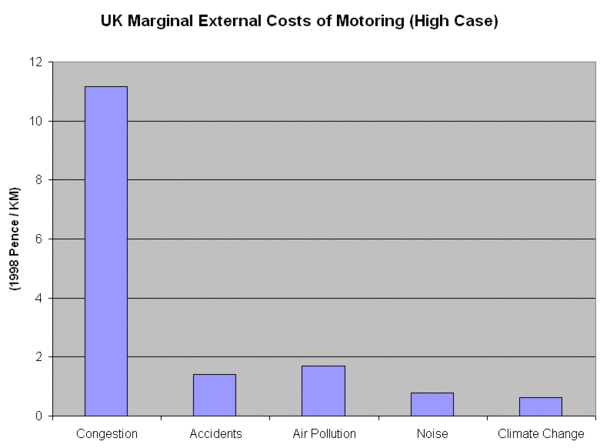
Climate change is estimated to have a smaller marginal externality than any one of: congestion, accidents, air pollution or noise. It is less than 5% of total listed external costs created by driving. By what logic would you argue that climate change should trump all of these concerns as the basis for a special tax?
Well, the argument might go, because of the risk. Congestion might be irritating and costly, and air pollution might kill some people today, but neither credibly threatens the planet.
I’ll note that I’ve purposely provided the high-end case provided in the original report for all of these costs in order to emphasize this risk. But in spite of this, there is a tail of extreme risk associated with climate change that is unique. This has been the subject of intense scientific research for decades, and the IPCC has published probability distributions for various levels of projected warming over the next century (see Figure 10.28, page 808). There is no odds-adjusted case for typical scenarios for global economic and population growth over the next century (i.e., in which we handicap the odds of more and less severe possible impacts) which could justify such costs.
The only real argument for rapid, aggressive emissions abatement boils down to the point that you can’t prove a negative. If it turns out that even the outer edge of the probability distribution of our predictions for global-warming impacts is enormously conservative, and disaster looms if we don't change our ways radically and this instant, then we really should start shutting down power plants and confiscating cars tomorrow morning. We have no good evidence that such a disaster scenario is imminent, but nobody can conceivably prove it to be impossible. Once you get past the table-pounding, any rationale for rapid emissions abatement that confronts the facts in evidence is really a more or less sophisticated restatement of the precautionary principle: the somewhat grandiosely named idea that the downside possibilities are so bad that we should pay almost any price to avoid almost any chance of their occurrence.
But if you want to use this rationale to justify large economic costs, what non-arbitrary stopping condition will you choose for how much we should limit emissions? Assume for the moment that we could have a perfectly implemented global carbon tax. If we introduced a tax high enough to keep atmospheric carbon concentration to no more than 1.5x its current level (assuming we could get the whole world to go along), we would expect to spend about $17 trillion more than the benefits that we would achieve in the expected case. That’s a heck of an insurance premium for an event so low-probability that it is literally outside of a probability distribution. Of course, I can find scientists who say that level of atmospheric carbon dioxide is too dangerous. Al Gore has a more aggressive proposal that if implemented through an optimal carbon tax (again, assuming we can get the whole word to go along) would cost more like $23 trillion in excess of benefits in the expected case. Of course, this wouldn't eliminate all uncertainty, and I can find scientists who say we need to reduce emissions even faster. Once we leave the world of odds and handicapping and enter the world of the precautionary principle, there is really no principled stopping point. We would be chasing an endlessly receding horizon of zero risk.
We are left, then, wandering in exactly the wilderness of mirrors that I described earlier. There is no analytical basis on which we can really “put a price on carbon”. It becomes pure power politics. This isn’t just theory. Consider seriously the evidence of what really happened in the Waxman-Markey debate. That wasn’t random. Even more, consider how such taxes have really been set in the UK. Matthew Sinclair has a recent paper in the journal Energy & Environment in which he compares the total green taxes paid by Britons to the estimates of external AGW costs created by them according to various well-known and authoritative sources such as the IPCC, Nordhaus, Tol and DEFRA. Take the example of driving. According to this paper, Britons currently pay motoring taxes (net of road construction and maintenance) that are somewhere between 5 and 50 times the AGW externalities that they impose. The paper argues that massively excess green taxes are paid economy-wide.
I yield to few men in my admiration for Hayek and his ideas. His prediction that the welfare state would lead to serfdom, however, has (thus far) not been correct. I don’t think that a carbon tax will be the one event that will push the free world into socialist slavery. But it does seem clear that the same dynamics he described decades ago have re-emerged, simply with a different theoretical justification. The same problems with planning that he highlighted will also be present now.
Taxing carbon to reflect its social costs seems like a common sense idea. Unfortunately, it simply provides another excuse to politicians to raise taxes and exert more power over us.

 The Dish