The Gestapo Precedent for “EITs”

by Andrew

Marc Ambinder addresses the subject of torture today. Ambers poses the following analogy:

An American CIA interrogator whose techniques yield valuable information is much less reprehensible than a Gestapo torturer whose techniques resulted in the death of Jews or gypsies. Doesn't mean the CIA guy was right, but it's still hard to disagree with that sentence. 

But that is the wrong analogy. The sadism and murder of Jews and gypsies in Nazi Germany do not fall under a torture category. The Nazis were not trying to get information out of them as prisoners of war; they were trying to annihilate them as a race and murder as many of them as possible.

For torture to be torture, it must be a government-authorized official's application of "severe mental or physical pain or suffering" in order to acquire information from an individual suspected of having it. So the correct analogy would be the torture via EITs of terrorist insurgents to get information to avoid guerrilla attacks in a war zone. And we have a very good precedent for that in military history. Here's a document from Norway's 1948 war-crimes trial detailing the prosecution of Nazis convicted of "enhanced interrogation techniques" (the phrase in its original German is "verschaerfte Vernehmung)" in the Second World War. Here's a document detailing Nazi bureaucratic description of these techniques. You will note the striking similarities between its content, its legalisms, its bureaucratic tone, and the recent CIA documents pried out of the US government's hands by the ACLU:
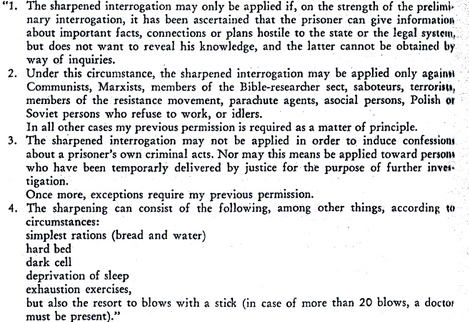
Translationofmuellermemo

Notice how the Gestapo, like Cheney, had doctors present, and all torture was very carefully monitored. Blows with a stick, like collaring someone and bashing his body against a plywood wall – were carefully monitored to a maximum number of times. The "windowless cells", and sleep deprivation are identical to Cheney's methods. In the 1948 trial, cold baths were also used to bring prisoners' temperatures down to near-death levels, like those used by Navy SEALS in Afghanistan, by McChrystal's special ops in Iraq, and by Cheney's supervised torture in Gitmo. The victims wore no uniforms (which was used as a defense by the Nazis in the trial as they have been used by some on the right to defend American torture), and, unlike those subjected to Cheney's torture techniques, none of those tortured by the Gestapo died in the process. In fact, the Gestapo's defense at trial was John Yoo's:

Most of the injuries inflicted were slight and did not result in permanent disablement.

The Gestapo did not use waterboarding – so their methods of interrogation in this case were not as extreme as Cheney's. Nonetheless, the US-run court ruled that Cheney-style EITs, deployed by the Gestapo with the same justification as Cheney, constituted prosecutable torture:

As extenuating circumstances, [accused torturer] Bruns had pleaded various incidents in which he had helped Norwegians, Schubert had pleaded difficulties at home, and Clemens had pointed to several hundred interrogations during which he had treated prisoners humanely.

The Court did not regard any of the above-mentioned circumstances as a sufficient reason for mitigating the punishment and found it necessary to act with the utmost severity. Each of the defendants was responsible for a series of incidents of torture, every one of which could, according to Art. 3 (a), (c) and (d) of the Provisional Decree of 4th May, 1945, be punished by the death sentence.

And they were executed for war crimes.

The question Americans have to ask themselves is why they hold the former president and vice-president to lower moral and ethical standards than the United States once held the Gestapo. That's all. And that's everything, isn't it?

Creepy Ad Watch

by Chris Bodenner

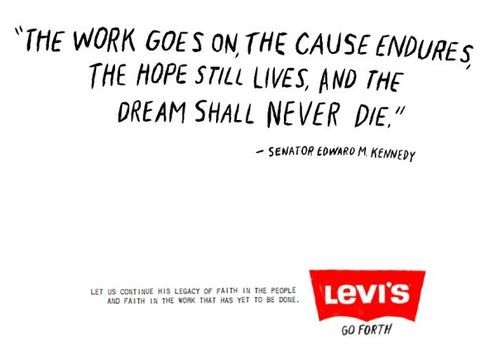
Because nothing says blue jeans like deceased patrician senators:

Levi'sKennedy

And what horror flick was that font taken from? Copyranter adds:

Oh, c'mon. It's not that bad of an ad vulture execution, is it? Democrats and jeans are both blue, right? And what the hell: JFK's still selling wicked-expensive yachts. Thanks to Gareth Hornberger for the grab of the ad, which ran yesterday on the New York Times website.

Cutting Off The Fringe

by Patrick Appel

Jon Henke is organizing against WND:

The Birthers are the Birchers of our time, and WorldNetDaily is their pamphlet.  The Right has mostly ignored these embarrassing people and organizations, but some people and organizations inexplicably choose to support WND through advertising and email list rental or other collaboration….I think it's time to find out what conservative/libertarian organizations support WND through advertising, list rental or other commercial collaboration (email me if you know of any), and boycott any of those organizations that will not renounce any further support for WorldNetDaily.

A Just World

by Jonah Lehrer

I’m still trying to shake some haunting thoughts of Cameron Todd Willingham, the Texas man who now appears to have been executed for a crime he didn’t commit. I linked yesterday to David Grann’s exhaustive New Yorker article, which chronicles the chronic incompetence of his criminal prosecution.

These stories of a failed justice are important, and not just because they expose specific errors. (Such as: arson investigators who got every important fact wrong, psychiatric diagnoses based on music posters and juries that should have been more skeptical.) Instead, I think these harrowing tales need to be told because they contradict a powerful moral intuition we all share, which can unfortunately lead us to turn a blind eye: Because we believe in justice, we ignore stories of injustice.

I’m talking about the Just World Hypothesis, a scientific theory first developed by the social psychologist Melvin Lerner. Consider this clever experiment, conducted in 1965: Several volunteers are told that they are about to watch, on closed circuit television, another volunteer engage in a simple test of learning. They see the unlucky subject – she is actually a graduate student, working for Lerner – being led into the room. Electrodes are attached to her body and head. She looks a little frightened.

Now the test begins. Whenever the subject gives an incorrect answer, she is given a powerful jolt of electricity. The witnesses watching on television see her writhe in pain and hear her scream. They think she is being tortured.

One group of volunteers is now given a choice: they can transfer the shocked subject to a different learning paradigm, where she is given positive reinforcements instead of painful punishments. Not surprisingly, the vast majority of people choose to end the torture. They quickly act to rectify the injustice. When asked what they thought of the "learner," they described her as an innocent victim who didn't deserve to be shocked. That's why they saved her.

The other group of subjects, however, isn't allowed to rescue the volunteer undergoing the test. Instead, they are told a variety of different stories about the victim. Some were told that she would receive nothing in return for being tortured; others were told that she would be paid for her participation. And a final group was given the martyr scenario, in which the victim submits to a second round of torture so that the other volunteers might benefit from her pain. She is literally sacrificing herself for the group.

How did these different narratives affect their view of the victim? All of the volunteers watched the exact same video of torture. They saw the same poor woman get subjected to painful shocks. And yet the stories powerfully influenced their conclusions about her character.

Here the most disturbing data point: the less money the volunteer received in compensation for her suffering the more the subjects disliked her. The people explained the woeful injustice by assuming that it was her own fault: she was shocked because she wasn't paying attention, or was incapable of learning, or that the pain would help her perform better. The martyrs fared even worse. Even though this victim was supposedly performing an act of altruism – she was suffering for the sake of others – the witnesses thought she was the most culpable of all. Her pain was proof of her guilt. Lerner's conclusion was unsettling: "The sight of an innocent person suffering without possibility of reward or compensation motivated people to devalue the attractiveness of the victim in order to bring about a more appropriate fit between her fate and her character."

The moral of the Just World Hypothesis is that people have a powerful intuition that the world is just and that people get what they deserve. While I’m sure this instinct makes all sorts of social contracts possible, it also leads to one very troubling tendency: we often rationalize injustices away, so that we can maintain our naive belief in a just world. This, I believe, is what happens when we read about innocent people getting sent to Guantanamo, or the wrong immigrant getting waterboarded, or why it’s so easy to brush aside calls for prison reform. We might acknowledge the awfulness of the error, but then quip that he shouldn’t have been hanging around with the Taliban, or that the guy who got sent to prison for a crime he didn’t commit was still a creep, or that the Madoff victims should have known their money manager was a fraud. In other words, we act like the subjects in the Lerner experiment blaming the innocent volunteer, as we search for reasons why the wrongfully treated deserved what they got. Subsequent studies have found that people with "a strong tendency to believe in a just world" tend to exhibit certain characteristics: they're much more likely to admire political leaders and existing social institutions, and have negative attitudes toward underprivileged groups. Furthermore,they "feel less of a need to engage in activities to change society or to alleviate plight of social victims."

Is there any way out of this cognitive trap? The only thing I can think of is education: people are shocked out of their complacence. After all, if an honest man can get executed than maybe the world isn’t so just.

Shoot Me Now

by Patrick Appel

GOP Chairman Michael Steele, summoning up the fake earnestness of a vacuum cleaner salesman, is back to defending Medicare and scaring the elderly. Weigel says "it's running in Florida and 'select national cable networks.'" In another context the ad could be run, almost verbatim, by a Democrat. It's surreal witnessing how unprincipled the national GOP has become, opposing a sensible cut to Medicare Advantage. There are plenty of legitimate arguments to make against the health care bill, but this sort of rhetoric makes the inevitable eventual reforms of Medicare tougher. Steele also repeats the ceaselessly debunked end-of-life care lie:

Damning Labels

by Chris Bodenner

Foreign Policy, in its four-author critique of Paul Wolfowitz's take on realism and Obama, touches on way too many issues and first principles to cover in this space, so I recommend reading Walt, Rothkopf, Drezner, and Clemons for yourself. But I think this passage from Rothkopf is relevant for foreign-policy wonks and non-wonks alike:

Reading Wolfowitz's piece, I kept thanking Providence for giving me a concentration in English in college rather than say, political science. I actually was taught what words mean. (In fact, being an English major taught me that "political science" may be the humdinger of all oxymorons … even if calling "realists" realists and "neoconservatives" neoconservatives comes pretty darn close.) Economists have their "lies, damned lies, and statistics" and clearly, political scientists have their "lies, damned lies, and labels."

It's not just "neocons" and "realists" of course who are mislabeled or falsely advertising themselves. There is nothing "conservative" about the reckless fiscal policies of "conservative" champions like Reagan or Bush, nothing "progressive" about the New Deal nostalgia of many on the left, nothing "pro-life" about abortion opponents who also use a misreading of the Second Amendment to allow them stock up on assault weapons, nothing "liberal" about folks who think the answer to everything is greater government control of people's lives. Say what you may about the underlying beliefs, the labels are meaningless.

A huge pet peeve of mine is when people in the abortion debate refer to each other as "anti-choice" or "pro-abortion" (or even the noxious "anti-life"). People distort their own beliefs with labels enough as it is, as Rothkopf says, so it's that much more corrosive to public discourse when people distort the beliefs of others.

Can Money Buy Happiness?, Ctd

by Patrick Appel

E.D. Kain responds to Jonah:

I understand the argument that the fancy new watch will not buy you the same kind of happiness that a quality weekend away can purchase.  But a balance has to be struck.  A lot of the things we buy are not really necessities, but they can make life easier, more enjoyable – even happier.  And a lot of the things we buy really are necessities: boring, humdrum, and forgettable. I know some people who continually spend money going out to eat, yet never bother to purchase new appliances.  Sometimes spending money creating great memories can make it that much more difficult for you to save up for a new car or a down-payment on a house.  I’d say that when buying memories becomes more like buying things the two become basically indistinguishable. 

Chris weighed in on this debate over the weekend. A expat reader also had a few thoughts on the matter:

As someone who owns around 200 things – cut down from thousands – I find happiness in simplification and non-possession. (Although like Chris my laptop is my pensieve, my precious. If I could create and store everything in electronic form, including clothing, I would be an exceedingly happy person. It's on the fritz lately, I can't afford to replace it, and that's making me very uneasy). I work for an NGO in Southeast Asia and earn enough to have a reasonable standard of living month to month, but cannot easily make savings. What I came to realise in January of this year, when my father in the UK suffered a massive stroke and I had less than 3000 baht in the bank to put towards a plane ticket, is that money may not buy happiness but it buys choice. Freedom of choice. And that, to me, is happiness. Or more accurately, it is the difference between contentment and discontent, a sense of order and one of chaos.

Forms of Accountabilty

by Patrick Appel

Scott Horton interviews David Cole, author of The Torture Memos:

I believe that there must be some form of official accountability for these wrongs, and some official recognition that the illegality included the actions of the lawyers who wrote the memos and the Cabinet officials who authorized the tactics. Criminal prosecution, however, is just one form of accountability. There are other forms. They might include civil judgments against the perpetrators, the report of an independent commission, a censure or apology from Congress, bar disciplinary actions for lawyers, impeachment for Judge Bybee, or the dismissal of Professor John Yoo. I do not think we have enough facts yet to know what precise form of accountability is warranted for each individual. And therefore I think the best route for the moment would be an independent commission, armed with subpoena power, comprised of people who are trusted by all and above partisan politics, to conduct a full investigation. I am confident that if that happened, it would ultimately lead to some official recognition of the wrongs that were committed—and that is critical to ensuring that it not happen again.

Just When You Start To Get Numb

by Chris Bodenner

New accounts like this pop up.

Saeedeh Pouraghaei was arrested because of her chants of Allahu-Akbar on the roof of Victim-chantsher house in Dowlat Ave, in north of Tehran. Saeedeh was the only child of Abbas Pouraghaei who died two years ago of injuries sustained during the Iran-Iraq war. Saeedeh was arrested by the plain-clothed agents, and about 2o days after her arrest her mother was summoned to identify her body. Saeedeh’s mother says that the body was partially burned, and she recognized her daughter with difficulty. She was asked to announce “kidney failure” as the cause of death. According the Saeedeh’s family it seems that the body was intentionally burned to hide the evidence of rape and torture. Her body was not even handed over to her family, and they were just notified that she was secretly buried in Behesht Zahra cemetery in one of the unknown graves in section 309. Mir Hossein Mousavi attended Saeedeh’s funeral ceremony on Saturday in a mosque in Dowlat Ave.