The Tummler

Lee Seigel brilliantly articulates how Irving Kristol's quest for power created an intellectual vacuum ultimately filled by the Limbaughs and Becks of the right:

An intellectual who constantly put down the vocation of being an intellectual, a gifted wisecracker who reduced complex social problems to glib one-liners—“a neoconservative is a liberal who has been mugged by reality”—a circular reasoner who seemed to care more about the motions of his mind than the moral or political conclusions he reached, Kristol used thinking to discredit the act of thinking. […] As a result, he gave up on principled thinking and became a kind of intellectual tummler—the Yiddish term for a mischief-maker, whose power lies in creating prankish distractions. But Kristol had a motive for his tummling: the acquisition of power unavailable to intellectuals.

Missing Torture Documents

We know that the CIA destroyed critical evidence of Bush-authorized torture of prisoners. We also know that critical evidence in the Padilla trial went missing – tapes of his final torture session. Now we discover, as Marcy Wheeler first noticed, that documents previously cited by the Bush administration no longer exist:

After President Obama took office, he issued a new FOIA policy, instructing executive branch agencies to "adopt a presumption in favor" of releasing information. The Obama Justice Department reprocessed the ACLU's earlier request under the new guidelines. But when they did so, department officials discovered that 10 documents listed on the index compiled by the Bush administration were nowhere to be found. The Justice Department noted this in a filing [PDF] by David Barron, an acting assistant attorney general, which was submitted last week as part of the ongoing ACLU case and first highlighted by Firedoglake blogger Marcy Wheeler. Barron acknowledged in the filing that even more documents could be missing, because "many" of the documents the Obama team did find were "not certain matches" to the ones on the Bush administration's list.

War? Sanctions? Or Inspections?

Roger Cohen argues that exposing the Qom facility "did not change the nuclear equation," and that harsher sanctions "won't work."

The choice is indeed between a military strike and living with a nuclear Iran. But what is a “nuclear Iran?” Is it an Iran that’s nuclear-armed — a very dangerous development — or an Iran with an I.A.E.A.-monitored enrichment facility? I believe monitored enrichment on Iranian soil in the name of what Obama called Iran’s “right to peaceful nuclear power” remains a possible basis for an agreement that blocks weaponization.

[US negotiator William] Burns must seek to open a parallel bilateral U.S.-Iran negotiation covering at least these areas: Afghanistan and Iraq (where interests often converge); Hezbollah and Hamas (where they do not); human rights; blocked Iranian assets; diplomatic relations; regional security arrangements; drugs; the fight against Al Qaeda; visas and travel. Isolated, nuclear negotiations will fail. Integrated, they may not. […] Think E.U., not Versailles.

Gary Sick has a similar stance:

The risk for the P5+1 negotiators is that they will be so filled with righteous indignation that they will overplay their hand. The purpose of the negotiations, after all, is not simply to posture, to issue impossible demands, and thereby justify moving to sanctions. […] Sanctions have not worked after 15 years of trying, and sanctions alone are almost certainly not going to get Iran to abandon its basic nuclear program. Sanctions are and always have been more useful as a threat or a trading card than as an effective tool in practice.

I keep thinking of Iraq. Sanctions helped destroy Iraqi society and did not weaken Saddam. Invasion turned into a catastrophe whose outcome is still unknown (I fear an implosion if and when US troops leave). Would we have been better off with invasive, serious nuclear inspections? Obviously yes. This doesn't mean that the same is a good idea for Iran, which soon will have a capacity for nuclear WMDs. The complicating factor, of course, is the internal situation where a resolute opposition has the support of a hefty majority of the people, and the regime is increasingly beleaguered and internally divided.

Understanding The Tea Party Right

This struck some chords:

Materialism is deeply and profoundly threatening to many people. It’s the reason that the philosopher Peter Singer is so widely attacked, despite his humanitarian intentions. The current Pope and the last one both railed against this form of materialism. The materialism of the secular left opens it up to charges that it promotes a “culture of death.” Liberals are said to like to kill fetuses and the elderly; they don’t treat anything as sacred. This term has been bandied about on the right for many years, and while it is a gross exaggeration, it is based in a real truth, a real difference on the question of the sacredness of life. So when Palin threw out the term “death panels,” the term struck a chord that had been played many times in recent years.

Liberals were flabbergasted, because it’s a blatant lie, but it’s false only in a logical sense, not an emotional one. And once again, logic has little to do with morality. If a pro-life social conservative asks himself whether Obama is secretly plotting to create death panels, he is not asking whether this is likely to be true, he is asking only “can I believe it,” and the answer is usually yes.

Of course, liberals believe that it is conservatives who like to kill people (think militarism and capital punishment). Both sides care about life, but in different ways. Both sides live inside their own moral matrices. And just like in the movie The Matrix, morality is a “consensual hallucination” that is very hard to step out of. But moral psychology can help people to understand that there are moral motivations on all sides. People may not be logical, but few of them are crazy.

The Other Health Insurance Debate

Guinea_1

A reader writes:

I insure my seven guinea pigs. Their vet care runs into the thousands even with the insurance. I am quite savvy and turn down care and tests they don’t need.

(The pet healthcare system is increasingly like the people healthcare system: more technology, more expensive tests, vets/doctors always giving you more “options”.) Insurance has a moderate financial benefit, but it’s also a pain in the butt.

Pet health insurance companies resemble their human counterparts. Most of the same rules apply–maximum allowed fees for certain services, pre-existing conditions, procedures not covered, etc. They are notoriously bad at honoring the terms of their policies. I have to hound them to pay claims, and sometimes they still won’t pay what they are obligated to under the policy. There is only one company that insures “exotics” (which for some reason guinea pigs are classified as), so this company has a monopoly on my business at the moment.

There are websites with reviews of pet insurance companies. Some merit better reviews than others, but many people take insurance companies to small claims court. If your dog gets a fish hook caught in its mouth, or your cat is hit by a car, you might still have to worry about paying for it even if you got a policy for your pet.

Calling Cheney’s Bluff

A reader writes:

Hold on, those in Gitmo are the worst of the worst, but we did not even keep a file on them? How did we plan to stop terrorist attacks?

Look: Cheney and Rumsfeld simply knew these people – mostly shifty types handed over by bounty hunters or seized in Pakistan – were the worst of the worst. They didn't need any proof. They were never going to put them on trial. Some, of course, were dangerous Islamists who had real information worth finding out. But many more were foreigners captured in chaotic situations by other foreigners with axes to grind. Their use for Cheney was as a demonstration project for what America could do to bad guys with funny names and long beards. And once they had been seized and described as the "worst of the worst", Cheney could not admit he had seized dozens of innocent human beings. So he doubled down on the lie.

But you know it's a lie because he always acted as if it was.

The Internal Republican Divide

Michele Bachmann invited Ron Paul to co-host a town hall at the University of Minnesota on Friday night. The two joined forces over fiscal concerns – Bachmann drew praise from Paulites with talk of 100% taxation by 2050 and a “one-world currency” – but things got awkward when the topic turned to empire:

As Paul spoke passionately about ending all military operations and keeping government out of people’s “lifestyles,” a lone heckler began to shout, “Tell her!” Bachmann remained serene, hands folded in her lap, facing Paul. Bringing up Obama’s announcement that Iran had secret underground nuclear facilities, Paul announced that he had had enough of “fear-mongering” for the sake of the “military-industrial complex.” Bachmann, who once advocated nuking Iran, kept her eyes trained on Paul as her heckler repeated, “Tell her! Tell Michele! Tell her!”

And just a reminder of Bachmann’s “small government” stance when it comes to “lifestyles”:

Supports both a federal and state constitutional amendment banning same-sex marriage and legal equivalent, and is a critic of any type of civil union for gay couples. In support of a constitutional amendment she proposed to ban same-sex marriage, Bachmann said that the gay community was specifically targeting children and that “our children…are the prize for this community.”

A Tale Of Two Countries

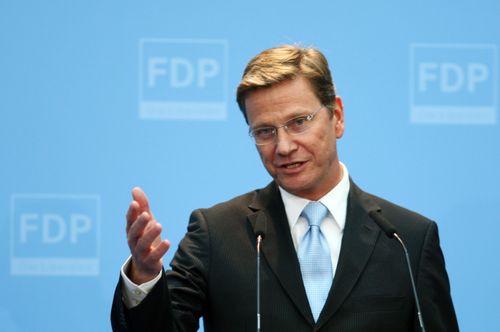
WESTERWELLEJoernPollex:Getty

In socially conservative Germany, an openly gay man, representing a politics of free enterprise and limited government, will now become vice-chancellor and foreign minister:

The FDP leader is best known at home for his espousal of Thatcherite economic reforms. But it is his position on Afghanistan that will make him the welcome face of Germany’s foreign policy among the country’s allies. While Germany’s deployment to Afghanistan has become increasingly unpopular, Mr Westerwelle has emerged as the most powerful and articulate proponent of sustained involvement in the war. The Free Democrats’ support for nuclear energy means that the country is likely to reverse an isolationist decision to mothball the industry within the decade.

Westerwelle is now the world’s leading non-leftist gay leader. His politics are eclectic: for example, he favors removing the last American nuclear weapons from Germany. He came out formally five years ago. The Germans paid no mind. Meanwhile, in America, there are almost no openly gay politicians, and one major party seeks to marginalize and disenfranchise gay people, stripping them of all relationship rights, and running ad campaigns focused on the “threat” that openly gay couples pose to schoolkids.

The other party, while offering lip service to gay equality and being disproportionately financed by gay donors, enforces the federal ban on gay soldiers, refuses to repeal the law that requires the federal government to treat gay couples as strangers to one another, and has no openly gay people in any but minor roles in government.

As the world moves forward, Washington has more in common with developing countries in its treatment of its own gay citizens than with the civilized world. And this president and Congress have no intention of changing that in any foreseeable future. The opposition is even worse – with discrimination against homosexuals written into its party platform. They even want to amend the federal constitution to enshrine gay people as second class citizens and moral pariahs.

Yep: America was the model for many of these other countries’ evolution on gay rights. But, while American society has made huge strides in acceptance and inclusion, American federal government remains hostage to bigotry and fear.

(Photo: Guido Westerwelle, party leader of the Free Democratic Party (FDP), attends a press conference of the FDP on September 28, 2009 in Berlin, Germany. FDP reached 14.6 percent in German federal elections and the Christian Democratic Union (CDU) won a new term in German elections and looked set to be able to form her preferred centre-right coalition with the FDP. By Joern Pollex/Getty.)