The Neocon Panic, Ctd

WaPo reported Friday that the White House is "working to recover from missteps that have put officials behind schedule" in closing Guantanamo. Greg Craig, charged with leading the mission, is being replaced by Pete Rouse. Craig was caught off guard after crafting the January 2010 deadline:

Senior administration officials said the central roadblock during those early months was the condition of the detainee files, which had been left in disarray by the previous administration. "We assumed that for each detainee there was going to be a file somewhere," one senior administration official said. "Some of the intelligence files were not even organized by detainee.

Jim Geraghty views this story as vindication that closing Gitmo is untenable. He targets the Dish and splutters:

The close-Gitmo crowd was, and is, stupid. The we-can-deal-with-Iran crowd was, and is, stupid. They didn't want to see the counter-evidence. They didn't want to think about all the complications, the scenarios where their plans don't work out as planned. They insisted the world operated in a certain way, and we argued otherwise. A man who espouses their views won last year. And now they learn that there aren’t easy and good alternatives to Gitmo, and that the Iranians can’t be trusted. With any luck, this crowd’s weapons-grade refusal to see the hard truths of a difficult and dangerous world won’t get anyone killed.

What excitable piffle. I don't know many people who believe that Ahmadinejad can be a useful negotiating partner – but making the failure of talks his responsibility and not ours is obviously the point here. And let us consider the positive results of the alternative Cheney position: endless public relations victories for Iran, a dismembered and weakened Iraq (one less thing for Tehran to worry about), eight years of nuclear development, alienation of Russia (preventing any hope of international sanctions), and an increasing gulf between Israel and her Sunni neighbors. Did that help? Who's living in the real world here?

As for Gitmo, does Geraghty believe it was a net plus for the US?

Does he place no weight on America being identified in the world as a torturing nation, running a web of torture-and-abuse camps? Does he think that helps us win the battle for hearts and minds against al Qaeda? Please.

Closing Gitmo was supported by Bush, McCain, Powell and Petraeus.  Are they all stupid? That the Bush administration collected no real data for prosecution (they set up Gitmo not to prosecute terrorists but to torture them) is not Obama's fault. Adjusting to practical and legal details, even to the extent of postponing the actual closure for a while, is simply a matter of responsibility, responsibility the Cheneyites never took.

As for Iran, does Geraghty believe that a careful process whereby the rest of the world takes the lead in warning Iran, in which the opposition within Iran makes the internal isolation of Ahmadinejad more possible, in which Russia, yes Russia, is softening its hard line against sanctions … does he believe Bush and Cheney achieved more?

What the neocons do not seem to be able to grasp is that America's open hand to Iran is not weakness, but strength. It calls their bluff, has refocused global attention on the real problem – not American hegemony but Tehran's insanity, and has moved the ball further forward than at any time under Bush and Cheney. Hence their splutters. There are enormous challenges and dangers ahead, but the worldview of the neocons – that violence and coercion and polarization are the only tools in foreign policy – is looking shakier by the day.
Drug Companies Keep Us Safe?

DiA passes along a paper:

In this paper we consider possible links between the advent and diffusion of a number of new psychiatric pharmaceutical therapies and crime rates. We describe recent trends in crime and review the evidence showing mental illness as a clear risk factor both for criminal behavior and victimization … We find that increases in prescriptions for psychiatric drugs in general are associated with decreases in violent crime, with the largest impacts associated with new generation antidepressants and stimulants used to treat ADHD. Our estimates imply that about 12 percent of the recent crime drop was due to expanded mental health treatment. Our estimates imply that about 12 percent of the recent crime drop was due to expanded mental health treatment.

I wonder how much productivity has been added to the economy from more effective anti-depression drugs in the last decade or so. The pharma-demonizers rarely point out how widespread the benefits of pharmaceutical research are.

Emoji Dick

Moby Dick translated into the emoticons used in Japanese texting. The author's reasoning:

I’m interested in the phenomenon of how our language, communications, and culture are influenced by digital technology. Emoji are either a low point or a high point in that story, so I felt I could confront a lot of our shared anxieties about the future of human expression (see: Twitter or text messages) by forcing a great work of literature through such a strange new filter.

The View From Your Recession

A reader writes:

Several years ago I began doing very well. My friend and I started our own law firm. I bought a large house, too large a house, and paid far too much for it; but things were good and I wanted to give my kids a backyard room to run around in. So my girlfriend, kids and I moved from our downtown rental apartment to the suburbs. My law partner and I took on a case against a bank that grew into a huge case. The bank hired a large, aggressive law firm to grind us down but we kept winning, picking up more and more clients and winning important rulings that pointed to what appeared to be an inevitable win if we could withstand the cost and time, which rose to several hundred thousand dollars out of our pockets and many hours spent not working on other cases. We started leaning on our credit cards pretty hard.

Then we got a call from our adversary; the bank had filed for bankruptcy protection. It was devastating; our multi-million dollar case was now worth next to nothing.

We managed to eventually pay the firm’s bills and always managed to keep our employees paid and insured, but that meant that we would often go without any pay ourselves for months at a stretch. My formerly good credit plummeted and I got behind on my mortgage and credit cards. The bank I was paying my mortgage to had already gone under itself. I was utterly miserable; my girlfriend wanted to help but she didn’t make enough to make a real difference and we decided to keep her credit strong rather than put both of us in a hole. So I just stopped. I didn’t pay my mortgage and waited to be foreclosed. I tried, but there was no way to sell the house in this market. I saved what money I was able to pay other bills that had been piling up and to prepare to move. Eventually the bank filed a foreclosure. We told the bank to take the house which took them almost seven months to do.

What came from it turned out to be liberating. I got rid of or refrained from everything that I didn’t need or that cost a lot. I am now somewhat happy for the first time in a long while. My girlfriend had hated where we lived and it was a much longer commute for both of us. My kids didn’t really use the backyard. We moved back downtown into a small but very nice apartment, at a quarter the cost. The building is a very social place; I had barely known my previous neighbors. I am now an eight block walk to my office so even gas is barely an expense any more; and my girlfriend and I had forgotten how much we enjoy living downtown generally. I can sleep better with the stress lowered; the kids even claim they sleep better because the sound of the cars and the general hum of the city. Now I am trying to slowly build up my credit. I spend a lot less than I used to because I don’t buy things I don’t absolutely need and will never extend myself again.

Deep Thoughts On Publishing

Paul Graham has one:

In fact consumers never really were paying for content, and publishers weren't really selling it either. If the content was what they were selling, why has the price of books or music or movies always depended mostly on the format? Why didn't better content cost more?

A copy of Time costs $5 for 58 pages, or 8.6 cents a page. The Economist costs $7 for 86 pages, or 8.1 cents a page. Better journalism is actually slightly cheaper. Almost every form of publishing has been organized as if the medium was what they were selling, and the content was irrelevant. Book publishers, for example, set prices based on the cost of producing and distributing books. They treat the words printed in the book the same way a textile manufacturer treats the patterns printed on its fabrics.

One of Jeff Jarvis' commenters counters:

It’s good to take an extreme position to try and evince some insight, however, the idea that publishers sell paper is a bit of a reductio ad absurdum. […W]hat about books by authors that don’t sell[?] A best selling author and a poor selling one are both printed on the same paper. If the publisher were selling paper, wouldn’t there be equal demand for both?

Letters Of Note

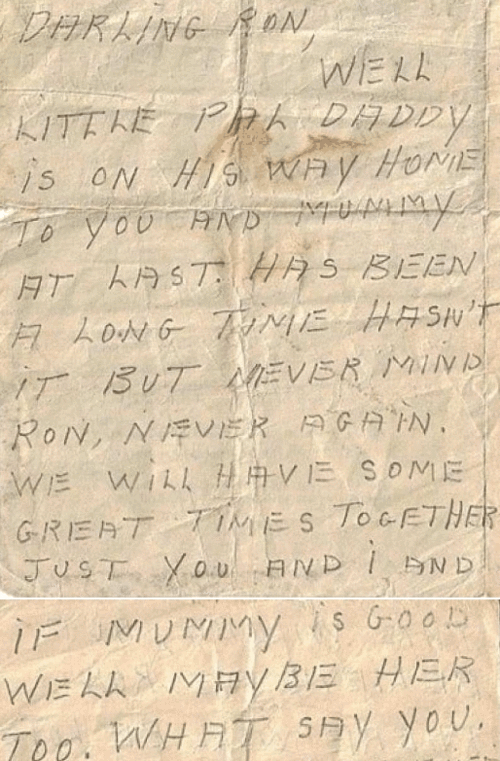
A fascinating blog featuring pieces of personal correspondence throughout history. Here is a fan letter written by Elvis Presley to president Nixon, which prompted their historic meeting. Here is a letter from Jackie Robinson to president Eisenhower, pressing him on his dithering over civil rights. And here is a letter from an Australian soldier to his son in 1945 after spending 3.5 years in a POW camp in Malaya:

ScreenHunter_03 Sep. 24 20.10

"If Mummy is good"? Maybe that's a reference to Nancy. The rest here.

Dissent Of The Day

A reader writes:

I've been following your posts on theodicy and it dovetails with something that's happening in my own life right now.

A cousin just died last Friday of ALS – Lou Gehrig's disease. I don't know how familiar you are with the disease, but it's among the most cruel, evil of diseases – robbing the person of his ability to move, to communicate, to go to the bathroom by himself – yet leaving his or her mind untouched.

My cousin was a man with a very strong faith in God, but after about five years of fighting the disease it just got too hard. He was getting worse, it was costing so much money, it caused so much anguish for him but moreso, for his family – his wife and his four girls, ages 12-19. They watched their daddy, their rock, shrivel up and die. And I know how much they loved him – it had to have been the most devastating thing imaginable.

They remain devout; and I've no doubt their faith has helped them get through this. But I look at it and think: Where is the justice in this? If faith cannot protect the most devout, the best among us, who can it protect? And what's it for, then? I cannot consider his death, and the pain it inflicted upon his children, and think that there was some greater purpose in it. I cannot think of it as anything but UNjust; and as such, if God does exist, I cannot consider him anything but unjust, or at best arbitrary.

When faith serves no practical purpose, when even those with the most faith are at risk of being slapped down like this, I see no reason for faith. A greater purpose? Bullshit. For this man, there was no greater purpose than his children; now they are fatherless. The God to whom they devoted such a large portion of their lives could do nothing to prevent it; their personal relationship with Jesus Christ afforded them no protections. Perhaps they are wiser. But all I can think about is: There is no justice in the world. And how, then, can I believe in a just God?