Face Of The Day

TATTBEAROllScarff:Getty

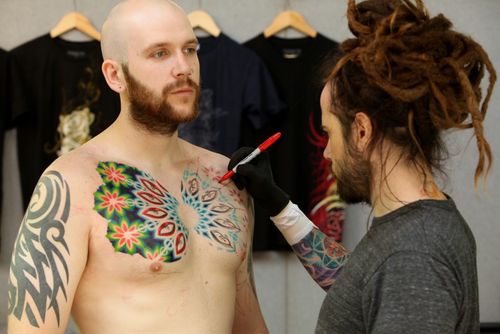
A Tattooist sketches a tattoo design on the chest of a man on the opening day of the fifth London Tattoo Convention held at Tobacco Dock in the east end on September 25, 2009 in London, England. The three day, annual convention for all aspects of body art is one of the main events in the European tattoo circuit and was attended by 20,000 visitors last year. By Oli Scarff/Getty Images.

“Bite Me, Jew Boy!”

The Tea Party Media spent yesterday jumping up and down accusing an NBC producer of anti-Semitism because of an email she allegedly sent to a mass email from Americans For Limited Government (But Only When There's A Democratic President).

ALGBOWTADP put out this email yesterday. Breitbart's Big Government site immediately declared it legit (and then backtracked for hours). But NBC vehemently denies it. This strikes me as an interesting moment in the emergence of the far right media. Was this a hoax, designed merely to smear NBC and the MSM – and with the hope that even if it were debunked, it would remain true in the WND-world? Or did someone hack the email address? Were ALGBOWTADP punked? Or propagandizing? We'll see where the evidence leads. And just how credible this new Breitbart empire is.

Will The Web Destroy Cable?, Ctd

A reader writes:

"Will the internet replace broadcast TV as the primary launching pad for new show concepts?"

Yes.

I've been seriously thinking of getting rid of my cable and just keeping my broadband, for a while now. I live alone, so watching TV on my computer isn't a hardship — actually, being a web designer and photographer, my computer monitors are a lot *nicer* than my TV. Most of the shows that I watch can either be watched in streaming video off of the network's website, or Hulu, or downloaded via Netflix or iTunes. I realized recently that even if I bought every episode of the two or three series that I might want to watch via iTunes, that would still be *substantially* cheaper than what I pay for my cable service in any given year.

The problem with cable is that you can't just buy the products that you want from them. You have to buy these ginormous packages, which, I suppose, might be nice for families with varied interests (sports, kids' programming, news, movies, etc.), but for one person like me? I don't *NEED* 250 channels or whatever it is now.

Up on the Cape we have never had a TV. This year, we downloaded the three shows we are addicted to: The Daily Show, The Colbert Report and The Soup, and watched them on a laptop. No ads. Just a day's delay. What's not to love?

An Anti-Protectionist Parable

Lexington sketches out the folly of tariffs:

If tariffs are such a good economic idea, then why stop at national boundaries? If they make everyone richer, why not have customs posts between New York and New Jersey? Cars entering and leaving the Lincoln tunnel would have to pay, on top of the toll, a surcharge on all the goods they contain. Why not, indeed, make New York and New Jersey self-sufficient in all their needs, making all their own cars, growing all their own food etc?

Let us imagine that such a scheme was proposed by a future Governor Paterson or Corzine, as a wizard wheeze for boosting tax revenues. Is it just possible that such a system would discourage trade between the two states, raise costs to consumers, result in massive inefficiencies etc etc? 

Malkin Award Nominee

"I killed the Kentucky Census worker — along with every man and woman in America who is guilty of having said or written anything critical of government. The criminalization of conservatism continues," – Michelle Malkin. Many of the details she pooh-poohs have now been confirmed. In fact, the murder seems even grislier the more you examine it.

By the way, there is nothing conservative about Southern populism.

The Ethics Of Photo-Cropping

Cheney-crop

Newsweek editors excised the left two-thirds of the above image and captioned it:

"'I am.' Dick Cheney on Fox News Sunday, in response to the question, 'So even these cases where [C.I.A. interrogators] went beyond the specific legal authorization, you're O.K. with it?'"

Getty photographer David Hume Kennerly, who captured the shot, protests:

By linking that photo with Mr. Cheney’s comment and giving it such prominence, [Newsweek] implied something sinister, macabre, or even evil was going on there. [The magazine's] objective in running the cropped version was to illustrate its editorial point of view, which could only have been done by shifting the content of the image so that readers just saw what the editors wanted them to see. This radical alteration is photo fakery. Newsweek’s choice to run my picture as a political cartoon not only embarrassed and humiliated me and ridiculed the subject of the picture, but it ultimately denigrated my profession.

Kottke disagrees:

This is hardly photo fakery. Crops aren't lies. Full-frame photos aren't the truth. Kennerley himself could have easily taken that exact picture in the moment. A spokesman for Newsweek defended the magazine's action:

Yes, the picture has been cropped, an accepted practice of photographers, editors and designers since the invention of the medium. We cropped the photograph using editorial judgment to show the most interesting part of it. Is it a picture of the former vice president cutting meat? Yes, it is. Has it been altered? No. Did we use the image to make an editorial point — in this case, about the former vice president's red-blooded, steak-eating, full-throated defense of his views and values? Yes, we did.

Given Cheney's reputation, the cropped photo of him is not an outlandish or biased depiction of the man…in fact, it's a pretty good visual metaphor of the former VP. If there's one thing that both Cheney's supporters and detractors can agree on, it's that he's a "red-blooded, steak-eating, full-throated [defender] of his views and values".

Kennerly responds to Newsweek here. We fall somewhere between these two commenters:

[I]t does seem like it is the same as quoting someone out of context… which also happens frequently in media. And, as far as photo manipulation goes, fairly small compared to the other photo manipulations. In the cropped image, you can tell he is at a home in a kitchen and that other people are there. It doesn’t take a huge jump of imagination to figure out what is going on. Poor taste? Yes. But, far from unreasonable.

What’s the big deal? Could anyone really think that the photo shows something “evil” going on in the Cheneys’ kitchen? Lighten up!
No Suicide

That's the one thing we know for certain now in the case of the Kentucky lynching:

Two people briefed on the investigation said various details of Weaver's account matched the details of the crime scene, though both people said they were not informed who found the body. The two spoke on condition of anonymity because they were not authorized to discuss the case. ''And they even had duct tape around his neck,'' Weaver said. ''And they had like his identification tag on his neck. They had it duct-taped to the side of his neck, on the right side, almost on his right shoulder.''

That's the detail that makes you stop and think. If this was a revenge murder for stumbling upon a meth lab or pot plantation, it's hard to understand why such a big deal would be made out of his census identification card. It's possible, I suppose, that anger at the feds in general could make a drug dealer murder a census worker. But the most worrying possibility – that this is Southern populist terrorism, whipped up by the GOP and its Fox and talk radio cohorts – remains real. We'll see.

Staying In Afghanistan To Save India

That's what Steve Coll seems to suggest:

India is well advanced on a march to prosperity and greatness in the mid-twenty-first century; already, her stable pluralism seems a solid pillar of the coming Asian Century. Internal demand from the Indian economy is driving rapid economic growth this year in that country at a time when most of the rest of the world’s economy is shrinking. Like Brazil and China, the country faces huge challenges. But to imagine within decades a subcontinent—including Pakistan—that has become as successful as Southeast Asia or Latin America are today is not by any means a fantasy; barring the collapse of Pakistan, it is more than probable. This process is of interest to the United States not only because it would create a better world and a more stable Asia but because it would subdue the region’s terrifying nuclear risks.