Bill Clinton Explains Why He’s Now For Marriage Equality, Ctd

Althouse:

Clinton signed DOMA when he thought it was in his political interest, and I suspect he thinks it's in his political interest now to embrace same-sex marriage. I can understand Sullivan enthusing over whatever high-level support he gets for his big cause, but I would find him a much more interesting writer if he would shine a sharp, critical light on everything.

The Dish posted the interview without comment: how exactly is that "enthusing" over Clinton's statement? We have scoured through his record on gay rights many times. Having shone a sharp, critical light on Clinton's record on gay matters for years, the Dish is actually obliged to present his conversion to correct the record.

Has The Journal Jumped The Shark?

Felix Salmon seems to think so:

The front page of [last] Friday’s WSJ was not its finest hour. Along the top was the headline “Bankers Face Sweeping Curbs on Pay” — something which occasioned Justin Fox to note that “in the pre-Murdoch era that would have been a 600-word story on page A24, headlined ‘Fed Mulls Pay Guidelines’.” Underneath that headline was the biggest front-page story: “U.S. Missile U-Turn Roils Allies”. Except there was nothing in the story to indicate that any allies were roiled at all. The online story now has the headline “Allies React to U.S. Missile U-Turn”, along with a formal correction of the old headline.

The WSJ doesn’t need to do this, but Murdoch does: it’s in his blood. A Murdoch paper without punchy headlines which grab you by the throat is pretty much a contradiction in terms. Readers of the WSJ will have to get used to trusting the stories more than the headlines, or the implicit news judgment which governs where they’re placed. The WSJ’s journalism seems to be much less scathed than the headlines have been.

I have to say that I'm increasingly enjoying the Murdoch Journal myself. But then I'm British and appreciate a few broad brushes. The editorial page seems unable to move past the 1980s, alas.

Dissents Of The Day

A reader writes:

I'm really enjoying all your coverage of how we "busted" Iran by letting them know that we know they're building illicit nukes. Yeah, its great we actually called them out on it, and yeah its great that France is involved this time around (though that has more to do with Sarkozy and Chirac than Iran and Iraq), and I certainly don't think Obama has done anything wrong in his navigation of these treacherous waters. But do you realize how silly it is fall all over yourself with glee before a single tangible result has been achieved?

Not much has happened in the past week, aside from a few speeches and photo ops. The Iranian regime still abuses its people, the nuclear program marches on, Israel still feels backed into a corner, Russia isn't exactly on board (yet) with sanctions, there is no indication China ever will be, and the big visit to Riyadh and Cairo yielded absolutely zero movement from the Arab world on the basics Obama was after (recognition, airspace rights, etc.)

That's not to say the wheels aren't in motion. I'm proud of the president, I hope he knows what hes doing- but it's way too early to tell.

I have stated as much myself. I remain skeptical in many areas. But I am thrilled to see some progress and deftness in US diplomacy. Another reader:

The existence of the additional Iranian facility has been known for a number of years by the West. Obama only told us about it now because the Iranians, having confirmed our knowledge of its existence, finally told the IAEA. So what's all the bluster about? I guess that, as usual, you're a sucker for virtually any and all things that you hear from Obama.

The End Of Easy Oil

Ken Silverstein interviews Peter Maass, author of Crude World: The Violent Twilight of Oil:

The oil industry is filled with a lot of smart people whose companies possess amazing technology. There is a debate within this industry about peak oil. Chevron and BP, though denying the imminence of a peak, have been ahead of others in admitting that the era of “easy oil,” as they sometimes call it, is over. The rest of the oil that’s to be found, they say, will be in hard-to-reach reservoirs that won’t be as large as the huge ones in Saudi Arabia or Iran.

Oil executives are inherent optimists, because they are accustomed to drilling nine dry holes before finding a good one. So I think their dismissal of peak oil–the idea that the world has reached or will soon reach its peak of oil output–is genuinely felt to an extent. I also think there’s some willful distortion, because admitting to peak oil–which I define as a combination of geological and political limits on production–means their business model, which consists of extracting the stuff, has a dismal future. The major companies are of course investing in alternative energy projects, but I think these are optional bets they can afford to make and that they don’t regard as crucial to their future. Just as the railroad companies did not lead the way into automotive production, I wouldn’t expect and wouldn’t want oil companies to control the next generation of energy technologies.

The Daily Wrap

Today on the Dish we discovered that Iran has been hiding a not-so-secret facility. Andrew interpreted Obama's revelation as part of a masterful strategy to isolate Ahmadi. (And Russia seemed to bite already.) Mark Lynch and a Dish reader had some good follow-up. Meanwhile, Kristol and Co. embarrassed themselves, and a reader kicked them for good measure.

Rounding out foreign policy, Gary Sick assessed the upcoming negotiations with Iran, Tom Ricks gauged Petraeus on Iraq, and Haaretz and Juan Cole punctured Bibi's speech to the UN. Andrew critically recommended Brooks' latest on Afghanistan and put two cents on the public option. In conservatism death watch, Damon Linker digested the new book by Tanenhaus, Frum went another round with Horowitz, a reader offered a smart assessment of race and culture, and the Birther right crawled to late night.

Rounding out the wrap, Friedersdorf and Will Wilson tussled over loyalty, Ed Schultz auditioned to become the liberal Beck, and Michael Leeden lost it. Oh, and this ad was pretty cool.

— C.B.

Face Of The Day

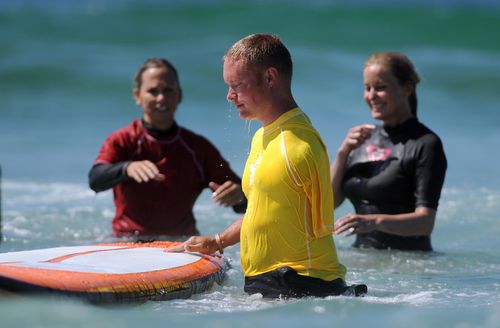
VETSURFGabrielBuoys:Getty

US army Veteran Greg Reynolds learns surfing as actress Bo Derek (R) supports him during the 2nd National Veterans Summer Sports Clinic in San Diego, California, on September 25, 2009. Reynolds lost his left arm and shoulder in Iraq. The National Veterans Summer Sports Clinic introduces recently injureds veterans to adventure sports and recreational activities such as surfing, sailing, cycling or kayaking. During one week, organised by the US Department of Veterans Affairs, they promote rehabilitation of body and spirit. US actress Bo Derek is supporting the program as a volunteer. By Gabriel Buoys/AFP/Getty Images.

Polling The Public Option, Ctd

A reader writes:

You call the public option a "Trojan horse." I take it that you do not mean that allowing a public plan in which the government could generate savings by using its collective buying power will not, in fact, result in lots of Greeks with swords jumping out and killing us in our sleep. I am at a loss, however, as to what exactly you imagine the danger to be — your sentence follows with no explanation. This is one of those things that I just do not understand at all when public option opponents gesture in this direction: what is the perceived worst case scenario here and why do you find it objectionable?

Let's say that such a government public plan would prove so effective at negotiating low rates that it would price private plans out of the majority of the health care insurance market. Is this a problem in some way? Anyone who had enough money could assuredly buy whatever high-end services or plans they would wish–you can't seriously believe that such a government plan would result in the absolute legal preclusion of private payment for medical insurance or services, can you? Or is this just a generalized fear that people will overwhelmingly prefer the public option, and the portion of our collective income going to the government in taxes (rather than private insurance policies) will increase? Really wondering what your fear is.

Busted, Ctd

Kevin Sullivan responds to my post:

I'm not so certain. After all, most reports indicate that the United States had been monitoring the development of this facility for years. In that case, it seems appropriate to applaud President Bush for sitting on this intelligence nugget for a later date, no?

Obama's discretion is not surprising. However, such discretion form the Bush White House – an administration known for its itchy trigger finger – is in fact far more laudable.

And I remain skeptical, much like Andrew, over whether or not this nuclear revelation truly hurts the Iranian position. Remember, the audience here is in Beijing and Moscow, respectively. If they remain mostly unmoved it leaves the West precisely where it was yesterday. As I said, there's a good chance this could become a meaningless bargaining chip for Iran during next week's negotiations, which may only serve to stall discussion on Iran's active and real threats.

Bill Clinton Explains Why He’s Now For Marriage Equality

Anderson Cooper has the scoop. Amazingly, no one has asked him so directly before:

AC: You said you recently changed your mind on same-sex marriage. I’m wondering what you mean by that. Do you now believe that gay people should have full rights to civil marriage nationwide?

Clinton: I do. I think that, well let me get back to the last point, the last word. I believe historically, for two hundred and something years, marriage has been a question left to the states and the religious institutions. I still think that’s where it belongs. That is, I was against the constitutional amendment to ban gay marriage nationwide, and I still think that the American people should be able to play this side in debates.

But me, Bill Clinton personally, I changed my position. I am no longer opposed to that. I think if people want to make commitments that last a lifetime, they ought to be able to do it. I have long favored the right of gay couples to adopt children.

AC: What made you change your mind? Was there one thing?

Clinton: I think, what made me change my mind, I looked up and said look at all of this stuff you’re for. I’ve always believed that—I’ve never supported all the moves of a few years ago to ban gay couples from adoption. Because they’re all these kids out there looking for a home. And the standard on all adoption cases is, what is the best interest of the child? And there are plenty of cases where the best interest of the child is to let the gay couple take them and give them a loving home. So I said, you know, I realized that I was over 60 years old, I grew up at a different time, and I was hung up about the word. I had all these gay friends, I had all these gay couple friends, and I was hung up about it. And I decided I was wrong.

That our society has an interest in coherence and strength and commitment and mutually reinforcing loyalties, then if gay couples want to call their union marriage and a state agrees, and several have now, or a religious body will sanction it, and I don’t think a state should be able to stop a religious body from saying it, I don’t think the rest of us should get in the way of it.  I think it’s a good thing not a bad thing. And I just realized that, I was, probably for, maybe just because of my age and the way I’ve grown up, I was wrong about that. I just had too many gay friends. I saw their relationships. I just decided I couldn’t, I had an untenable position.