[W]hat I really haven’t seen is anyone attempt to seriously lay out some kind of cost-benefit analysis of how important this whole Afghanistan situation really is relative to what I’m being told it would take to “win.” It seems to me not that we should “lose” instead, but rather that we should define “winning” as us achieving something useful and realistic rather than something grandiose and out of proportion to its actual importance.
Month: September 2009
PSA
Not everyone is as addicted to politics as you are.
Boiling Frogs
Kevin Drum takes on Jim Fallows pet peeve:
[E]ven though it's untrue that frogs will mindlessly poach themselves to death if you're careful to turn up the temperature on them slowly, it's a useful metaphor. Still, it's not true. So we should find another one. But here's the thing: Fallows issued a worldwide call for good substitute metaphors two years ago. Four days later he promised that winners would be announced in a couple of days. And then….nothing.
So here's what I'm interested in. The boiling frog cliche is untrue. But it stays alive because, as Krugman says, it's a useful metaphor. So why aren't there any good substitutes?
If Dish readers can think of a suitable substitute, and thereby complete Fallows' mission in life, please e-mail.
Placing Bets
Andrew Gelman uses an old paper to size up the 2010 elections:
The current state of the generic polls gives the Democrats .412/(.412+.377) = 52% of the two-party vote. Going to the graph, we see, first, that 52% for the Democrats is near historic lows (comparable to 1946, 1994, and 1998) and that the expected Democratic vote–given that their party holds the White House–is around -3%, or a 53-47 popular vote win for the Republicans. Would 53% of the popular vote be enough for the Republicans to win a House majority? A quick look, based on my analysis with John Kastellec and Jamie Chandler of seats and votes in Congress, suggests yes.
Obama’s JFK Moment?
George Packer, who is always worth listening to, approves of McChrystal's report on Afghanistan. A taste:
In my piece I wrote about the fears within the Administration that escalation in Afghanistan could do to Obama what the same thing in Vietnam did to Johnson (just substitute health care and energy legislation for the Great Society). That’s the Vietnam analogy people in the Administration keep coming back to. I’ve long thought that Obama was more like J.F.K.: rational, coldly objective in the heat of events, unlikely to allow his advisers and his ego to destroy his Presidency by getting the country deeper into a war he never felt fully committed to.
Obama has Kennedy’s confidence in his own judgment, which Johnson tragically lacked. Gordon Goldstein’s very good book “Lessons in Disaster,” about McGeorge Bundy—national security adviser to both J.F.K. and L.B.J.—pretty much proves that Kennedy, if he’d lived, would not have committed ground troops to Vietnam at the start of his second term. After the disaster at the Bay of Pigs, Kennedy stopped trusting his military advisers, and went on to overrule them during the Cuban missile crisis and, again and again, on Vietnam. Perhaps this is Obama’s J.F.K. moment. We’ll know in a few weeks. And if so, perhaps he would be right.
His caveat:
[T]he alternatives were already rejected by Obama’s strategy review, and since then no one has made a persuasive case why they would work any better.
“No Gimmicks”
Glenn Beck in 1986.
A Hard Act To Follow
The Guardian recaps yesterday's speech by Libyan leader Muammar Gaddafi:
He tore up a copy of the UN charter in front of startled delegates, accused the security council of being an al-Qaida like terrorist body, called for George Bush and Tony Blair to be put on trial for the Iraq war, demanded $7.7tn in compensation for the ravages of colonialism on Africa and wondered whether swine flu was a biological weapon created in a military laboratory. At one point, he even demanded to know who was behind the killing of JFK. All in all, a pretty ordinary 100 minutes in the life of the colonel.
(Hat tip: Exum)
The Daily Wrap
A particularly scattered mix on the Dish today. Speaking at the UN, the president had the courage and common sense to use words like "torture" and "occupation." Speaking at a China-based, French-owned financial brokerage, Palin caused people to walk out.
Andrew primarily tackled the precarious political position in Iran (whose people seem more and more powerful) and went two more rounds with Coyne over theodicy. The Dish also aired follow-ups from readers on US immigration laws, teen sex crimes, and Andrew's Bush piece.
In other news, support for healthcare reform grew, anti-marriage forces targeted Maine, Bruce Bartlett targeted Rove, and Balloon Juice made a dictionary.
Finally, if you're on the Cape this weekend, go see Aaron in action.
— C.B.
Face Of The Day
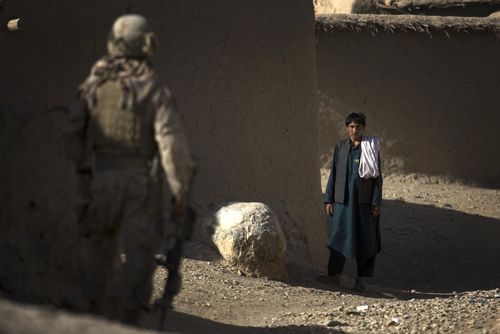
An Afghan villager stares at a US Marine from 2/3 Fox company patrolling in Farah Province, southern Afghanistan, on September 23, 2009. As President Barack Obama weighs his options for the Afghan war, some lawmakers and analysts are pushing more modest strategies that would require a smaller US force and rely more on drones. By David Furst/AFP/Getty Images.
The Birther Party
More Republicans believe that the president is illegitimate and born in Kenya than those who acknowledge reality. A quarter of Dems believe Bush allowed 9/11 to happen. But at least a big majority – 63 percent – are not insane.
 The Dish