Handling The Iran Scorpion

AHMADINEJAD09BehrouzMehri:AFP:Getty

On the one hand:

I would hope by now that the murderous crackdown on Iran’s mass democracy movement by the country’s oil-funded ruling cartel would have removed the last scales from the eyes of those Iran watchers who think this is simply a poor, misunderstood regime that really wants to repair its relations with the West, and we just have to learn how to speak to it properly. This is a brutal, cynical, corrupt, anti-Semitic regime that exploits the Palestinian cause and deliberately maintains a hostile posture to the West to justify its grip on power. A regime that relates to its own people with such coercive force is not going to be sweet-talked out of its nuclear program. Negotiating with such a regime without the reality of sanctions and the possibility of force is like playing baseball without a bat.

On the other, as Tom Friedman also argues, the deep unpopularity of the regime, and the divisions within the elite, may make economic sanctions more potent. Juan Cole notes:

Further unilateral U.S. sanctions and collective UNSC measures should be taken more seriously than they are by Iran.

Ahmadinejad defiantly told NBC, “We think for one or two countries to think that they own the world and they are the ones that make the major global decisions and others should follow — that period has come to an end.” But Iraq’s economy was ruined by U.S. and U.N. sanctions in the 1990s, and the lack for some period of time of chlorine for water purification and of some medicines is thought to have been responsible for the deaths of 500,000 Iraqi children.

Targeted sanctions on North Korea interdict military and technological equipment, exclude luxury goods, and constrain the country’s finance system. This summer, the UNSC went further and urged member nations actually to board suspect North Korean ships. China, which had earlier blocked such moves, agreed to this resolution because its leaders were furious about North Korea’s underground nuclear test. The Khamenei-Ahmadinejad regime risks making Iran a pariah on the North Korea model if it goes on defying the international community. Iran’s people will be the real losers if that happens.

All one can say is that this is an extremely delicate and difficult balancing act for the US. On the one hand, the US has to prevent Israel detonating World War III in the Middle East; on the other, the US has to ensure the security of Israel. On the one hand, Obama has no choice but to talk to the regime to address the nuclear issue; on the other, if he only addresses the nuclear issue, then the Green Revolution might feel slighted. On the one hand, sanctions might tip the balance toward revolution and regime change; on the other, they might isolate the regime – and entrench it – on the North Korean or Saddam’s Iraq model. God knows the coup-leaders have no qualms in using Kim Jong-Il type brutality. But Iranians are not North Koreans. Real sanctions could heighten the regime’s contradictions and bring it down.

From a laptop, these maneuvers are impossible to judge. This is a prudential judgment that we have no choice but to delegate to leaders and diplomats. But it seems to me that the worst possible outcome would be an Israeli attack; the best would be regime change from within. Between those two, a policy of containment – economic and financial sanctions wrapped in both the nuclear issue and the legitimacy issue – seems the most practical way forward to me.
“Nukular!”

An audience member tweeted Palin's neocon-controlled-and-ghost-written speech in Asia. This is a great piece of detail:

Two US delegates left early, according to AFP, with one saying "it was awful, we couldn't stand it any longer." He declined to be identified.

You can see why Kristol loved Palin: she would bring in the "real Americans"; she'd fight the culture war against gays and abortion; and, best of all, she would do whatever he told her in foreign policy. Think of it as the Quayle model, which gave us George W. Bush.

Want another?

GOP Wins Battle, Loses War?

Jonathan Chait peers into his crystal ball:

I understand the reasons for the GOP’s behavior. Republicans are acting in their individual and collective political self-interest. Individually, Republicans realize that their base is convinced that Obamacare equals socialism plus death panels, and thus any Republican who signs on would kiss away his political future and quite likely face a primary challenge. Collectively, the party has put all its chips on defeating health care reform, or, as a fallback, withholding support and rendering reform a “partisan” exercise that can be used against red state Democrats in 2010.

It’s a smart political strategy. But the health care plan that Obama signs is going to be around for a very long time. Republicans might one day come to wonder if picking up some seats in 2010 were worth forgoing a chance to help put their imprint on the U.S. health care system.

Rape In Iran

Ebrahim Sharifi, "a 24-year-old student who worked for Mehdi Karrubi during the presidential campaign and participated in the protests that came after incumbent Mahmud Ahmadinejad was declared the victor in the June 12 election" says he was raped while in prison. It's a story we have heard repeatedly:

The fourth day, when they said they were going to execute me — it was a mock execution they subjected us to. I protested and said: "What is this? If you want to execute me, just do it. Why do you play these games?" Someone kicked me in the stomach and I fell on the ground. He kept kicking me in the stomach. Then he told someone: "Go and make [him] pregnant." He kept kicking me. I was throwing up blood and my stomach was injured. He pulled me to another room and tied my hands to the wall.

Aiming Low On Climate Change?

Joshua Keating reads Obama's address to the UN yesterday and writes:

It seems telling that [he] ended his [speech] not with a stirring call to action, but by urging pragmatism and compromise. […] It sounds a bit like Obama is premptively defending a climate bill that will probably turn out to be less aggressive than the other delegates in Copenhagen might like and like Bill Clinton, is looking to assure environmentalists that any bill is better than none if it moves the ball forward.

Chart Of The Day

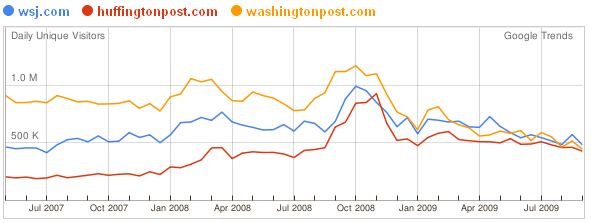
HuffPo-WSJ-WashPo

Katherine Mangu-Ward posits:

Notice that the moment the various sources synced up was the 2008 election. One possible interpretation: When the country suddenly developed a voracious appetite for news, they gave all three sources an equal chance. But it was HuffPo, not WaPo, that gave people what they were looking for—super-speedy coverage of the political story-of-the-second, followed by a bikini babe chaser.

What is also clear is that HuffPo, while not regaining the mountain tops of the election months is still way ahead of where it was two years ago. The Washington Post, in contrast, has lost almost half its traffic in the same period. Call it Froomkin's revenge. The Dish has triple the readership it had three years ago, and, on current trends, this year's traffic will likely be roughly the same as the boom year of 2008.

Condi Cranks Up The Fear

She tells Fortune magazine:

"The last time we left Afghanistan, and we abandoned Pakistan," she said, "that territory became the very territory on which Al Qaeda trained and attacked us on September 11th. So our national security interests are very much tied up in not letting Afghanistan fail again and become a safe haven for terrorists…It's that simple," she declared, "if you want another terrorist attack in the U.S., abandon Afghanistan."

Josh Marshall jumps in:

[T]he 'safe haven' argument just doesn't seem to add up. The safe havens or rather the training camps in the safe havens, where so many would-be terrorists apparently did an endless stream of calisthenics on those iconic monkey bars, were neither a necessary nor a sufficient condition for the 9/11 attacks. They were funded through too loosely guarded global financial networks, planned and organized in cities in Europe and executed right here in the USA.

The Daily Wrap

The Dish hummed with activity today. Andrew continued to express misgivings about the Gulliver-like situation in Afghanistan, and criticized McChrystal for the pressure he seems to be exerting on the White House – a concern challenged by Dish readers. Building on the reactions to yesterday's leak, we grabbed commentary from Exum, Ricks, Packer, Michael Lind, Ackermann, Les Gelb, and Ed Morrissey.

In the spiritual sphere, Andrew continued his running debate over theodicy (here, here, and here), a topic sparked by this Sunday post. He also responded at length to new numbers showing a decrease in religious faith among Americans.

Elsewhere, Andrew waxed eloquent over the insanity of the HIV ban, bemoaned the brain drain caused by US immigration law, and took another long look at the legacy of Irving Kristol.

The Dish also covered: two more updates from the Atlanta bar raid, a look at how the US criminalizes teen sex, a view from a Canadian sickbed, two examples of Glenn Beck taking hits from the right, and a glimpse into Obama's vast, art-wing conspiracy.

Finally, we organized a dance competition between Tom Delay and David Brent. (Too close to call.)

— C.B.

Henry Fairlie On Irving Kristol

Another classic Tory shot across the bow of neoconservatism – back in 1984:

It is not at all surprising that Kristol, whom I regard as by far the most intelligent and interesting of those who are trying to work out an American conservative philosophy, begins by disowning the past. He may raise his eyebrows and say that he has not done so. But here we come close to a distinction that has to be made between conservatism and Reaganism, and one must ask what meaning can be attached to these words of Kristol’s to which he deliberately gives weight. ‘‘What is ‘neo’ (‘new’) about this conservatism is that it is resolutely free of nostalgia. It, too, claims the future.’’

That ‘‘nostalgia’’ is one of Kristol’s many escape words: the hatch in a submarine or the bay in a spacecraft through which an idea can escape without any harm to the body of ideas left within. One’s mind glides over it even as one reads: How right to be ‘‘resolutely free of nostalgia.’’ But whenever has a true conservatism been informed by nostalgia? Far from yearning for the past or wishing to recover it or live in it, the conservative cares so much for the past that he wants only to leave it alone. 

The past is itself, or, as the English conservative philosopher Michael Oakeshott would have said without wincing, the past is herself. Do not touch her. Do not think to rebuke her. Thou art so beautiful—those haunting words of Faust—stay as thou art.

With his disavowal of nostalgia, Kristol seems to shake the past from him, like a dog coming out of a river; and in this he is representative not only of the neoconservatives but of most American conservatives. When he does reach to the past, which he often does to make his argument, it is to plunder it. The past is usable to him—an especially American notion—and is interesting for its prescriptions. From the past he will, no less, ‘‘claim the future.’’ The idea of any true conservative ‘‘claiming the future’’ is so wrongheaded that one can only suggest that Kristol go back to City College with his fellow Trotskyite students and begin plotting the future again on the back of a greasy frankfurter wrapper.

— "If Pooh Were President: A Tory's Riposte to Reaganism," Harper's, 1984, collected in Jeremy McCarter's superb new collection, "Bite The Hand That Feeds You."