
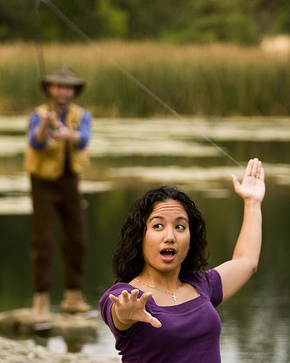
Face Of The Day
The Dish should have known better than to discuss Canadian politics. A reader writes:
First of all, you're conflating the Parti Quebecois with the Bloc Quebecois. The Parti Quebecois is a provincial party, which means that it sits within the Quebec Provincial Parliament and only deals with provincial matters. The Bloc Quebecois is a federal party that sits in the national legislature in Ottawa with the unique goal of representing Quebecker goals (or at least the goals of the Parti Quebecois, with whom they are naturally affiliated). In that respect, yes, the Bloc represents Quebec.
However, I completely disagree that the Bloc's goal at the federal legislature is "to use politics as a means for disruption or protest or threat or veto." While their end goal is disruptive to keeping Quebec within Canada, they can also contribute constructively to economic or social issues that face the Federal Parliament. For instance, they were in favour of the Civil Marriage Act (Bill C-38) that legalized same-sex marriage. Just this past week, the Bloc supported Harper's Conservative Minority Government budget motion. Without the Bloc's support, the Conservative government would have fell, and an election would have been called. In short, to equate the Republicans with the Bloc is a gross over-simplification, as the Bloc Quebecois's involvement in Canadian federal politics is much more complex than that of the current Republican Party in Congress.
Another reader:
You mean the "Bloc Québeécois", I suppose. Even then, not a very good analogy. The Bloc Quebecois did not became a regional party, it was from the start, and it never meant to take power. Beside, everybody agrees that the work of the Bloc in Ottawa, while focused on Quebec demands, have been moderate and mostly constructive. To be compared to the GOP nuts is rather insulting.. The Bloc is however an obstacle to a majority government in Ottawa. Without Quebec, both Conservative and Liberal are doomed to minority status and it has consequences.
One more:
It is very clearly a protest, and its goal is secession from Canada. But, in contrast to the GOP, it actually votes on key laws, participates in discussion, is open to compromise, and even has proposed a series of bills which were eventually accepted as laws. Like it or not, this party has played its part in Canada legislative branch. They may want to split, but they act like any democratic party should, and play the same ball game as every other party in recent memory. And they don't hide their motivations: they know they will never be in power, and use their 50 or so deputies in a respectable manner as not to prevent the parliament from functioning.
Which may be more that can be said of the GOP at this time.
A reader writes:
Even before your recent prompting to purchase a subscription to The Atlantic I decided that I am such a heavy reader of the Dish that it was basically the least I could do to support my multi-hit a day habit (I liken it to listening to so much NPR you just feel compelled to give during pledge week). I have been a New Yorker subscriber for many years, but the combination of becoming a parent 6 years ago and starting to bike to work (thus eliminating my usual reading time) has effectively killed my ability to keep up with the New Yorker’s weekly onslaught (not that I am without leisure reading time, but it I think we can all agree that it never looks good to be seen reading a magazine at work, where I happen to do most of my web browsing).
I’ve been an Atlantic subscriber since June and I’m sorry to say I will likely let my New Yorker subscription lapse when it comes due, but I can no longer justify paying $40 a year to look at the cover art, and read one article and a bunch of cartoons. Prior to subscribing to the Atlantic I’d picked up the magazine perhaps once. I’ve rarely been so satisfied with a product purchase (exceptions: my Macs and my Sirius radio). I’ve read each issue cover-to-cover and can safely say there has not been one dud article in the three issues I’ve already received. I’m impressed, glad I subscribed, and never would have were it not for you and the Dish. Keep it up!
David Frum and David Horowitz have been debating the worth of Glenn Beck. Frum is anti-Beck and thinks he should be cast out of the GOP; Horowitz thinks Beck provides a necessary service and deserves a seat at the table. Unsurprisingly the two are talking past each other. Here's Horowitz:
[Al] Franken is now a U.S. Senator in part because conservatives of whom you are typical want to conduct politics by the Marquis of Queensberry rules when the other side is in it as war in which destruction of the enemy is the game. Franken calls us evil. You call him mistaken (and unfunny). And you want other conservatives to do the same. The more conservatives who follow your advice the more we will lose. Personally, I am thrilled with what is happening now in the conservative movement – our aggressive media like Fox and talk radio, the emergence of enraged conservative masses – the tea baggers – as leftist half-wits like to dismiss them. It is this energized, unapologetic, in-your-face (but also civilized and intelligent) conservative base on whom the future not only of the movement but the country depends.
Where does one begin?
"[W]hen the going gets tough, the president’s favored modus operandi is to resort to the most disingenuous rhetoric he can get away with. He seems to operate on the presupposition that no one is paying close enough attention to the hypocrisy and half-truths. But there are plenty of people who do—the CIA and the rest of the intelligence community, our enemies, and many informed voters who cringe at the unseemly sight of a war waged against those who protected us. They all understand the political gamesmanship at work here and the lack of real concern by the president for our intelligence community," – Jennifer Rubin, conflating a concern for the rule of law with a "war on the CIA".

Hacienda Heights, California, 6.03 pm
Ah, those were the days. Damon Linker reminds us of the golden age of neoconservatism, before it became corrupted by power:
Given how often Rush Limbaugh, Glenn Beck, and other right-wing populist rabble-rousers make coarser versions of the same argument today, it's important to note that Kristol and his colleagues initially refused to propose a political response to the rise of new class. Adopting Trilling's ambivalent stance toward the adversary culture of the intellectuals, Kristol explicitly rejected a "populist perspective" that portrayed new class elites as "usurp[ing] control of our media" and using "their strategic positions to launch an assault on our traditions and institutions." Such a simple-minded view was, for Kristol, "misleading and ultimately self-defeating." The rise of the new class and the adversary culture could not simply be willed or wished away, since they had emerged out of and had their roots in the extraordinarily complicated dynamics of modern, urban civilization itself. The appropriate response to recent troubling trends was thus careful study and reflection on the complexities of contemporary American life–not futile and destructive calls to stamp them out through political action.
But Kristol's moderation and detachment would soon come to an end.
Guidespot compiles 42 and counting. See if you decipher this brilliant pun:
Answer after the jump:
“He caught me!” Then this:

Nate Silver parses the Value Voters' summit straw poll and finds tepid opposition to marriage equality:
Public opinion is moving toward acceptance of gay marriage. But it is doing so very slowly, at a rate of perhaps a point or two per year, and has at least a few years to go before it is the majority opinion. In the near term, the more relevant dimension may be 'passion', or depth of feeling. It used to be that the conservatives were ahead on passion — they were strongly opposed to gay marriage, whereas liberals were, at best, lukewarmly in favor of it. Increasingly, that dynamic seems to be reversing.
A reader writes:
I must certainly be one of those "militant atheists" I read about if I'm bothered by this video about Christ-camp for the developmentally disabled. I guess it pushes my biggest button about religion, which is that it is absolutely imposed upon kids by trusted adults from before an age where they're able to think for themselves, and then you have one of the camp staff saying of these vulnerable young disabled kids, "In everything that we do, we're trying to point them to the lord." Amidst all the footage of frolicking in the pool, we saw plenty of glimpses of prayer sessions, sermons, and oddIy creepy images of kids just sort of… hanging out around crosses. I realize that the campers who are competent to give consent may well have asked to come there, but this is such a vulnerable population, and for those who aren't, I wonder if these indoctrination sessions are as mandatory as mine were growing up. There's that slippery slope toward the type of "instruction" that was documented in Grady and Ewing's eye-opening film Jesus Camp.
I also have my feathers ruffled by the conceit that Christians "accept everyone" (not my impression of the state of Christianity today) or that this "saving grace" type of compassionate enterprise is somehow uniquely Christian. Not to mention the disturbing moral undercurrent to the co-founder's statement, "You learn God's love because it's the only way you can deal with it…": apparently, you need a supreme overlord breathing down your neck in order to be nice to disabled kids? I'm being overly harsh in response to an organization that is clearly doing some good things for kids, but having witnessed a great deal of intellectual, moral, and physical violence from the Christian church I am not so eager to grant them "saving graces," especially of the kind that are offered indoctrination-free by secular institutions.
Tangentially, I wonder how many times Catholic churches in Maine will require second passings of the collection plate in order to care for those dumped from their medical insurance plans, or if that's just to collect money to defeat marriage equality.
 The Dish