A nifty interactive graph that shows various occupations as a percentage of the workforce over time (click on a profession to see it individually). Larger version here.
(Hat tip: Yglesias)
A nifty interactive graph that shows various occupations as a percentage of the workforce over time (click on a profession to see it individually). Larger version here.
(Hat tip: Yglesias)
Remember when there wasn’t Internet?
Uploaded by smithy00101. – Arts and animation videos.
Will Saletan floats a pipe dream:
If we're devouring our planet, and we can't find more resources, and we refuse to have fewer children, where does that leave us? Hence my proposal: Shrinking our numbers isn't the only way to reduce our environmental impact. Another way is to shrink our size. Don't tell me it's impossible. Look what we've done to dogs. If you come up with a less crazy solution, let me know.
![[play+doh+2.jpg]](https://i0.wp.com/andrewsullivan.readymadeweb.com/wp-content/uploads/2009/09/play%2Bdoh%2B21.jpg "[play+doh+2.jpg]")
The Consumerist writes:
These Play Doh ads from Singapore don't seem to be aimed at kids. Then again, the message "safe no matter what you make" seems to be aimed directly at parents of kids who play with Play Doh, which leads us back to our initial thought, which is wtf kind of kid requiring parental supervision is shaping eerily realistic looking bottles of pills and razor blades for fun?
More examples here.
Marc Lynch is unimpressed by the strategic review of Afghanistan and the McChrystal leak:
I must confess to finding the entire exercise baffling. The "strategic review" brought together a dozen smart (mostly) think-tankers with little expertise in Afghanistan but a general track record of supporting calls for more troops and a new counter-insurgency strategy. They set up shop in Afghanistan for a month working in close coordination with Gen. McChrystal, and emerged with a well-written, closely argued warning that the situation is dire and a call for more troops and a new counter-insurgency strategy. Shocking. Were it not for the optics of a leaked "strategic review" amidst an intensifying public debate, I doubt this would dominate the front pages.
A reader writes:
You confused me with

First, I have never looked at the theodicy argument as an argument against faith, or I should say, all faith. Rather, I have looked at it as an argument against an omnipotent, wholly good God. It does not necessarily deny God; it denies a particular God and, at most, the supposed rational portions of a faith associated with that particular God. Second, the snippet of Blackford’s argument that you presented noted suffering that “took place long before human beings even existed.” Yet your dismissal of the argument rested on your belief that “suffering is part of a fallen creation.” My understanding of the Judeo-Christian “fallen creation” is that it did not occur until – and it occurred only with – the presence of human beings. Therefore, your rejoinder had nothing to do with Blackford’s argument that you presented your readers.
It seems to me that the theodicy argument is an argument from reason. Your argument is an argument from faith. Therein lies the paradox: you cannot counter reason with faith. As I learned this summer from reading Unamuno, the irresolvable conclusions arrived at through reason and through faith lead us to what he calls the tragic sense of life.
I take the first point. But I do not adhere to the Rick Warren God, intervening like some massive finger coming down from Heaven to push us through every decision we have to make. The idea of everyone's life as divinely "purpose-driven" is horrifying to me.
My notion of a fallen world is related to the fact of mortality, which embraces almost everything on our planet, and causes terrible suffering to animals as well as humans. The difference is that, so far as we know, only humans experience this suffering as a form of alienation; we feel somehow as if we belong elsewhere, as if this mortal coil is not something we simply accept, as if our home was from somewhere else.
This, in my view, is our intimation of God, nascent in the long march of human existence only in the last couple thousand years, and unleashed most amazingly in the person of Jesus of Nazareth. Ni ange, ni bete. And from that disjuncture between what we sense of as our actual home and this vale of tears we perforce inhabit, comes our search for God. No reason can end that sense of dislocation because it is some kind of deep sense that is prior to reason.
That's why I do not experience faith as some kind of rational choice or as some kind of irrational leap. I experience it merely as a condition of being human.
(Anonymous portrait of Blaise Pascal.)
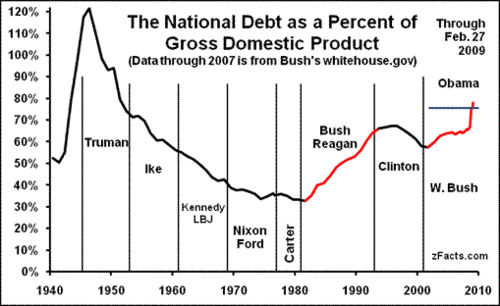
Yglesias pairs this chart with this quote by Irving Kristol:
Among the core social scientists around The Public Interest there were no economists…. This explains my own rather cavalier attitude toward the budget deficit and other monetary or fiscal problems. The task, as I saw it, was to create a new majority, which evidently would mean a conservative majority, which came to mean, in turn, a Republican majority – so political effectiveness was the priority, not the accounting deficiencies of government…
In this respect, neoconservatism has always maintained a Trotskyite bent. Sifting of empirical data – how it began – soon shifted under the Kristols' cynical maneuvering into Rovian politics. The core conservative impulse to balance budgets and only add debt in emergencies was inverted into neoconservatism's cynical fiscal vandalism. The real conservative in this was Clinton; and Olympia Snowe-style conservatism is now best represented by the Democrats. Yglesias adds:
The presence of a major ideological movement in the United States of America dedicated to the dual propositions that taxes must never go up, and that government expenditures don’t need to relate to government revenue in any real way as long as the Republican Party is in charge simply makes it almost impossible for the country to be governed in a responsible manner. If we had a different political system, it’s possible that such an ideological movement would marginalize itself, lose elections, and the other guys would run the show responsibly. Maybe. You could at least imagine it happening. But in our system even a defeated minority gets a ton of influence over policy and becoming completely dogmatic and irrational actually enhances that level of influence.
(Hat tip: Brad DeLong)
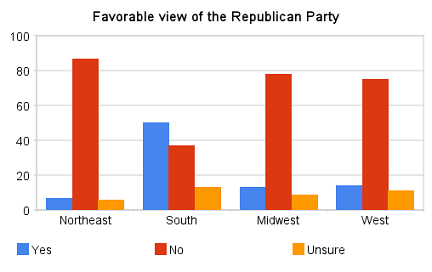
Steve Benen used the weekly research 2000 poll to make a graph. A reader recently made a very interesting reference. He said he believed that the GOP was morphing into the American equivalent of the Parti Quebecois. It is essentially a regional party now – representing the South in the national discourse. And its rhetoric seems divorced from any desire to actually hold responsible public office. So Republicans, like the Quebecers, tend to use politics as a means for disruption or protest or threat or veto.
It's also worth remembering that the huge amount of noise on the far right is actually quite narrowly based. Here's a fact from the Time profile of Beck:
In 1987 comedian David Brenner bombed in syndication with about 2.5 million viewers at midnight — which is roughly what Fox, the leading network for political talk shows, averages in prime time.
There is certainly a very angry far right base out there. But it would be foolish to over-estimate it.
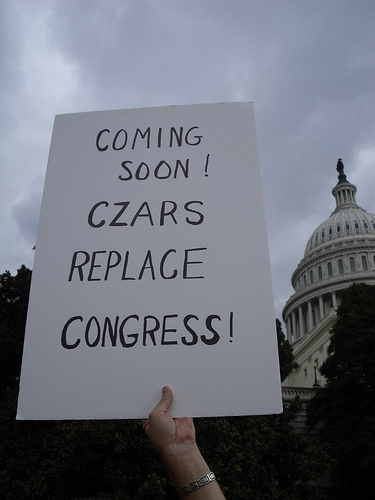
David B. Rivkin Jr. and Lee A. Casey, who served in the Justice Department under Reagan and H.W. Bush, correct Senator Kay Bailey Hutchison and other Republicans for claiming that Obama's "czars" are an unchecked, unconstitutional abuse of executive power:
In many respects, [czars] are equivalent to the personal staff of a member of Congress. To subject the qualifications of such assistants to congressional scrutiny — the regular confirmation process — would trench upon the president's inherent right, as the head of an independent and equal branch of the federal government, to seek advice and counsel where he sees fit. […] However much the czars may drive the policymaking process at the White House, they cannot — despite their grandiose (and frankly ridiculous) appellation — determine what that policy will be. The Constitution's "appointments clause" requires that very senior federal officials be appointed with the Senate's consent, though lesser appointments can be made by the president, agency heads or the courts, as Congress provides.
As Hutchison decries Obama's creation of "an unprecedented 32 czar posts," a recent report found that the last president created 36. And by the way, here's a cursory look at Hutchison's record on executive power during the Bush era, according to OnTheIssues.org:
Voted NO on requiring FISA court warrant to monitor US-to-foreign calls. (Feb 2008)
Voted YES on removing need for FISA warrant for wiretapping abroad. (Aug 2007)
Voted NO on preserving habeas corpus for Guantanamo detainees. (Sep 2006)
Voted NO on requiring CIA reports on detainees & interrogation methods. (Sep 2006)
Voted YES on reauthorizing the PATRIOT Act. (Mar 2006)
Voted YES on extending the PATRIOT Act's wiretap provision. (Dec 2005)
(Photo by Flickr user MeetTheCrazies. More 9/12 images here.)
 The Dish
