"If I'm ever eighty-two years old and acting like that have someone put me away," – George W. Bush on Jimmy Carter, according to Matt Latimer.
Month: September 2009
What Prodded Holder
Ambers notes an important piece of data in the Holder response to former CIA officials on his inquiry into some of the more grotesque torture sessions/murders authorized by Bush and Cheney:
The Justice Department's response to these claims contains a buried piece of information: "Given the recommendation from the Office of Professional Responsibility as well as other available information, he believed the appropriate course of action was to ask John Durham to conduct a preliminary review…"
For the uninitiated, this means that the preliminary report sent to Holder by the Office of Professional Responsibility on the torture-related lawyering of the Bush-era DOJ political appointees — a report prepared by career prosecutors – recommended that the cases deemed closed during the Bush administration be re-examined.
Holder is following the advice of his in-house 'internal affairs' shop… and didn't simply make the decision after reviewing the files himself.
Which makes me wonder what exactly is in the still-unreleased OPR report on the lawyers who ignored vast sections of existing law in order to give their political masters the legal cover to illegally torture. Why have Holder and Obama held this back? Are they biding their time as the evidence mounts of the horrors that Yoo and Bybee and Bradbury unleashed? We'll see.
Green Friday In Retrospect
Last Friday’s astonishing display of resistance to the regime in Tehran can be difficult to absorb. But it seems to me that this reader is right:
Looking back, we should put this crowd in context. Imagine living in Iran and either seeing with your own eyes that people are brutally beaten, taken away by riot police or plain clothes Basij forces and some are shot and killed. Then people hear of others who died in custody. Some were injured and have horrific stories of rape and torture while in detention. Many are still in jail. Then the show trials appear on TV. Above it all you have the supreme leader leading the Friday prayers a week before and once more threatening the protesters and saying Quds day (Jerusalem day) is only to protest against the existence of Israel and no one should mark this occasion in any other fashion.
And then on Wednesday, you have the Revolutionary Guard issue a bizarre statement threatening people. (In the past, a statement like this would have come from the intelligence ministry. The warning: “chanting unrelated slogans and carrying symbols with misleading colors [green]” will have serious consequences.
Despite all of that this many people took to the streets in green and chanted NOT GAZA, NOT LEBANON, MY LIFE IS DEVOTED TO IRAN. DICTATOR, THIS IS THE LAST WARNING! THE NATION IS READY TO RISE UP AGAINST YOU and WHERE IS YOUR 63%? …..
The political impact of this brave move is abundantly clear: The propaganda behind the coup d’etat has not worked. The Iranian people have figured out that together they have the power; and there is only so much that Khamenei and Ahamdi Nejad can do. As of Friday, Iran’s green movement is much more confident than it was the day before and is learning how to organize and use every opportunity to remind the leaders of how they feel about them and the world of what happened on June 12th.
Fear is the key to control. And Iranians are not afraid any more.
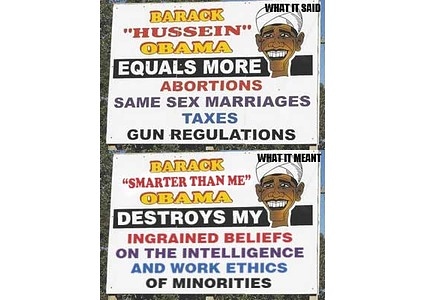
“What It Said” / “What It Meant”

Fox’s Journalism
Not exactly neutral on the tea-party event:
While Fox was covering the protest, a Fox producer, at one point, rallied the crowd to cheer while Griff Jenkins was on camera. Media Matters caught this clip a few days back, but now Fox confirms that it was, indeed, a staffer.
A “More Complicated” Racism
John McWhorter sounds off on the recent racial foofaraw:
And yet, even if Dowd and I are correct that Wilson's outburst was motivated by dislike for blacks, I'm not entirely sure that I, or anyone else, should care. Consider a hypothetical: Wilson, we can presume, would have been pleased as punch if the new black president were a Republican and were up at the podium singing the praises of small government and sending immigrants back to where they came from. This thought experiment does not exonerate Wilson of the charge of racism; what it does mean is that we are talking about a racism more complicated than the bigotries of old, a racism intertwined with other brands of animus (against liberals, against Democrats, against elites) to an extent we can only speculate about.
Dismissing the proposal to admonish Wilson formally for his outburst, Barney Frank quipped, "I don't have time to monitor everyone's civility." Frank is right. It is certainly not pretty that some people's take on Obama is likely mediated by racism. But the phenomenon is less a matter of open bigotry than a breach of civility. Who ever thought that all people would be civil at all times? And who ever thought, given the inherent imperfectability of humankind, that racism is somehow different from our other flaws and could be subject to complete elimination?
My own reflections on the hubris of attempting to eradicate bigotry from human life are here. My take on the racism debate is here. The Dish was unshocked and not terribly offended by Wilson's heckle. What offends me is the cynical, poisonous race-baiting of Limbaugh and Malkin.
How New Media Can Help Old Media
Or: an update on the power of Dish readers.
Karroubi To Court
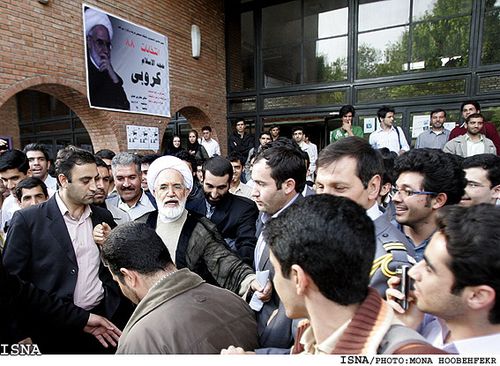
Tehran Bureau gives weight to the rumors:
In a meeting with a group of physicians and dentists on university faculties, Mehdi Karroubi announced that the judiciary was preparing a case against him. Karroubi said when he was served with the court summons, which required a signature, “I wrote underneath the order that this would be a good opportunity for me to speak in court about the crimes that even the Shah did not commit, and then I signed it.” […] Karroubi also said that, “I will do whatever I believe must be done [in pursuit of people's rights], and stand by [it] and bear the consequences."
Gulliver In Afghanistan, Ctd
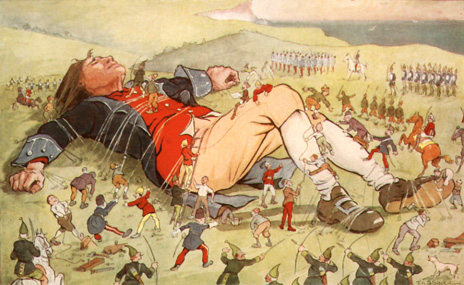 The blogosphere is absorbing the leaked McChrystal report. My take is here. Some early responses. Judah Grunstein:
The incremental
application of politically palatable troop increases — always sufficient to avoid collapse but never enough to make progress — has been identified as an inherent flaw of democracies when it comes to waging small wars. But if the Afghanistan War debate is to be carried out in an adult manner, we should be given an idea of what it will take to maximize the chances of success. That way we could actually decide whether such an investment is, in fact, worth the known costs and risks involved. The choice would then be between incrementally guaranteed failure and decisively embraced uncertainty. Instead, we seem destined to forever prepare the way for further escalation or, alternatively, accusations of giving up prematurely, by postponing the moment when we can say, "We did everything we could and the patient could — or could not — be saved."
Without knowing the provenance of the leak, it is impossible to state with confidence what the motives were. For my part, I would guess that this leak is an indication that some on the Obama team are dismayed at the White House’s slow response and fear that this is an indication that President Obama is leaning towards rejecting the inevitable requests for additional U.S. forces that this report tees up. By this logic, the leak is designed to force his hand and perhaps even to tie his hands.
[I]nstability marks not just the Afghan security and political scene, but international support as well. Many national governments and their publics, including major players like the US, Germany and the UK, are questioning the national interest of continued expenditure and loss of life in the country, particularly as opposition pressure mounts. While military and financial commitments are likely to hold for several years, it is clearer than ever than national interests and security, rather than international commitments to democracy or human rights, lead the calculus.
The question now becomes whether a serious debate emerges in the administration, within Congress, and with the broader population about what to do next, or whether the administration will simply decide to double-down on the more troops option. I am guessing that ultimately the administration will opt to send in more troops rather than risk the political attacks that would come if it decided to “abandon Afghanistan.”
I think that's the key thing to look for when McChrystal gets more specific: what, exactly, does he propose to do with the additional troops? If the idea is to spread them out in some way (for troop training, insurgent fighting, population protection, etc.), his request should probably be viewed skeptically. But if he can propose some key operation or area where additional troops would represent a doubling or tripling of capacity and success might have an outsize effect on the entire conflict, then it might be worth trying. We'll see.
[T]he president dawdles—waiting for what? Is it health care or some other agenda item that concerns him? We don’t know, but what is evident by the McChrystal recommendation (and by the apparent need to leak its contents, stemming no doubt from frustration with the White House stall) is that there is good reason to be concerned that the president’s failure to make a prompt decision may in and of itself impair our ability to succeed. The president may not like what he’s hearing (”Toward the end of his report, McChrystal revisits his central theme: ‘Failure to provide adequate resources also risks a longer conflict, greater casualties, higher overall costs, and ultimately, a critical loss of political support. Any of these risks, in turn, are likely to result in mission failure’”), but he owes the country a timely decision—or at least an honest explanation as to why he finds it so hard to make up his mind.
Already, Republicans are warning that Obama had better follow the military's advice, or else. In fact, the president can afford to cross swords with the GOP troglodytes, but what he can't afford is to alienate his own Democratic party base, which has overwhelming rejected the war. (Polls show Democrats are strongly opposed to the war in Afghanistan.)
One hope that Washington repeatedly expresses is that an Afghan national army can be trained and the country turned over to it in only a few years. Ann Jones at Tomdispatch.com suggests, based on her own experience in Kabul, that the Afghan army may not actually exist, and may, in fact be a scam whereby an Afghan joins, takes the basic training pay, and then disappears. Some may even go through it two and three times. She points out that when 4,000 Marines went into Helmand Province this spring, they were accompanied by only 600 Afghan troops, and she wonders where the others are. She has a dark suspicion that no such army tens of thousands strong even exists. The US may even have trained persons who then defected to the Taliban.
I really can’t be bothered to spill a lot of words on the latest development in US strategy towards Afghanistan. Why bother to go through 400+ pages of a supposed mystery when you’ve seen the “surprise” ending in the final paragraphs?…[S]ometime in the next month or two, the “compromise” will be announced of 25,000 more US troops to Afghanistan.
McChrystal can’t be faulted for presuming that Obama’s commitment in March to a counterinsurgency campaign for a counterterrorism goal meant he should interpret counterinsurgency as broadly as he could or pursue it as aggressively as he could. Nor can the administration be faulted for worrying that such commitments push the means into overtaking the ends they’re supposed to yield. And the public can’t be faulted for turning away from a war that exhibits such strategic drift. But the leak of the strategy review means it’s now harder for everyone to make rational decisions without worrying whether their bureaucratic adversaries are going to undermine them in the media.
Health care reform won't make or break Obama's presidency. The way he conducts the war in Afghanistan will.
Gulliver In Afghanistan
 General McChrystal is to be congratulated, it seems to me, for the candor and seriousness of his report to the president on what has gone so wrong in Afghanistan and what can be done to set it right. McChrystal's role is to find a way to win: he's a soldier fighting a war. And yet this hardest of hard-nosed military men essentially concedes that this is a political problem at its heart. You cannot fight a counter-insurgency on behalf of a government that is as corrupt as Karzai's. And you cannot fight a counter-insurgency without vast numbers of troops to protect a population in an extremely remote and ungovernable region. And you cannot fight either without tackling the real source of the terror – in Pakistan.
So we are left with this dire set of alternatives. We either pack up and go home. Or we double-down for a couple of decades to try to stabilize Afghanistan and Pakistan, knowing that, even then, we cannot prevent any single Jihadist plot or attack coming from that region. The latest terror case reveals the threat:
What has troubled federal prosecutors and the F.B.I. is the belief that Mr. Zazi embodies what concerns them most: a Westernized militant, trained by Al Qaeda in Pakistan, whose experience and legal resident status in the United States give him the freedom to operate freely, yet attract little attention.
How would doubling down in Afghanistan affect this kind of activity?
From the Woodward leak:
While the insurgency is predominantly Afghan, McChrystal writes that it "is clearly supported from Pakistan. Senior leaders of the major Afghan insurgent groups are based in Pakistan, are linked with al Qaeda and other violent extremist groups, and are reportedly aided by some elements of Pakistan's ISI," which is its intelligence service. Al-Qaeda and other extremist movements "based in Pakistan channel foreign fighters, suicide bombers, and technical assistance into Afghanistan, and offer ideological motivation, training, and financial support."
Al Qaeda operates with impunity in Pakistan:
McChrystal identifies three main insurgent groups "in order of their threat to the mission" and provides significant details about their command structures and objectives. The first is the Quetta Shura Taliban (QST) headed by Mullah Omar, who fled Afghanistan after the attacks of Sept. 11, 2001, and operates from the Pakistani city of Quetta. "At the operational level, the Quetta Shura conducts a formal campaign review each winter, after which Mullah Omar announces his guidance and intent for the coming year," according to the assessment.
How do you win a war when it is being led and conducted in a country you are not at war with?
It seems to me we are at another turning point in the road, and one of the few moments when American enmeshment in Afghanistan might be turned back. We have to weigh the chances of serious terror groups re-grouping and operating even more freely throughout Afghanistan and Pakistan against the risks of more money, more troops, more casualties and more blowback. And let's not fool ourselves: neither of these is a good option. That's the Bush legacy.
But if McChrystal is right, he is strategizing Afghanistan as a semi-permanent protectorate for the US. This is empire in the 21st century sense: occupying failed states indefinitely to prevent even more chaos spinning out of them. And it has the embedded logic of all empires: if it doesn't keep expanding, it will collapse. The logic of McChrystal is that the US should be occupying Pakistan as well. And Somalia. And anywhere al Qaeda make seek refuge.
In the end, Gulliver cannot move. And his pockets are empty. Whom does that deter?
 The Dish