Major hathos material here. My favorite (Oprah) after the jump:
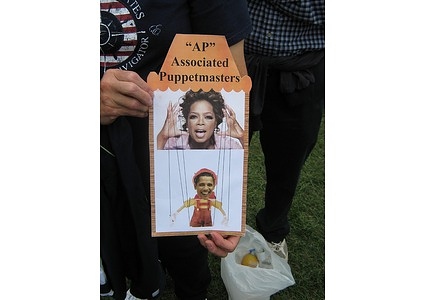
Major hathos material here. My favorite (Oprah) after the jump:
Thoreau notes:
In a report on Indonesia, the Economist makes the interesting point that urban Muslims in Indonesia are actually more likely to be drawn to more austere, fundamentalist versions of Islam than their rural counterparts. The rural Muslims prefer religious practices that blend Islam with elements of Hinduism and indigenous faiths that were practiced there prior to Islam. No generalizable point here, just an interesting observation on how complex matters of religion and culture can be.
In England, in the early modern period, Catholicism flourished in the countryside while Protestantism took hold in cities. The rural Catholicism was a wondrous blend of folklore, ritual, holidays, processions, votives, icons … the full Shiite. It was wiped out by the end of the Elizabethan era. Religious life is religious life; it has its variations within most faiths, and sometimes the psychology and structure of faith is remarkably similar across the globe, while the doctrines are utterly different.
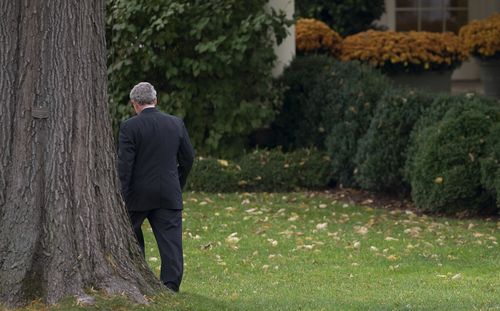
It's somewhat mysterious given his graceful silence since leaving the White House. But it's not at all clear he saw himself as the tip of the spear in the conservative movement. Here's a fascinating anecdote from a forthcoming book, by a former speech-writer (they all write memoirs apparently), reported by Byron York:
Latimer got the assignment to write Bush's [2008 CPAC] speech. Draft in hand, he
and a few other writers met with the president in the Oval Office. Bush was decidedly unenthusiastic.
"What is this movement you keep talking about in the speech?" the president asked Latimer.
Latimer explained that he meant the conservative movement — the movement that gave rise to groups like CPAC. Bush seemed perplexed. Latimer elaborated a bit more. Then Bush leaned forward, with a point to make.
"Let me tell you something," the president said. "I whupped Gary Bauer's ass in 2000. So take out all this movement stuff. There is no movement."
Bush seemed to equate the conservative movement — the astonishing growth of conservative political strength that took place in the decades after Barry Goldwater's disastrous defeat in 1964 — with the fortunes of Bauer, the evangelical Christian activist and former head of the Family Research Council whose 2000 presidential campaign went nowhere.
Now it was Latimer who looked perplexed. Bush tried to explain.
"Look, I know this probably sounds arrogant to say," the president said, "but I redefined the Republican Party."
He didn't. He just broke it.
(Photo: Paul J Richards/Getty.)
Ackerman sees more of the same from the Obama administration:
[In] 2008, the Supreme Court ruled in the landmark Boumediene case that [Guantanamo] detainees were entitled to habeas corpus protections…[David Remes, the legal director of the non-profit Appeal for Justice law firm who represents 19 Guantanamo detainees] foresees a protracted fight [over Bagram detainees]. “We’ll spend another four years going up to the Supreme Court on the question of Bagram [detainees'] habeas rights,” he said. “It’s another stall. And one I would have expected from the Bush administration but not the Obama administration.”
Megan challenges my math:
[It] is not only not true that "no one" believes that [health care reform] will cost more than Medicare Part D, it's not really very reasonable for anyone to disbelieve it. We are, after all, preparing to provide health care for millions of more people, who will not only be consuming prescription drugs, but also heart catheterization and asthma treatment and the leg amputations that doctors apparently prefer to providing routine diabetes care. Prescription drug costs are on the order of 10% of overall spending, even for Medicare.
The Medicare prescription drug entitlement almost immediately was projected to cost $1.2 trillion over ten years – more than Obama's cost-projections. The CBO's estimate of long-term spending in the program is $8.2 trillion. Unlike Obama's healthcare plan, which focuses on the younger uninsured working and middle class, Bush's massive bribe was directed at seniors, a demographic set to grow very fast in the near future.
Now Megan is right that we do not know the final cost of the current proposal or what the future will bring. But when the CBO scores the final version, let's contrast and compare, shall we? And one more thing: the more immediately expensive one was rammed through by Republicans, the allegedly small government party. I still, for some reason, expect a little more fiscal responsibility from the right than the left. But we now know, of course, the both are dreadful but the GOP is worse.
In last weekend’s NYT magazine, Cathleen Schine reviewed Alexandra Horowitz’s Inside of a Dog: What Dogs See, Smell, and Know, a book about the world from a dog’s point of view. A taste:
Dogs, as anyone who has ever met one knows, sniff a lot. They are, says Horowitz, “creatures of the nose.” To help us grasp the magnitude of the difference between the human and the
canine olfactory umwelts, she details not only the physical makeup of a dog nose (a beagle nose has 300 million receptor sites, for example, compared with a human being’s six million), but also the mechanics of the canine snout. People have to exhale before we can inhale new air. Dogs do not. They breath in, then their nostrils quiver and pull the air deeper into the nose as well as out through side slits. Specialized photography reveals that the breeze generated by dog exhalation helps to pull more new scent in. In this way, dogs not only hold more scent in at once than we can, but also continuously refresh what they smell, without interruption, the way humans can keep “shifting their gaze to get another look.”
This is unsurprising. Megan and Kevin Drum debate whether "this sort of thing works, or whether it comes across as so ludicrous that people start wondering about the Democrats' sanity." It's the Dems at their own scare-mongering worst (it's partly how Clinton won re-election). I hope it fails. But fear it won't.
James Surowieki on yesterday's speech:
The key line in Barack Obama's speech…on the need for new financial regulation was the straightforward statement: "Normalcy cannot lead to complacency." This is a real danger: as I argued back in April, while it would have been disastrous had the government's bailout efforts failed, their success was inevitably going to create the risk that "reformist pressure may well dissipate," as people became less anxious about the survival of the financial system.
This, roughly speaking, has been the pattern of financial crises in the U.S. over the past thirty years: big banks get into trouble and people start talking about the need for meaningful reform, then the banks work their way out of trouble (with the help of the Federal Reserve and bank regulators, and sometimes, as in the case of TARP, with the help of state funding), and the reforms never materialize. Obama's speech, coming as it did a year after the failure of Lehman, was an argument for why that should not happen again. The substance of the speech was not new — the reforms Obama advocated were essentially the same as those Treasury Secretary Tim Geithner unveiled in late March. What was important about it was Obama's rhetorical commitment not merely to tinkering around the edges of the financial industry, but rather to "the most ambitious overhaul of the financial system since the Great Depression."
A reader writes:
I'm not surprised that few of your readers respect Carl Jung's model for why we believe what we believe, but it is interesting that you posted a view that says reality is actually simpler than that. As someone who spent my career in neuroscience, I suspect Jung is too simple, not too complicated.
All of our beliefs have many associations, to ego, to shadow, to practical benefits, to lessen our cognitive dissonance, more aspects than I've ever seen in a list. One would have to analyze each belief someone has against each of those dimensions to fully answer why we believe something. It isn't even all about us. That belief might be an undeniable truth! So a complete model is very complicated.
Yet it is natural for human beings to oversimplify, just as we naturally overgeneralize or reduce a spectrum of phenomena to just two extremes, like good or evil, hot or cold, precious or discardable. It is natural to pretend, "I want my country back," is a handle that explains everything. No, it's a handle that lets one start exploring the phenomenon. It doesn't explain why or how Obama is vilified. Your reader didn't go that far. He or she was satisfied that it was simple enough to stop. No, it isn't.
If I could change one thing about political commentary, it would be to have people feel compelled to explore a subject until they have at least two hypotheses for the truth. One answer is never enough, especially a simple answer.
Now, the educated are most likely to understand the truth of that. Yet everyone's a sucker for something. I'm stuck being a sucker for beautiful women and comfort food. Fortunately I can keep my distance from the former and ration the latter. I pity those who can't do something like that with politics, but I'm angry with them, too.
They're voting with their shadow, and that causes so much grief. Why I feel that, what it is to which I'm reacting, and what to do about that is quite complicated. Anyone who says it's simple hasn't thought it through or doesn't know much to begin with. You see, that's at least two reasons. I bet there are more. Unfortunately they don't take bets like that in Las Vegas. If they did an educattion would be even more valuable.
Karroubi stands up to the coup one more time.
 The Dish