The Silver Lining Of The Right’s Apoplexy

Maybe I'm being too optimistic, but one effect Obama has had on the right is to galvanize its small government, balanced budget wing and cool off the Christianist boilerplate. I haven't noticed the tea-partiers going on and on about gays getting married for example, or cracking down on drugs. Yes, abortion remains an issue for some – but it is hardly front and center. And yes, there are the Dobbsian slights at illegal immigrants. But again, this is a minor theme. All of this, to my mind, could be healthy in the long run. Heaven knows what else would have pushed the GOP off its theocratic rails, but Obama's cultural conciliation has worked in a way. Economics is again the focus. And a small-government party that is not just an expression of cultural panic could conceivably wrestle its way out of the Bush legacy in time.

Of course, the right is a large coalition; and I'm not saying that the tea-partiers wouldn't accept any number of anti-gay moves if they won back power with the religious right. Many are anti-gay, but many who aren't accept the demonization of gays as the price to pay for political power in such a coalition. Nonetheless, to see the parties re-orient around the critical questions of the size and role of government is encouraging. More encouraging than distant wars in countries we occupy indefinitely and constitutional amendments to curtail civil equality.

Not Racism; Projection

A reader offers this psychological interpretation of the more ad hominem tea-party protestors:

A common meme on the left is that racism is driving the hatred of Obama. I think the root is deeper and scarier: it is shadow projection.

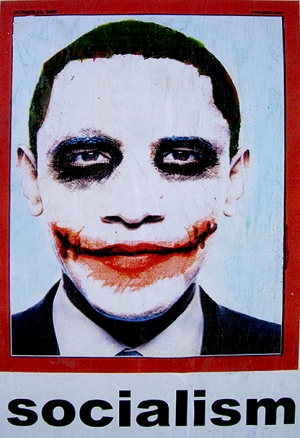
Our ego wants to believe we are wonderful, and so cannot tolerate evidence to the Obama-joker contrary. Consider America. As good as we are, we have a dark side and our actions often have dark consequences. We are large and cast a large shadow. If we were a more mature people we would simply own our dark side, integrate it into part of our self knowledge, and act accordingly. However American mythology says that we are the good country, and to maintain that the pure version of that belief, we are willfully ignorant of our faults. In the minds of many “patriotic” Americans, we have no dark side. Unwilling to own our dark side, we project our shadow onto others.

The Cold War gave us a long period as “the good country” as the Soviet Union gave us a steady (and objectively evil) force onto which we could project our shadow. After the fall of communism we finally found Saddam Hussein to play that role, which clouded our perceptions of the real Saddam (and again, he was objectively evil). Since the Iraq war we’ve looked for a new target onto which to project our shadow. Perennial candidates China, North Korea, and Iran don’t quite suit our needs, and “the terrorists” finally wore thin. I have wondered who our next victim would be. Now we know.

It is Obama.

The right is projecting its shadow onto Obama. The same qualities that make him a saint to the left make him the devil to the right – he is easy to project onto.

That is why he is the out of control spender when they sat on their hands through all of Bush's malfeasance. That is why his talking to schoolchildren is dangerous when our government wiretapping its citizens wasn’t. That is why saving the financial system from years of Republican regulation is taking away our future. The more evil revealed about the right’s excesses on torture, or wars of choice, or nearly destroying the economy, the more evil Obama will look in their eyes, as they cannot tolerate owning responsibility, because in their own minds they are only good.

That is why he is the Fascist/Communist/Socialist/Muslim… that is the list of our shadow projections over the last 60 years. In their minds he is now the USSR ("my grandchildren will have to stand in line for toilet paper!") or even the Anti-Christ. The Obama they see is a projection of their own psyche, not that actual man in the White House. Missing birth certificates, death panels, indoctrinating children, these are all the projections running in their own heads, not things happening in the real world.

Racism makes Obama the Other, but shadow projection is an even more powerful (if interrelated) force than simple racism, and it is very susceptible to the mob mentality – think Goldberg in Orwell’s 1984. This will not end well. Now that Obama is carrying their shadow, only a dramatic event from outside could change it. (Or, they could gain awareness of their disowned dark side, and tolerating the inevitable pain of that experience, integrate into a healthy whole. This would require white, middle-class, middle-aged Americans – the primary protesters – to acknowledge that white middle class Americans are not all goodness and light and start taking responsibility for white privilege, their environmental choices, effects of class on economic status, etc. Don’t hold your breath.) The more those on the right deny their own failings, the more their internal unease will increase, the more the hatred to Obama will grow, and the more the need to do something will increase.

No wonder the far right is going bat shit crazy. In the movie playing in their minds, the enemy is within the gates.

I should say I'm not endorsing this view by publishing it; I think the opposition to healthcare reform is perfectly legitimate and may well be an entirely logical position for many enraged at Obama. But the rage itself, the spluttering ire directed at this young president who inherited one of the worst legacies in modern times? I can't explain it myself. But I'm happy to air theories.

Amateur Hour

Adam Serwer, responding to Ali Soufan's article from last weekend, is on point:

We're not seeing too many "professionals" argue the case for torture–instead we see those who believe fighting terrorists is about some kind of contest of will between Islam and the West romanticizing criminal behavior as "necessary" because, for some reason, they think protecting American society requires that take our cues from those we're fighting.

The only reason we know anything substantive about the torture-and-abuse era is because of people on the inside – the professionals at the CIA and Pentagon and FBI who were as horrified by Cheney's amateur and counter-productive thuggishness as many of us were. But the Soufan piece deserves being re-read. It calmly rebuts all the hysterical and unproven claims that torture somehow "worked" in a way that traditional, ethical American interrogation could not have achieved.

In Liberated Iraq

The-bodies-of-gays-on-the-001

Shiite militias are conducting pogroms of gays:

Sitting on the floor, wearing traditional Islamic clothes and holding an old notebook, Abu Hamizi, 22, spends at least six hours a day searching internet chatrooms linked to gay websites. He is not looking for new friends, but for victims.

"It is the easiest way to find those people who are destroying Islam and who want to dirty the reputation we took centuries to build up," he said. When he finds them, Hamizi arranges for them to be attacked and sometimes killed.

Hamizi, a computer science graduate, is at the cutting edge of a new wave of violence against gay men in Iraq. Made up of hardline extremists, Hamizi's group and others like it are believed to be responsible for the deaths of more than 130 gay Iraqi men since the beginning of the year alone.

The deputy leader of the group, which is based in Baghdad, explained its campaign using a stream of homophobic invective. "Animals deserve more pity than the dirty people who practise such sexual depraved acts," he told the Observer. "We make sure they know why they are being held and give them the chance to ask God's forgiveness before they are killed."

This is the freedom young Americans died for? And American tax-payers were bankrupted for?

(Photo: The bodies of gays on the streets of Iraq. By Bilal Hussein/AP.)

Slow And Steady Wins The Lane

Kottke points to a statistical analysis of why the express lane at the supermarket is often the longer option:

You attract more people holding fewer total items, but as the data shows above, when you add one person to the line, you're adding 48 extra seconds to the line length (that's "tender time" added to "other time") without even considering the items in her cart. Meanwhile, an extra item only costs you an extra 2.8 seconds. Therefore, you'd rather add 17 more items to the line than one extra person!

Dissent Of The Day

A reader writes:

You wrote:

"But those who voted for [Bush] are absolutely enraged at the possibility of any change."

This is an absolute strawman, a tactic straight out of the Obama playbook. I am for all kinds of change. Health care deregulation would be nice. Ending agriculture subsidies and corporate welfare would be nice. Tax reform would be outstanding.

But with Obama we don't get change, we get more of the same. More government, just like Bush. A failed Keynesian stimulus driving us ever deeper into debt (and straight out the Bush playbook, with his ridiculous tax rebate of last year). More government in health care (Bush, Medicare expansion). More government in energy policy (energy bill passed under Bush's watch). I'm all for change, just not for big government.

Well, count me in, then. Unlike many of these tea-partiers and their supporters, I actually took on the Bush administration's big government tendencies, fiscal recklessness and massive expansion of executive power at the time (and was largely cast out of the conservative coalition as a result). I opposed the Medicare prescription drug benefit as unaffordable – and no one can argue that what looks like the current healthcare reform would cripple future finances as profoundly as that Bush entitlement. But it was rammed through the Congress by some of the very people who are complaining loudest about the debt today. And unlike Obama, who has pledged either to find the money by internal reform or to take spending cuts if that fails, Bush never offered any way to pay for it – except to rack up even more Chinese IOUs.

Sure, Obama isn't ideal. I'd like a carbon tax rather than cap and trade, drastic 1986-style tax reform, and an end to the government subsidizing employer-based insurance plans. I'd also like marriage equality in every state and a flat tax and an immediate end to the military's gay ban. But unlike so many of these tea-partiers, I also realize that in real politics, you have to construct a solid coalition for all this and make arguments for it consistently (as Reagan did for decades) and have some credibility. But the GOP has been doing he opposite, fighting wars – cultural and military – instead of attending to basic fiscal responsibility and limited government. You cannot just pivot on a dime without some accounting of the recent past. Well, you can, but you look so partisan and so two-faced you'll only persuade people by ratcheting up fear and hysteria to drown out the actual issues.

But there's something else here and it has to do with a view of constitutional politics. I don't believe in politics as warfare.

While I adhere to most of the principles of the small government right, I am aware of the important balancing act of a liberal coalition in keeping this country on an even keel. I come from the Oakeshottian school that supports what he called "civil association" but also understands the necessity for the other strain in Anglo-American thought, "enterprise association." I do not want either party to have total power; and I do not believe every political argument has to be zero-sum. I loathe the cynicism that prefers trashing a new president over solving a serious social problem for people in real need.

And look: while I would like all the things my reader does in an ideal world, none of them was seriously on the table in last year's election. And the candidate who was closest to them was soundly beaten. It's perfectly proper – even admirable – to demonstrate and argue against the new administration's ideas, but it's also worth recalling that this plan in its essentials was an integral part of the president's campaign platform and his party's effective manifesto. It was debated ad nauseam last year, and Obama won by a hefty margin. The tone of these protests suggests that this is some wild power-grab. It isn't. It's a centrist and not-too-ambitious plan to fulfill a clear campaign pledge as responsibly as possible within a sensible fiscal framework.

The protestors keep saying that they want their country back. Sorry, my fellow small-governmenters, but this country is a democracy, and you didn't lose your country, you just lost an election. You had your chance for eight years. You blew it, and you lost. What Obama is doing is what he was elected to do. The principled response is not a massive, extremist-riddled hissy fit a few months in, but a constructive set of proposals to build on universal care for a more market-friendly and cost-conscious system in the future. You have to win some political credibility for that; and then you have to beat the man you lost so badly to last year. That's the civil and civilized way forward for the right. It also seems, alas, to be the one they are currently refusing to take.
Google Saves Print?

Niraj Chokshi analyzes the micropayments scheme floated by the company:

The search giant is probably the only company that has the reach to introduce a new product on an all-Internet scale. According to various Web statistic-gatherers, Google owns 16 of the top 50 visited sites and accounts for almost ten percent of Internet traffic…Google hopes that readers sign up for the Google account because they trust the company and they know it will probably be the only such account they'll ever have (or want) to create to read the Internet for money.