The Next Bubble?

Peter Boone and Simon Johnson predict:

The bubbles this time will likely appear abroad. Parts of Asia and Latin America, a tiny fraction of the size of the U.S. economy, are experiencing large capital inflows, low interest rates, and the beginnings of a major boom. Countries with intact banking systems and access to global capital markets will lead the next speculative wave. The United States will be pulled in–probably soon enough that we will all be surprised by a supposedly robust recovery, fed by continued low interest rates and loose credit. We all know these episodes end in tears, but they can be spectacular while they last.

Why Do We Forget?

Jonah Lehrer checks out some new research:

The conventional assumption is that memory loss occurs because our memories vanish, because cells die and the hippocampus gets tired. But what if memory loss is actually triggered by the steady degradation of the frontal cortex, a brain area associated with memory retrieval? (The frontal cortex starts to lose cell density at about the same time we start to lose our memory – in our mid-thirties.) This suggests that our memories are still there, waiting to be found, like a misfiled piece of paper. The struggle of aging, then, isn't simply a matter of holding on to the past – the brain has a seemingly infinite hard drive. Instead, the challenge is remembering where all of our memories are.

I knew I'd find that somewhere.

The Black Heart Of Climate Change

David G. Victor and Richard K. Morse lay out the problems with and our attraction to the worst of carbon emitters, coal. A taste:

Emissions from coal are growing faster than from any other fossil fuel. Beyond greenhouse-gas pollution, coal is linked to a host of other environmental troubles such as local air pollution, which is why a powerful coalition of environmentalists in the richest and greenest countries is rallying to stop coal. Mired in opposition, barely any new coal plants are being built anywhere in the industrialized world. Coal, it may seem, is on the precipice.

Yet coal remains indispensable. No other fuel matches its promise of cheap and abundant energy for development. About half the electricity in the United States comes from burning coal. Germany, the anchor of old Europe’s economy, is a coal country. Poland, the heart of new Europe, gets 90 percent of its electricity from coal. The fast-growing economies of Asia, in particular China and India, are all coal-fired. Indeed, while the outlook for coal consumption in the industrialized world is flat, soaring Asian growth is expected nearly to double world consumption by 2030.

(Hat tip: 3QD)

How Things Change

Because, in time, the better arguments sway reasonable people. A reader writes:

Yesterday I attended the funeral of Dr. Richard Garibaldi, the Chairman of the Department of Medicine at the University of Connecticut.  The Catholic priest who was conducting the funeral mass heralded Dr. Garibaldi's moral courage and championing of society's underdogs.  As an example, the priest talked about an incident a couple of years ago, when the priest had reluctantly–but out of obedience to ecclesiastical authority–read from the altar a pastoral letter whose subject was the "objectively disordered" nature of homosexuality.

After the mass, Dr. Garibaldi–a mensch in the true sense of the word–approached the priest and expressed profound disappointment in the letter.  Dr. Garibaldi discussed how homosexuality is actually a normal and natural part of humanity, and he told his parish priest that the Church "shouldn't kick a group that doesn't deserve kicking."

Yesterday, while standing over Dr. Garibaldi's coffin and standing before Dr. Garibaldi's widow, family, and hundreds of their friends, this priest apologized for having read the letter.  The priest said that he had been moved by Dr. Garibaldi's appeal.  The priest apologized and said that he would never again read such a letter from the altar.
The Rise Of Political Hit Men?

Mark Bowden criticizes bloggers and is saddened that investigative journalism is being outsourced to political operatives. He traces how a blogger drove the Sotomayor coverage and posits:

I would describe their approach as post-journalistic. It sees democracy, by definition, as perpetual political battle. The blogger’s role is to help his side. Distortions and inaccuracies, lapses of judgment, the absence of context, all of these things matter only a little, because they are committed by both sides, and tend to come out a wash. Nobody is actually right about anything, no matter how certain they pretend to be. The truth is something that emerges from the cauldron of debate. No, not the truth: victory, because winning is way more important than being right. Power is the highest achievement. There is nothing new about this. But we never used to mistake it for journalism. Today it is rapidly replacing journalism, leading us toward a world where all information is spun, and where all “news” is unapologetically propaganda.

Friedersdorf agrees. The blog Bowden focuses on responds.

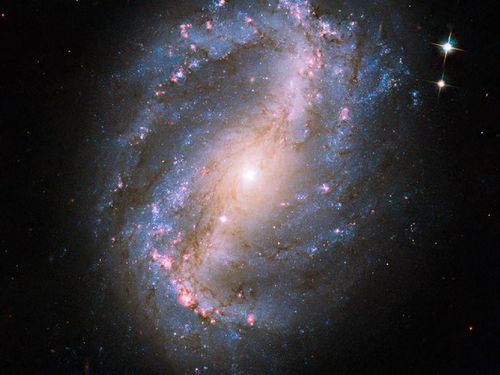
Why Are Pictures From Space So Beautiful?

Hubble

Photoshop:

In reality, each shot already represents a color—the wavelength of light captured by the filter when that picture was taken. But in some cases the images represent colors that we wouldn't be able to see…To create a composite image that has the full range of colors seen by the human eye, an astronomer picks one image and makes it red, picks another and makes it blue, and completes the set by coloring a third image green. When he overlays the three images, one on top of the other, they produce a full-color picture. (Televisions and computer monitors create color in the same way.)

(The galaxy above lies 6 million light-years away in the north circumpolar constellation Ursa Major. More images released this week by NASA here.)

Face Of The Day

TEAPARTY09BrendanSmialowski:Getty

A protester holds a version of the Betsy Ross American flag during the Tea Party Express rally on September 12, 2009 in Washington, DC. Thousands of protesters gathered in Washington to march to the Capitol Hill to protest high spending, higher taxes and the growth of the federal government. By Brendan Smialowski/Getty Images.