Kottke spotlights some incredible footage of how fire ants survive floods in the Amazon.
Month: September 2009
Sex After The Singularity

H Plus, the transhumanist magazine, ponders it. My favorite answer:
The primary purpose of the Singularity will be seen, after the fact, to be Awesome Sex. There will be exponentially more sex, with exponentially more interfaces, and with exponentially more measures of pleasure … We will be installing bioports into our body, a la The Matrix or Sleep Dealer, each of which can stimulate our nervous system. In heterosex, men penetrate women, but with this, men and women will interpenetrate each other, multiply, and, as with USB 2.0 daisy-chaining, so will men, women, and androids be able to multiply-interpenetrate, locally or remotely. determine how many selves would be involved. The entire field of posthuman sex could give new meaning to sex freedom and gender differentiality — where a person could have different scenarios, depending on what form or type he/she is in.
(Hat tip: Kerry Howley)
Unread Books
Speed-reading will only get you so far.
Osama’s Undoing
Tony Karon declares al-Qaeda a failure:
The flaw in bin Laden's strategy of trying to capture the imagination of the Muslim masses through spectacular acts of terror was obvious even in the immediate wake of 9/11. In much of the Arab and Muslim world, there was a pervasive refusal to believe that Muslims had been responsible for the attacks, even after bin Laden claimed responsibility. The denial inherent in the tendency common from Egypt to Indonesia to blame the Mossad or the CIA for 9/11 reveal a damning negation of al-Qaeda's tactics — so repulsive was the mass murder of innocents to ordinary Muslims that most refused to celebrate the attacks, as bin Laden had hoped they might, but instead sought to blame them on those deemed enemies of Islam.
The greatest irony was that some in the Muslim world believed "the Jews" did it! But what a karmic thought: that anti-Semitism undermined Osama bin Laden.
The Murder Of A Pro-Lifer, Ctd
We now know the motive; it was personal blended with political in the case of the pro-life victim (the murderer didn't like the man's graphic photos of abortions on posters) and a strange personal grudge for the other. It's hard to know what to make of it except to defend pro-life rights to free expression and to pray for the dead and their families.
Song For The Day
For Aaron, with love.
Paying For Heathcare: Then And Now
Freddie responds to this dissent by wondering where the outrage was when Bush passed the prescription drug benefit:
Look, I think we all know why the prescription drug bill wasn’t fought against where health care reform is: the elderly are a protected political class, and those without health care are not. But few people are willing to admit to such naked horse race concerns behind their policy preferences. So what can people who are explicitly opposed to health care because of concerns of fiscal responsibility say in defense of the prescription drug benefit?
If you are blogging or writing politically now, and you weren’t then, you get a pass. If you have some separate reason for resistance to reform other than the expenditure, that’s ok too. But if you are specifically arguing that you don’t like health reform because it’s too expensive or fiscally irresponsible, and there’s no record of you arguing similarly against the wildly expensive prescription drug bill, it’s hard not to see that as hypocritical and partisan. Fair?
Face Of The Day
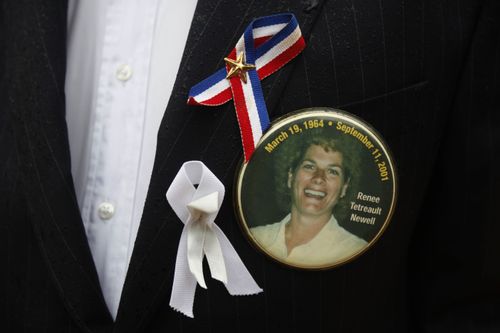
A man memorializes a loved one with pin on his jacket as he pays his respects at Ground Zero during a 9/11 memorial ceremony on September 11, 2009 in New York City. Family of the victims, government officials and others gathered at the annual ceremony to remember the attacks that killed more than 2,700 people with the destruction of the World Trade Center, the crash at the Pentagon and United 93 in Shanksville, Pennsylvania on September 11, 2001. By Seth Wenig-Pool/Getty.
The Power Of Graphs
Ezra Klein doesn't think that presidential speeches are as effective as flow charts. When will we see the first presidential PowerPoint presentation?
Debating The Cap
A reader writes:
It may make sense to reform our approach to medical malpractice liability. However, capping non-economic damages does little to prevent frivolous suits, as such suits generally have no hope of achieving a $250,000 verdict anyway, and a plaintiffs' lawyer has no such expectation. Arbitrary damage caps mainly serve to insulate doctors and insurance companies in cases of truly egregious conduct.
There are many potential solutions to increasing fairness and reducing the costs that litigation imposes on our healthcare delivery system (such as gatekeeper panels and more stringent ethical sanctions against lawyers who bring frivolous suits). But particularly given the admittedly small impact that the legal system imposes on the healthcare system, it doesn’t make sense to prevent plaintiffs injured by doctors from recovering under a different regime than those injured in other circumstances.
Surely we can design a more elegant approach to tort reform than one that prevents deserving plaintiffs from recovering based on awards that have been duly assessed by a jury that has heard the facts of a case.
Another reader:
I saw your post "The Right and Tort Reform". As a former litigator (I practice transactional law these days) I have seen the abuses of the current tort reform system (from both sides) first-hand. I do support tort reform but I do not recall seeing a case made on your site for what I believe is the best tort reform proposal. Instead of capping jury awards (another way of really saying let's ensure that the insurance companies are able to achieve the greatest profits possible), why not look at a "Loser Pays" system. For those unfamiliar with such a system, under "Loser Pays", the party that loses the lawsuit covers the attorneys fees and costs of the winning party. For those concerned about the costs of the current system, "Loser Pays" forces those who have bogus or questionable claims to really think hard before they file the suit as they put themselves at risk of paying the insurance company legal fees for defending the suit if they lose. In outrageous cases of medical malpractice (amputating the wrong leg for example) and where a high award is likely, it forces the insurance company and Defendants to come to the table and serious negotiate a settlement knowing they likely will lose at trial and have the added burden of paying Plaintiff's legal fees and costs. No one on either side (to my knowledge) is seriously considering this option. Like all options, it has its pros and cons, but is more rational than any I ever heard suggested.
Another lawyer:
I am a personal injury lawyer in Texas, and I currently represent individuals injured as a result of medical negligence. What I always find laughable is the Republican mantra of the need to do away with frivolous medical malpractice lawsuits. Where is this alleged glut of frivolous cases? They don’t exist because no rational lawyer would ever file them. Think about it: personal injury lawyers work on a contingency fee agreement (I don’t get paid if I don’t win); why would I spend hundreds of hours of my time and tens of thousands of my own money in expert fees and expenses filing and litigating a case that I knew from the get go was so baseless to be deemed frivolous? This simply does not make sense. I am running a business, and as such, I need to determine if my investment will reap dividends before I commit the time and money it takes to properly litigate a medical malpractice case. It is more likely that cases with merit are not filed because, although they do have merit, the risks are too high. As such, there is a direct- and very rational- incentive not to file frivolous medical malpractice suits. This is quite different from corporate and intellectual property litigators who have very rational incentives to file frivolous lawsuits- hourly billing and competitive business reasons (i.e. tying up patents for years in the court system). Why aren’t the Republicans talking about this waste and its affect on the economy? Could it be that most of the lawyers in Congress have a big firm/corporate background?
Now, this is not to say that every medical malpractice case filed has merit. Certainly, some frivolous ones will get through, but due to the reasons stated above, the numbers are certainly too low to consider it a national crises requiring reform.
A final reader:
I am all for eliminating frivolous lawsuits, but I find it ironic that some people who fear death panels are in favor of tort reform. If you are afraid of the government deciding whether you should live or die, you are essentially afraid that the government will decide that your life is not worth the cost of treatment to sustain it. Putting a cap on lawsuits essentially allows the government to decide the value of your life should you die from malpractice. This position seems inconsistent to me, but I guess maybe that isn't the point.
 The Dish