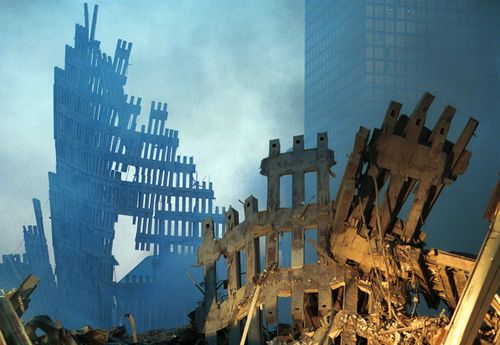
I'm sitting in the same spot as I was on that fateful morning, writing the same (if much more evolved) blog. The human psyche is built to recover from trauma, and so we should not be surprised or alarmed that the emotions of that day are less vivid to us now. But it is worth, it seems to me, remembering its extraordinary power. It was one of the most despicable mass murders in human history, conducted by religious fanatics bent on destroying Western civilization. It was terrifying because they achieved this with only 19 men, some box-cutters and the small freedoms that we once took for granted in this country and now have no longer.
It's worth also recalling, after the bitter and often justified criticism of the last president's subsequent war policy, how intense and terrifying it was for those in power back then. They deserved the support they were given because they were our elected leaders, regardless of party, and the nation had been attacked. It was extremely hard to know what to do in the absence of actionable intelligence and a display of such theatrical nihilism. Emergency measures in the aftermath are what the executive branch is there for. Mistakes are and should be forgivable at a moment like that. And, as readers know, my own passionate support for fighting back against Islamism under the last president only collapsed with the feckless negligence toward Afghanistan, the disastrously conducted occupation of Iraq, the shady intelligence fiasco that made it possible, and, much more profoundly, the embrace of torture in a war for human rights.
Those divisions and debates were and are legitimate and necessary. But it seems to me, looking back now, that I have learned a few other lessons from the war that began that day.
The first is that total security is impossible in a free society.
I understand deeply the hankering for it in the ashes of the World Trade Center. But we should all acknowledge that a free society will never be able to have 100 percent level of success against those who are prepared to kill themselves in acts of terror. The Cheney promise is a mirage – and getting there could mean losing far more than we gain.
The second is that defeating this menace is not amenable to conventional military power; and that intervention in Muslim countries needs to be calibrated very, very carefully to avoid generating more terror than we manage to suppress.
The third is that nation-building and counter-insurgency in countries which are barely nations and failed states is a century-long enterprise. Occupations that long are imperial ventures. Imperial ventures can become self-sustaining. They are harder to end than government programs, because they are, in part, a government program. Unless they can be shown to drastically reduce the terror threat to the West, they can be ghastly errors. The war in Iraq remains such a ghastly error. The war in Afghanistan, alas, now another. A great power with the debt levels of the US right now is not Britain in the early 19th century; it's Britain in the early 20th century. Empire has to be paid for. And we have long since run out of money.
Fourth. We should not grant the enemy more allure than he deserves. Al Qaeda is now weaker than it once was – rejected by the people in Iraq and Jordan, decimated by the military and CIA under Bush and Obama. They did not have access to weapons of mass destruction, or they would have used them a long time ago. Smarter, more targeted detection, surveillance, skilled interrogation (not sadistic brutality), more skilled and culturally-attuned human intelligence: these are the skills we need.
I was devastated that day by what was done to America. It was a rape of sorts. Nothing justified it. Nothing will ever erase our memory of it. Moreover, we still have a civilization to defend. What I have since learned – and learned hard – is that we can undermine it ourselves more surely than the enemy can. We have to be as aware of our own failures as much as the enemy's evil. This makes it a very difficult and long war. But in the names of all those who perished that day, we must still win it – if by subtler, shrewder, cannier moves than we have managed so far. That's not an indictment of America. It is a strength of a democracy that it can debate how it conducts wars and change strategy and leadership as necessary. The election of Obama was, I believe, a huge blow to Islamism and a huge gain for America in regaining the global initiative. And the Bush administration's dogged pursuit of al Qaeda, when it was done with legal and ethical means, is something to be grateful for. Now: to build on it, with diplomacy, containment and carefully targeted military power. We can learn from mistakes.
That learning is what al Qaeda fears. But if we keep up the introspection and debate, and and if we remember the trauma of that day, we can give them something much more to be afraid of.

 The Dish