The Snap Poll

Blumenthal parses the instapolls:

In terms of these "instant reactions," this speech falls within the range of previous addresses. Depending ont he measure it's better than some, worse than others. But keep in mind that none of these positive reactions translated into meaningful changes in presidential approval. Will the speech lead to lasting change in perceptions of health reform? To know that, we will need more surveys of the general population and, mostly, more time.

Merit Pay, Ctd

A reader writes:

I’d like to support merit pay. But as the husband of a teacher (and a great one), I have several qualms. 1. Who Makes the Call? Many administrators and principals have

limited classroom experience, and even that may be at very different grade levels or in very different subject areas. Unfortunately, we also often see school administrators sacrificing much on the altars of practical expediency, parental pressure and budget worship. How confident can teachers really be about the ability of these leaders to make difficult calls about allocating limited resources fairly and in a way that truly rewards merit?

2. What Measurements Get Used? If test scores are a part of the measurement process (and I assume they must be), they must be recognized as inherently imperfect. Because my wife is particularly good, she routinely takes on difficult kids and/or difficult parents. She also takes on kids (or groups of kids) with special needs (an ESL pod, for example). Doing so impacts “her” test scores. If those scores impacted her pay, why would she take on such challenges? Measuring improvement percentages rather than raw scores would be a help here, but still has problems. Some teachers cheat (giving hints, for example) to improve their scores even with no money on the line. More fundamentally, teachers can’t generate real change without parental cooperation and support. Without it, teachers are doomed to fail in the vast majority of cases, and merit pay won’t motivate parents. Moreover, character development is absolutely crucial to long-term success. But it is particularly dependent upon parental support and particularly difficult to quantify and measure.

3. What Price Collegiality? A good school is driven, in large measure, by collegiality – peers helping and supporting each other for the good of their students. If they become competitors for (increasingly) scarce resources, that collegiality will be threatened.

4. The Tenure Trade-Off. Teachers knowingly trade better pay for job security. Too many teachers, surely, are rewarded with tenure. But good teachers need it desperately in a world where parents increasingly denigrate the teacher’s role and expertise and believe that little Johnny or Judy can do no wrong, or need a different challenge, or less work, or, or, or. Oh the stories I could tell….

5. The Bigger Problem. Dana Goldstein makes a good point about what motivates good teachers. But there’s also a point to be made about what “demotivates” good teachers. My wife has noticed a decided lessening of respect for teachers and the job they do over the past decade, particularly among parents. Parents increasingly assume (and demand) that teachers work for them and must do their bidding.

A good parent’s insight can be extremely helpful to a teacher, but the teacher’s expertise, training and experience are often seen as meaning nothing in comparison to the parents’ certainty about what their oh-so-gifted children need. Good teachers cause friction and ignite criticism by doing what their expertise tells them is best for students; weaker teachers go along to get along. But the bottom line here is that teachers can’t successfully care more than the parents allow them to care about their children.

School districts are guilty too. With less and less money, teachers are always expected to take up the slack (which today includes janitorial work, little or no prep time, excessive duty, etc.). And, because they want the children to succeed, teachers typically do what’s asked, without complaint. But this lack of respect – more than money – gnaws at teachers and causes good ones, like my wife, to consider doing something else.

6. What’s Best for Students? I don’t know the answer to this question as it relates to merit pay. But I am sure that it’s the appropriate question. We shouldn’t be asking what’s best for bureaucrats, administrators, parents or even teachers. I’m also sure that good teachers will agree on this point, at least.

On the other side of the divide, Will at Ordinary Gentlemen makes the case for merit pay, and DiA suggests rewarding good schools rather than just good teachers.
Blame The Universities?

It seems to me that less than perfect graduation rates…can be interpreted in a two ways. The first, as Leonhardt has suggested, is as a failure of educational institutes to provide their students with the resources necessary to graduate. An alternative interpretation, however, is that the numbers demonstrate that universities are casting a wide net for potential college graduates, and then letting students determine on their own once they get there whether they will sink or swim.

From a Rawlsian viewpoint, this offers a number of nice attributes for society: we are able to identify our college graduates later in the process than if we restricted admission only to those we knew were guaranteed to be able to graduate from college. Yes, some students will fail, but others will get a chance they might not have had with more restrictive admissions policy. Moreover, one can argue that for a college degree to have any meaning, at least some students will have to fail to achieve it; otherwise, the diploma simply equates admission, and not any accomplishment while at the university.

Free Exchange has a few more criticisms.

Healthcare Reform Reax II

Drum:

I've been on record for some time as believing that since healthcare reform emerged still standing even after the August hailstorm, the odds were good that it could pass this year in some reasonable form.  So obviously I still think that.  But I'd say the speech probably helped.  It won't affect Republican votes much, but it will probably move public opinon a few notches and make it easier for centrist Dems to stick together and overcome a GOP filibuster.  Basically, I'd say the odds of healthcare passing this year have gone up from 65% to about 75%.

Keith Hennessey:

I think [Obama is] anticipating that the Congressional Budget Office will continue to score legislation as increasing long-term budget deficits by an increasing amount each year.  The President and his Budget Director will, I think, continue to assert that their “game changers” will reduce long-term budget deficits, despite providing no quantitative evidence to support this claim.  This new Presidential language suggests that they will include additional language that requires actual spending cuts if (when) the game changers don’t work. If I’m right, it’s a transparent gimmick designed to try to get CBO to say the bills don’t increase the long-term budget deficit, without actually making any of the hard choices needed to do so.  If you care about the deficit, keep a close eye on this element of the President’s proposal.

Yglesias:

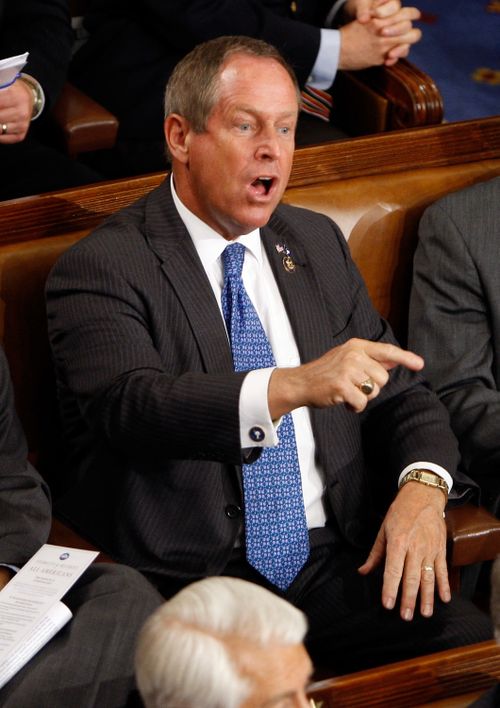
Personally, I sort of liked Rep Joe Wilson’s idea of introducing British-style heckling to the halls of congress; totally disrespectful and out of step with American tradition, true, but their tradition is better. Unfortunately, Wilson was also lying about the point at issue and will thereby set back the cause of heckling by decades.

Ezra Klein:

Obama needed to do the precise opposite of what he's best at. He needed to bring health-care reform down to earth rather than launch it into orbit. He needed to make it seem less dramatic and unknown. He needed to cast it not as change, but as improvement. All of which he did.

Kristol denies there is a healthcare crisis:

The real “public option” is to scrap the current grandiose plans and to start over. There is no health care crisis, and doing no harm is far preferable to doing real damage to a good health care system.

Josh Marshall:

I think Obama may have resumed a certain command over the debate. Because the contrast between him and the hucksters to whom the Republicans have ceded this debate, and the difference between the actual details of reform and whatever it is everyone has been talking about through August, is simply very difficult to ignore.

Jonathan Chait:

I've written critically of this notion that health care is a drama revolving around Obama. It's not. The Senate is the key entity here. No speech is going to have much effect — it could make health care more popular, but centrist Senators were dragging their feet long before Obama's slide in public opinion. Fortunately, I also think that at the end of the day, even moderate Democrats will recognize their self-interest in passing something substantial.

If We Could Go Back In Time

Noah Millman tries to understand what we should have done differently in Afghanistan and comes up empty:

This is what is meant by tragedy: when you feel compelled to do something that will only lead to pain and failure. You can talk all you want now about the need to win, and you can talk all you want now about simply declaring victory and going home, but the fact that will be plain in the first case is that we keep staying because we can’t figure out how to “win” and in the second case it will be plain that we left because we lost.

Mickey Moves

A week ago:

Noah and I agree Obama's big-deal speech is a mistake–Noah because thinks it's unnecessary to try to win over the public with "the same case for health reform that [Obama]'s been making for six months," me because I think making "the same case for health reform that [Obama]'s been making for six months" won't work in winning over the public (and when it doesn't, he won't be able to give another address to Congress anytime soon).

Tonight:

Expectations: Low! … Expectations: Exceeded. A moderately effective speech. …

Healthcare Reform Reax

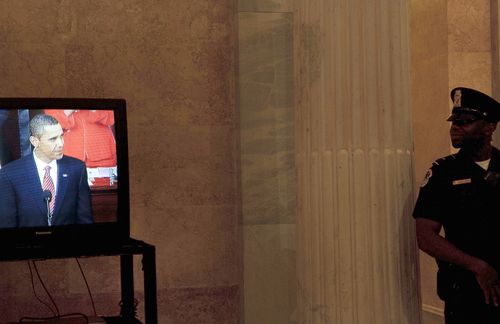
CAPITOL09BrendanSmialowski:Getty

Nate Silver:

This was not a home-run kind of speech; he was trying to leg this one out, and say a lot of different things to satisfy a lot of different constituencies. But I think it was a stand-up triple.

DiA:

I know we're way past the point of no return on this, but it's still maddening that we insist on discussing a debate about health care in the language of health insurance. If you have a pre-existing condition, whatever else the mechanism by which your care is funded might be, it is not insurance. Also annoying: The suggestion that people who get sick without coverage are "imposing" their costs on us because we have made a collective decision to provide care for them.

Taegan Goddard:

[T]he line every pundit will talk about is the GOP congressman — reportedly Rep. Joe Wilson (R-SC) — who yelled "lie" during the first part of the president's speech. It was so astoundingly rude that it's almost certain to backfire and will give the president a few extra approval points among the American public.

McArdle:

Obama says he doesn't want to demonize insurance companies–he just wants to hold them accountable.  This is the best line of the night.

Jonathan Cohn picks out what Obama has not said before:

Obama makes clear that health reform should cost about $900 billion. He's put that much money on the table before, but it wasn't clear whether he would try to seek more funding. Clearly he won't. 

Mike Madden thought comparing the public option to public universities was shrewd:

It was a far better metaphor than the one he's used earlier this summer, comparing the public option to the Postal Service and private insurers to FedEx and UPS. (For one thing, the post office might conjure up visions of long waits for service.) So many Americans have attended public colleges that it's hard for opponents to say they don't do exactly what Obama said they do — provide an alternative, without inhibiting private colleges. If advocates for the public option are smart, you might be hearing this comparison a lot in the next few days.

JPod (unsurprisingly) was not impressed:

[It] was nearly an hour of snake-oil salesmanship, promises that cannot possibly be kept, and false invocations of bipartisan civility even as he was trying to deliver partisan roundhouses of his own.

Hanna Rosin:

[At] the end, came the rousing defense of liberalism I was waiting for. For a speech in which he was trying to forge a consensus this was a brave and risky move. You can say to that vast middle of Americans nervous about their own health insurance plans: “There, there, don’t worry, things will be good for you.” And just stop there. Or you can go one step further and move them to a higher plane, which is what he did: “When fortune turns against one of us, others are willing to lend a helping hand."

Karen Tumulty:

After an August in which the health care debate threatened to drive into a ditch, President Obama tried to steer it back into the center lane, if there is such a thing to be found on an endeavor so ambitious as remaking one-sixth of the economy. He defended the public option, and yet downplayed it. The package that he described is about the size of the framework released yesterday by Senate Finance Chairman Max Baucus–$900 billion, which is the lower limit of what anyone is estimated that it would take over the next decade. And though he is not likely to get more than one or two GOP votes, Obama went out of his way to point out the ideas in his plan that can trace their parentage to the Republicans–including his former adversary, John McCain. And he laid on the table an issue that has been something of the Holy Grail to the right: tort reform.

Ambinder:

I thought it was much more focused on the 535 elected officials in the room than any joint speech I'd seen. It kind of felt more like a Roosevelt Room talk than a speech to the country. A lot of process. That said, the Kennedy riff was powerful and the portrayal of Kennedy as bipartisan leader was pretty brilliant. The line about government bureaucrats and insurance bureaucrats was a good conflation. Was it enough? I don't know. I don't think we'll know for awhile.

(Photo: Brendan Smialowski/Getty.)