A War Over How And Whether Islam Should Embrace Modernity?

Pivoting off an article by Tom Friedman, Yglesias considers the continuum of Muslim opinion:

There’s a huge conceptual space between wanting to “embrace modernity” in a way that a secular American Jew like Friedman or I would have amenable (after all, the Republican Party doesn’t meet that standard) and wanting to roam around the world killing everyone in the name of purifying Islam. If the entire Muslim world were governed by rights-respecting democracies it might be relatively easy to draw clear lines between dangerous violent people, and people just advancing a conservative political agenda. But that’s not the situation that exists, so you have a muddle of different actors who embrace violence to differing degrees against different targets and for different purposes.

Coloring The Dots

Etsy.swimmer

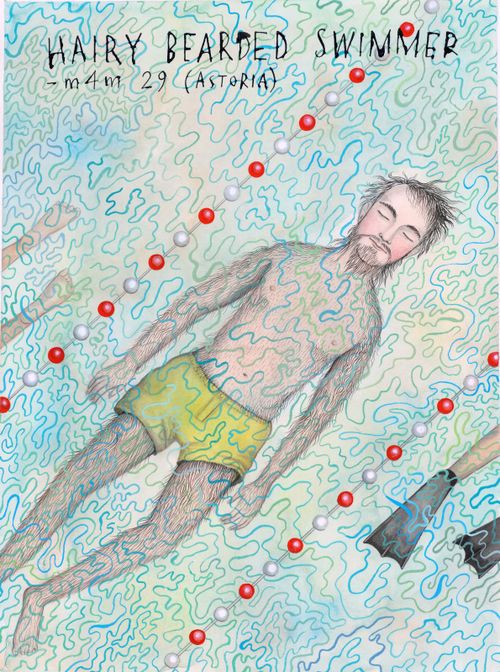
Sophie Blackall creates illustrations from "Missed Connections" ads.  The caption for the image above reads:

Saturday, September 5, 2009
– m4m – 29 (astoria)
we were both swimming around 5-6 in astoria pool. we ended up walking the same direction in the park for a while but didn't talk. i wish i had said hi…so i figured i would on here.
worth a shot.

(Hat tip: Laughing Squid)

New Torture Tapes

Not everything was destroyed:

The videotapes, which a judge has ordered the government to produce, are expected to reveal al Qahtani’s condition toward the end of three months of intensive solitary confinement and isolation just before the special interrogation plan was implemented. In a letter to his superiors, FBI Deputy Assistant Director T.J. Harrington described al Qahtani at the time as “evidencing behavior consistent with extreme psychological trauma (talking to non-existent people, reportedly hearing voices, crouching in a corner of the cell covered with a sheet for hours on end).”

Beyond Flat-Screen TVs

James Surowiecki blogs about his column from this week. This is worth noting:

[A]s this paper from economists at the Federal Reserve shows, the growth in indebtedness has largely been driven by demographic changes and housing prices. Most interestingly, as Elizabeth Warren has argued, the idea that most Americans have been spending frivolously on consumer goods actually isn’t true. Instead, a hefty chunk of the increase in consumption in recent decades has been the result of higher housing prices, the rising cost of medical care, more spending on education, and childcare.

A generation ago, Warren says, basics (housing costs, health insurance, transportation, education, and taxes) accounted for fifty-four per cent of the average family’s income. Today, they account for seventy-five per cent of it. Now, some of those costs arguably do reflect a lack of frugality—homes are more expensive in part because they’re so much bigger. But the fact that more than fifteen per cent of personal consumption expenditures now go to medical care, when in 1930 only three per cent of personal consumption did, isn’t a reflection of frivolity, and that’s not going to change any time soon. In fact, when you actually look at what Americans spend money on today versus what they spent it on fifty years ago, it’s striking that Americans today actually spend less of their income on goods—including everything from furniture to clothing to food to appliances—and much more of their income on services. For the savings rate to get back to ten to twelve per cent, in other words, will require a lot more than having people stop buying flat-screen televisions.
Tragic Humanism

Earlier this year Terry Eagleton had an involved essay on the role of religion in society. This Dish missed it at the time:

The distinction between Hitchens or Dawkins and those like myself comes down in the end to one between liberal humanism and tragic humanism. There are those who hold that if we can only shake off a poisonous legacy of myth and superstition, we can be free. Such a hope in my own view is itself a myth, though a generous-spirited one. Tragic humanism shares liberal humanism’s vision of the free flourishing of humanity, but holds that attaining it is possible only by confronting the very worst.

The only affirmation of humanity ultimately worth having is one that, like the disillusioned post-Restoration Milton, seriously wonders whether humanity is worth saving in the first place, and understands Swift’s king of Brobdingnag with his vision of the human species as an odious race of vermin. Tragic humanism, whether in its socialist, Christian, or psychoanalytic varieties, holds that only by a process of self-dispossession and radical remaking can humanity come into its own. There are no guarantees that such a transfigured future will ever be born. But it might arrive a little earlier if liberal dogmatists, doctrinaire flag-wavers for Progress, and Islamophobic intellectuals got out of its way.

(Hat tip: 3QD)

The Telegraph’s “Scoop,” Ctd

Ackerman reports on the alleged rift between McChrystal and Obama:

Officials throughout the Obama administration, military and civilian, deny any rift and contend that the controversy over McChrystal’s remarks is a media-driven event with little substance. Some noted that Defense Secretary Robert Gates, who has set himself up as a key swing vote in the debate over changing Afghanistan strategy, has zealously guarded the administration’s freedom of action, and reacted very badly to the leak of McChrystal’s assessment — which did not, several civilian and military officials confirm, come from McChrystal’s staff. “The impact may be the opposite of the leaker’s intent,” said an official in the Office of the Secretary of Defense. “This will increase the determination of the civilian leadership not to be rushed or pressured.”

Yes, That Was A Beagle, Ctd.

Dustycurtain

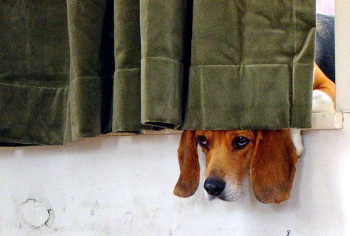
A reader writes:

Quite by chance, I was at a friend’s beach house recently, picked out of the shelf a musty volume of Ogden Nash, and stumbled on this:

On a Good Dog

O, my little pup ten years ago
was arrogant and spry,
Her backbone was a bended bow
for arrows in her eye.
Her step was proud, her bark was loud,
her nose was in the sky,
But she was ten years younger then,
And so, by God, was I.

Small birds on stilts along the beach
rose up with piping cry.
And as they rose beyond her reach
I thought to see her fly.

If natural law refused her wings,
that law she would defy,
for she could hear unheard-of things,
and so, at times, could I.

Ten years ago she split the air
to seize what she could spy;
Tonight she bumps against a chair,
betrayed by milky eye!
She seems to pant, Time up, time up!
My little dog must die,
And lie in dust with Hector's pup;
So, presently, must I.