T-Paw The Hawk?

Larison tries to determine whether Pawlenty knows anything about foreign policy:

The more I search, the more discouraging the results. There are not many results, and those that I do find confirm my impression that he doesn’t know anything and has compensated by echoing the most ridiculous criticisms of the current administration. Pawlenty just launched his Freedom First PAC, which is not primarily concerned with foreign policy, but in his first conference call for the PAC he kept harping on the missile defense decision. This tells me that the primary debates are probably going to be dominated by candidates trying to out-do one another in hawkish ignorance. Pawlenty’s off to a good start in that respect.

It’s Getting Worse

Michael Totten recommends that we listen to Michael Yon, who is more than worried about Afghanistan:

We are losing popular support. Confidence in the Afghan and coalition governments is plummeting. Loss of human terrain is evident. Conditions are building for an avalanche. Gen. Stanley A. McChrystal, the military commander in Afghanistan, and Defense Secretary Robert M. Gates are aware of the rumbling, and so today we are bound by rules of engagement that appear insensible.

We must curb civilian losses at expense to ourselves. I believe the reasoning is sound and will share those increased dangers. Erosion of popular support seems reversible. There still is considerable good will from the Afghan population, but bomb by bomb we can blow it. We have breathing room if we work with wise alacrity. I sense a favorable shift in our operations occurring under Gen. McChrystal.

Enemies are strengthening. Attacks are dramatically increasing in frequency and efficacy. We are being out-governed by tribes and historical social structures.

He ends the piece:

Either we will begin to show progress by the end of 2010 or, piece by piece, the coalition will cleave off and drift away, meaning 2011 will begin the end to significant involvement in Afghanistan.

Sigh Of The Times

Indy-graph

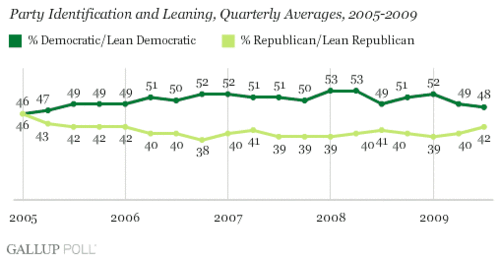
Scott Payne condemns Serwer and Sargent for excusing Grayson's "GOP wants you to die quickly" comments. But then he looks at the chart above and sighs:

I was going to premise at least part of my rationale for that post on the idea that playing into these kinds of antics is no way to win over the ever important independents and build a lasting coalition for positive change in the country. Sadly, I can’t write that post because the facts don’t support it (stubborn as they are). […] Democrats having been losing ground with independents to Republicans in a fairly steady manner since Obama took office, during which time just the types of antics about which I have been wagging my finger have been employed. […] What I’m left thinking is that it is a sad state of affairs when “death panels” and “the GOP wants you to die quickly” are the rallying cries that animate independently-minded voters in the country and that we have a good deal of work remaining in reinvesting a sense of intellectual rigourousness into our political discourse.

For goodness' sake. I don't interpret these numbers as a dramatic endorsement of the tea-party antics at all. I think most Americans view the expansion of government as worrying. So do I. I think we had little choice this past year to do what we did, and Obama's solid ratings suggest many understand that. The GOP, of course, is far more fiscally reckless than Obama – and supporting the current crew because of a desire to return to balanced budgets is absurd. What the Democrats need to do is reinforce this fact relentlessly – but, alas, too many of them find attacking the right on fiscal grounds too much of an ideological strain.

Too Boring To Run?

Ed Kilgore looks at Pawlenty's downside:

Pawlenty was, and remains, a fine "on-paper" candidate who doesn't have much else going for him.  Yes, he seems to be putting together a pretty good campaign team.   And yes, he's made at least one attempt to get into the manic spirit of today's conservativism by flirting with "tenther" nullification theories.  But unless he undergoes both an ideological and personality change of a major nature, he's never going to be more than a third or fourth choice among the kind of hard-core conservative activists who dominate the Republican presidential nominating process (particularly in Iowa, where familiarity with Pawlenty as the mild-mannered governor of a neighboring state might actually hurt him).

I fear he's Dubya II: a soft mask for an extremist base. I hope he's serious about government. Speaking of which, a shout-out to Bobby Jindal. His recent statement that his party needs to focus on constructive policy ideas rather than the Fox circus was running against the current. That's a sign of leadership and promise.

Are Nukes Really That Influential?

Stephen Walt casts doubt on the idea that a nuclearized Iran would spark an arms race in the Middle East:

There are between 40 and 60 states with the technological capacity and economic wherewithal to build a nuclear bomb, and the vast majority of them have decided not to do so, even when there were other nuclear powers in their neighborhood. A few states have started down that road and then turned back, sometimes in the face of international pressure (Libya, Brazil, Argentina), and sometimes mostly on their own (Sweden, South Africa). […]  Iran’s own nuclear program (which began under the Shah) reflected broader security concerns and the Shah's own desire for status, and doesn't appear to have been a direct response to anyone else's bomb.  North Korea’s entry into the nuclear club hasn't led South Korea, Japan, or anyone else to start a new nuclear weapons program yet. In short, people have been forecasting the rapid proliferation of nuclear weapons ever since the nuclear age began, but all of those forecasts have been overly pessimistic.

Americans really should understand this: we have several thousand nuclear weapons and we have a tough enough time getting other states — even rather weak ones — to do what we want. The same would be true for a nuclear Iran: it could not blackmail anyone because the threat would not be credible, and even nearby states might find it easier to adjust to than we sometimes think.

By the way, this same logic may also help convince Iran that it doesn’t need to go all the way to full acquisition of a nuclear capability. It won't by them much influence, but it still might encourage some of their neighbors to follow suit. Ironically, that situation might decrease Iran’s regional influence over time. Iran is the most populous state in the Gulf region, and it has enormous economic potential. If the mullahs ever get their act together, Iran’s conventional capabilities would overshadow the other states in the region. And if that's the case, crossing the nuclear threshold might lead others to look for a cheap way to counter that. Thus, from Iran's own point of view, staying on this side of the nuclear threshold (but having the capacity to go nuclear quickly if need be), might be the optimal strategy, particularly if they were less worried about an imminent Israeli or U.S. attack.

Pandering To Rich Seniors

Bruce Bartlett notes:

On Sept. 23, Rep. Dina Titus, D-Nev., introduced H.R. 3631, which would freeze all Part B premiums for one year–including those for couples with incomes over $170,000. It would pay for the $2.8 billion cost by raiding the Federal Supplementary Medical Insurance Trust Fund and the Medicare Improvement Fund. This legislation came up the following day and passed the House by a vote of 406 to 18.

This is why this country is fiscally paralyzed. And the tea-party Republicans joined the panderthon. They are utterly unserious about limiting government.

Engaging Iran: Iranian-Americans Speak

Since Obama took office intent on engaging Iran, a revolution has taken place, a revolution that both exposes the poignant power of the Iranian people and the vile repression of an illegitimate and torturing regime. Like many, I am torn between the need to see things very clearly and to promote American and Western interests and prevent avoidable conflict and the need to show absolute solidarity with those amazing people who changed the world’s consciousness last June. I’ve been hoping for a clearer message from the Green movement’s leaders as to what they think Obama and the West should do. Mousavi and Karroubi both oppose sanctions. And yet legitimizing the coup is a real danger of engagement. Here is a response, just posted and signed by many distinguished members of the Iranian diaspora in America:

Over the past century, the U.S relationship with Iran has been volatile, and the coming months may prove to be a decisive era in the history of the relationship between the two 0717GETTY countries. A misreading of the situation in Iran might lead to decisions which will damage the national interests of both countries.
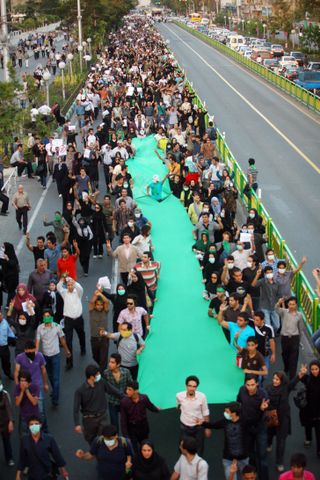
The harsh repression of peaceful protests in the wake of the disputed Iranian election this past June removed any doubt about the cruelty of the Iranian totalitarian regime. Direct shots fired at unarmed civilians in Iran captured global attention, but this was only an example of the atrocities that were committed. Intensifying pressure on protesters, the use of Stalinist methods against detainees, and threatening university students and faculty are only few more examples of the continuing campaign against peaceful opposition in the weeks since the election.

Recent news indicates the US administration’s intention to negotiate with the Iranian government. While maintaining an active venue of negotiation is necessary for resolving the conflict between the two countries, a constructive dialogue with Iran must address the Iranian regime’s recent brutalities. Neglecting such atrocities by any country, particularly in this crucial period, would have a severe negative effect on the Iranian public. As people with deep connections to their Iranian homeland, and who have studied and worked at universities across the world, the signers of this letter are concerned about the neglect of human rights violations in Iran by the rest of the world. As the current regime faces an internal crisis of legitimacy, it is obvious that the goal of the Iranian government is not the resolution of its international conflicts. Rather, they seek a false victory for their confrontational policies, which could be used as justification for escalating the violent crackdown against domestic political opposition.

From our point of view, the confrontational policies of the previous US administration, coupled with the use of double standard in dealing with issues of human rights, have had a negative impact on the public perception of the United States’ intentions in the Middle East. While we oppose any military threat against Iran, we remind American policy makers that turning a blind eye to human rights abuses, which began in 1953 with the coup against Mohammed Mosaddeq, has created suspicion within Iran about American intentions. In our opinion, neglecting the recent atrocities in future negotiations with Iran would confirm this suspicion in the eyes of the Iranian people and would have a negative effect on long-term relations between the two countries. We believe the issues of human rights violations and the Iranian government’s atrocities against its own citizens are critical issues that should not be sacrificed for short term gains. It is important to remember that the Iranian public is carefully following the interactions of foreign governments with those who violated their civil rights.