Face Of The Day

ElderlyAfghanManGetty3

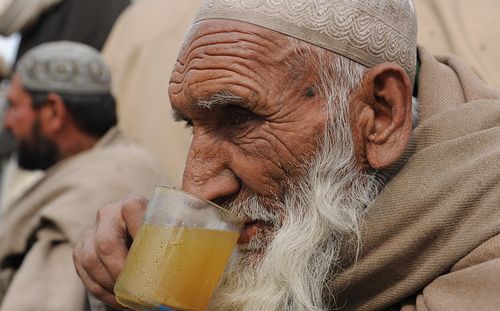
An elderly Afghan man drinks chicken soup in Kabul on October 27, 2009. Afghanistan's presidential rivals are reigniting their campaigns for a second vote, but analysts question whether a new election can be credible as calls for a government of national unity persist. Many observers fear a second round run-off on November 7 will be plagued by the same problems of fraud, low-turnout and Taliban violence that hit the first round of voting two months ago. By Shah Marai/AFP/Getty.

Uniting Against Islam?

Ross ruffles some feathers in his latest column:

[I]n making the opening to Anglicanism, Benedict also may have a deeper conflict in mind — not the parochial Western struggle between conservative and liberal believers, but Christianity’s global encounter with a resurgent Islam. Here Catholicism and Anglicanism share two fronts. In Europe, both are weakened players, caught between a secular majority and an expanding Muslim population. In Africa, increasingly the real heart of the Anglican Communion, both are facing an entrenched Islamic presence across a fault line running from Nigeria to Sudan.

Greenwald says Ross is "call[ing] for a Christian religious war — certainly metaphorical and perhaps literal — against Islam." He continues:

How ironic that someone who is virtually calling for a worldwide religious conflagration is simultaneously condemning his targets for lacking "Western reason."  It's obviously true that some Islamic extremists are inherently incompatible "with the Western way of reason," but that's just as true of Christian extremists and Jewish extremists and a whole array of other kinds of extremists. […] But the claim that Islam itself — and the world's 1.5 billion Muslims — cannot be accommodated by, or peacefully co-exist with, Western values or Christianity specifically is bigotry in its purest and most dangerous form.  It's hard to imagine anything more inflammatory, hostile and outright threatening than a call for Christians of all denominations to unite behind the common cause of fighting against Islam as Christianity's most "enduring and impressive foe."

Serwer adds:

[T]here's a great deal of common ground between Douthat's perception of a grand conflict between Islam and Christianity and the tribalism of Pat Buchanan. Each is grounded in a hostility to cultural pluralism and fear of an encroaching, menacing other. The major difference being that while outright prejudice against black people is largely culturally taboo, prejudice against Muslims is so acceptable as to be found expressed openly in the op-ed pages of the New York Times.

I'm with Greenwald and Serwer about 80 percent. But they miss Ross's context: Islam currently is nowhere near the levels of openness and dialogue that have been achieved in the West within Christianity these past few decades. It isn't wrong to point this out or to see it as a very large obstacle to a civil modus operandi between Muslim citizens and the liberal Western state. In fact, to deny this is to betray those who really are working within Islam for some kind of reformation.

But Ross, of course, is also a believing Benedict-follower. So while he is not averse to engaging in Western debates about theology or secularism, his interest is primarily in the developing world, where the kind of faith he holds still retains luster and force. So his column is really both an example of classic zero-sum religious thinking, and an analysis of it. It's that line between believing and analyzing that Ross leaves somewhat vague. I don't blame him. This stuff is hard. And he has a new audience to reassure.
Washington Rituals

Christopher Orr describes one:

[A]nyone who imagines that New Gingrich is going to make a serious bid for the presidency in 2012 is nuts. (The smart money is that he'll muse endlessly about the possibility; let it be known that if the party wants him badly enough he'll allow himself to be drafted; and, when this does not happen, publicly take his name out of contention, explaining that he's abruptly found himself far too busy with some new organization with the word "Future" in the name. This is, after all, what he always does.)

The Lethal Politics Of The Opt-Out Public Option, Ctd

A reader writes:

I put the opt-out's chances of enactment south of 5%.  Maybe 2-3%, tops.  The only people who believe that it is a "good pragmatic compromise" (as Marshall calls it) are liberals and leftists who favor a strong public option.  Schumer believes it's a good compromise.  So does Bernie Sanders.  Great.  Whatever.  Have you heard a single moderate Democrat other than Baucus endorse it?  Lieberman has already announced he will filibuster.  Given they need all 60 Democrats and Independents, that's game, set, and match. (Or "check-mate", seeing as how you like to speak in terms of Obama the Chessmaster.)

The reason moderates are balking on the public option opt-out is because they see it for what it is — a false concession.  Your rebuttal to Megan is equally baffling on policy grounds.  The opt-out does not make the public option weak.  It does not change the substance of the "full" public option in any meaningful way.  On process grounds, opting out would be very difficult because it would require two houses of a state legislature to pass a bill and the governor to sign it.  Having even one of those three branches be in Democratic hands likely would end chances of opting out.  And the ability to opt-out expires in 2014.  Furthermore, even if the entire state legislature and governor are philosophically against a national insurance plan, it's a very different thing to turn down a benefit that your state residents are already paying federal taxes to support.  Let's be clear: You cannot opt-out of the taxes to support

the program. You can only opt-out of the benefits.

That's like telling states they don't have to take federal highway funding, but their residents still have to pay federal gas taxes.  If you were a state officeholder, you would be guilty of dereliction of duty if you did that to your state residents, conservative philosophy notwithstanding.

Fortunately, moderate Senate Democrats appear to see it for what it is — even if you and Josh Marshall don't.  It's a national insurance plan with a symbolic gesture intended to provide cover to those who want to claim it's something other than what it is.  That's why even Reid knew it stood no chance when he announced it, as Dana Milbank described brilliantly in his column this morning.

My point is simply that if this gets into the final bill, it will pay dividends for the Democrats in the states – unless it's a dreadful idea that doesn't work and is thereby exposed when put into practice. If the GOP were really convinced this wouldn't work, they'd be happy backing it. Obama, meanwhile, has kept his options open. If the final bill does not contain this, he will not bear the political cost of backing it. Ezra noted the politics of this here. Tumulty sees the local interest of Reid in doing this here.

Fighting Us Because We Are There?

Greenwald praises Hoh's resignation letter:

We invade and occupy a country, and then label as "insurgents" or even "terrorists" the people in that country who fight against our invasion and occupation.  With the most circular logic imaginable, we then insist that we must remain in order to defeat the "insurgents" and "terrorists" — largely composed of people whose only cause for fighting is our presence in their country. 

All the while, we clearly exacerbate the very problem we are allegedly attempting to address — Terrorism — by predictably and inevitably increasing anti-American anger and hatred through our occupation, which, no matter the strategy, inevitably entails our killing innocent civilians.  Indeed, does Hoh's description of what drives the insurgency — anger "against the presence of foreign soldiers" – permit the conclusion that that's all going to be placated with a shift to a kind and gentle counter-insurgency strategy?

Yglesias has related thoughts:

There’s always going to be distrust of a foreign army roaming through your country. In part you can dispel that distrust through good works. But in part you can dispel that through showing people what a post-American Afghanistan would be like and how we’re going to get there. I don’t know if that means a chronologically-boud timetable or a political checklist or what, but it’s got to be something. What you don’t want is to get in the situation of saying, basically, that we can’t leave Afghanistan until first we kill everyone who wants us to leave Afghanistan. For a while our Iraq policy was stuck in that loop, and I worry that our Afghanistan policy may veer in that direction.

A question: if we hadn't invaded for legitimate reasons eight years' ago, would anyone be proposing this kind of commitment now?

Dealing With Joe

A Chait reader has an idea:

Reid and the rest of the Dems in the Senate really need to do something about the Senator from Aetna. In the simplest possible terms, one of the key differences between committee chairmen and backbenchers is that chairmen vote with the party on procedure. This relationship between procedural loyalty and the perks of committee chairmanship needs to be made starkly clear to Lieberman. Just as Holy Joe wants to make the cloture vote a referendum on the bill's passage, Democratic leaders ought to make the cloture vote a referendum on Lieberman's seniority within the caucus.

A vote "no" on cloture should be a vote "no" on retaining seniority status, and with it not only his chairmanship but also his entire slate of committee choices. Whoever is next on the wait lists for Armed Services, Homeland Security, and Small Business gets bumped up onto those committees, and Lieberman gets whatever assignments are left after the other 59 members of the caucus have filled the resulting openings.

Presumably, that would give Lieberman the junior seats on, say, the Rules Committee, the Special Committee on Aging, and the Joint Committees on Printing and the Library. Maybe someone on Reid's staff — or maybe Schumer's, since this is more his style — can sort through the committee requests, run the numbers, and quietly pass on to Lieberman the list of committees he would be left with if his seniority were reset to zero as of the day of the cloture vote. Then let Joe see if the GOP is willing to kick any of its own members off of the committees he wants in order to make room for him. If he can cut that deal, fine. If not, then Holy Joe can contemplate exactly how to keep sufficient corporate money coming in to his campaign for 2012 if he has to spend the next three years sitting in the back of the room on the crappiest committees in Washington.

Studying Dick Cheney’s Brain

Ryan Sager passes along some new findings:

"Our research suggests that torture may not uncover guilt so much as lead to its perception," says Gray. "It is as though people who know of the victim's pain must somehow convince themselves that it was a good idea — and so come to believe that the person who was tortured deserved it."

Not all torture victims appear guilty, however. When participants in the study only listened to a recording of a previous torture session — rather than taking part as witnesses of ongoing torture — they saw the victim who expressed more pain as less guilty. Gray explains the different results as arising from different levels of complicity.

"Those who feel complicit with the torture have a need to justify the torture, and so link the victim's pain to blame," says Gray. "On the other hand, those distant from torture have no need to justify it and so can sympathize with the suffering of the victim, linking pain to innocence."

Dissent Of The Day

A reader writes:

When I read a humor-challenged remark like yours today I can hardly believe it comes from the same man who loves South Park. It was a laugh line and the audience laughed.

If Dunn had said "my two favorite moral philosophers, Attila the Hun and Saint Paul," would you pompously chide her for "kind words" about a mass murderer? Good joke or bad, I challenge you to find a kind word for Mao in her statement. She quotes him to make a point. Mao sometimes said insightful things. Like many people, I've used the quotation about power coming from the mouth of a gun, and it didn't make me feel like pulling on a Guevara T-shirt.

On a more serious note, we all hate the caution and blandness of almost every word that comes out of the mouths of people in public life in this country. Yet every time we flyspeck innocuous remarks and help spread faux outrage, we help enforce a deplorable rule against trying to be interesting. The press is teaching Anita Dunn the same lesson it taught Sonia Sotomayor: a joke that falls flat might cost you your job.