Why Don’t Customers Leave The Big Banks?

James Surowiecki asks:

[W]hy, given the broader backlash against the big banks and the less-than-inspiring performance they’ve turned in over the last couple of years, are people still sticking with them? What makes this even more curious is that the big banks, which have historically offered their customers worse deals than smaller banks, have not changed their ways: they pay less for deposits, charge more for loans, make billions from overdraft fees, and have jacked up credit-card rates.

He points to two factors: the cost of switching banks is high and "reputation (which is often reduced to market share) has a major impact on winning deals."

The Daily Wrap

Today on the Dish we saw Harry Reid make a move on a federalist public option. Ezra reax here and here. On Afghanistan, Judah Grunstein endorsed a time-bounded surge, Roger Cohen gleaned some perspective from Miliband, Paul McGeogh was pessimistic about the McChrystal report, a reader in Afghanistan shared that pessimism, and both Tony Karon and the Economist were not optimistic about the run-off election. But in a bit of good news, the HIV travel ban appeared on its last leg.

Andrew looked at a new study on sensory deprivation while Craig Murray looked back at the torture he witnessed in Uzbekistan. Friedersdorf and called for an end to prohibition on pot while George Will gestured toward the same. McHugh talked some sense on DADT, Dreher talked rednecks, and apostate Paul Haggis shamed the Super Adventure Club.

The prowess of newspapers and cable news continued to wane. Damon Linker lamented fast publishing while a reader praised slow reading. Aaron Renn seemed to think diversity only means poor black people – a perception countered by readers, but somewhat defended by Will of Ordinary Gentlemen. We also got emails from several Irish readers and a Scandinavian.

— C.B.

What Reid Is Up To

REIDChipSomodevilla:Getty

Ezra:

First, as Frates's unnamed lobbyist points out, [Reid] can lose this vote but credibly claim that he went to bat for a pretty good compromise on the public option. Second, it creates consequences for those who want to vote against the public option. Rather than killing the proposal in a back room, moderates who won't vote for cloture will actually have to vote against cloture. That makes them a target in their next election, and ensures a lot of harassment from the left. Reid is, in other words, making it harder — not impossible, but harder — for them to oppose the public option. Procedurally, it's a big win for public option advocates.

(Photo: Chip Somodevilla/Getty.)

Off A Cliff, Not

A counter-blast to the death-watch for newspapers. Money quote:

Doing worse doesn't mean doing badly. Until recently, many newspapers had profit margins exceeding 30%. By 2008, the industry's average margin had fallen to the mid-teens. The speed and magnitude of this decline have resulted in wrenching changes in the way these historically stable businesses must operate.

The continuing drama shouldn't distract from real earnings power. Many newspapers still have almost double the profitability of other media sectors, such as movies, music and books — which have long struggled to achieve margins of even 10%.

Here’s Looking At You, Bug

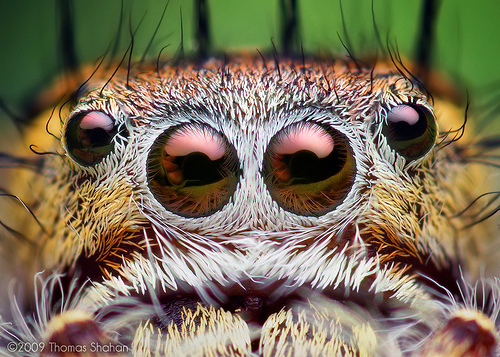
3863904636_fd61b5b85d

Some amazing "amateur" photography of the Anterior Median and Anterior Lateral Eyes of an adult female Phidippus putnami. I.e. a jumping spider. The photographer is Thomas Shahan who is interviewed here. His Flickrstream is here. Money quote:

After experimenting around with various ways of taking high magnification macros, I realized that nothing man-made is really all that exciting up close. I realized pretty quickly that bugs were one of the only things worth the effort. Nothing compares to the complexity, color, and intricate detail of arthropods up-close. Also, there is a seemingly infinite number of subjects when it comes to bugs.

(Hat tip: Insta.)

Emails From Ireland

It turns out the Dish has quite a following over there. Thanks for all the emails. My favorite:

He's a Cork man, Donal Og. The accent is one of the "thicker" ones in Ireland, at least to an American(or even a Brit/American) ear.  But having lived here now for 8 years, and having met and worked with so many Irish people from every county, the accent doesn't worry me much anymore.  What worries me is the attitude still prevalent here regarding gays…it's downright shockingly neanderthal.  I witness this almost every day as someone who works for an Irish airline…I am the "Cabin Crew" manager in one of our bases and there are two gay men among my charges. While most of the rest of the crew are excellent with them, if they are out of earshot, or sometimes even within, "gay" jokes are made.

Socially, Ireland is a bastion of ignorance on this matter.

It pains me, as the American mother of a gay son (who lives in Boston) to hear the incessant nasty jokes and chatter on this subject.  The Irish are still very uncomfortable with gay people. It is, I believe, a result of the mores of this still very Catholic country, but with the enormous change the Irish have experienced in the last 15-20 years one would think, or at least hope, that the bigotry would change, too.  Donal Og has done a great service for his country.

By the way, "Gaelic" is a collection of  languages which include Irish, Scots-Gaelic, and Manx-Gaelic.; Irish is the native language of Ireland.

And Tom Humphries is a brilliant sportswriter.

Little Hope For The Runoff

Tony Karon:

It is fanciful to imagine that a run-off election, or even forcing Mr Karzai to share power with his former foreign minister, will substantially improve the prospects for victory in Afghanistan. From a security perspective if nothing else, trying to avoid the run-off seems more sensible.

The Economist is almost as pessimistic:

The outlook for a successful second round is so bleak that most analysts believe it will in fact not take place at all. Some still cling to the hope that Mr Karzai and Dr Abdullah will make peace and form a coalition government, though both men have ruled this out. Or Dr Abdullah might withdraw in return for promises from Mr Karzai about enacting the constitutional reforms he wants, which would take power away from the presidency. That might indeed warrant praise as a piece of statesmanship.