The Daily Wrap

Today on the Dish, Sarah Palin injected herself into a congressional race and racist BNP leader Nick Griffin got his day in the sun. (Most were not impressed with Griffin, but the BBC also caught some flak.)

We saw some horrible homophobia out of Guam and Uganda, the CDC ignored gay boys for HPV protection, and NOM is starting to lose it. (Tom Cruise lost it long ago.) Mark Lynch reported from Palestine, Andrew Sprung made sense of the Afghan debate, and Lee Seigel took his Cheney hate a bit too far.

Our conversation on black American culture continued here, here, here, here, here, and here. Our thread on Human Rights Watch continued here, here, here, and here.

— C.B.

How To Pressure Israel

A reader writes:

The US has a much more potent lever than military aid – its pretty much automatic veto in the Security Council. The whole Goldstone affair has the Israeli government running scared: none of them want to be the first to be arrested in Europe, to which they love traveling (and staying in highly expensive hotels at the taxpayers' expense – this is a recent scandal over here). All the US has to do, to get Israel to move, is to hint that the veto is no longer automatic. No pariah state, which Israel is much as I dislike admitting so, can survive without support of at least one superpower; we can find ourselves under sanctions faster than Iran, and they will hurt more, to boot. So, no need to bring out the main gun. A side battery will do.

The AIPAC-J Street War, Ctd

Rebecca Abou-Chedid is one of the Arab-American J-Street donors vilified by former AIPAC staffer Lenny Ben-David. She writes:

It is possible to be both pro-Israel and pro-Palestine, not out of some blanket support for either government, but out of a sincere belief that peace is in both people's best interests.  I hold that belief as a result of years of work within the Arab and Jewish American communities, working in partnerships not just with J Street but also with such groups as Americans for Peace Now, Brit Tzedek v'Shalom, and Israel Policy Forum. I have traveled to the region and remain humbled and inspired by the courage and tenacity of those Israelis and Palestinians who refuse to submit to the cynicism or pessimism this conflict so often demands. The reason J Street causes such fury among certain detractors often has nothing to do with its policy positions. These people are angry because the political climate has shifted in a way that they no longer understand or control.

The generation that elected President Obama is not interested in being divided based on religion or ethnic heritage. We are not interested in a zero-sum game. We believe our elected officials must play a leadership role in brokering a two-state solution to this conflict, and that Arab and Jewish Americans must work together to support them. How can anyone profess to believe in a two-state solution, in which Israelis and Palestinians will live side by side, if they view with suspicion Arab and Jewish Americans working together to get there?

She has a point, no? What she doesn't quite grasp is that many in AIPAC are sadly dedicated to "war for ever." Spencer Ackerman defends Abou-Chedid here.

Face Of The Day

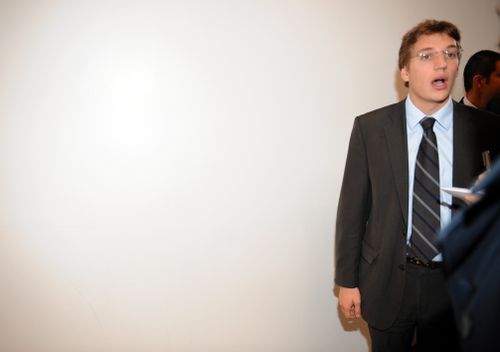
SARKOJRLionelBonaventure:AFP:Getty

Jean Sarkozy, President Nicolas Sarkozy's son is pictured on October 23, 2009 at the Hauts-de-Seine general council in Nanterre, west of Paris, after his election as a new member of the EPAD agency overseeing development in La Defense district. Sarkozy junior, an elected councillor in the rich Paris suburb of Neuilly, at the centre of a bitter row over alleged nepotism, abandoned on October 22 his bid for a job managing France's wealthiest business district. By Lionel Bonaventure/AFP/Getty.

Whose Country? Ctd

Perhaps the best retort to Buchanan is Ellison:

Whitman viewed the spoken idiom of Negro Americans as a source for a native grand opera. Its flexibility, its musicality, its rhythms, freewheeling diction and metaphors, as projected in Negro American folklore, were absorbed by the creators of our great 19th century literature even when the majority of blacks were still enslaved. Mark Twain celebrated it in the prose of Huckleberry Finn; without the presence of blacks, the book could not have been written. No Huck and Jim, no American novel as we know it. For not only is the black man a co-creator of the language that Mark Twain raised to the level of literary eloquence, but Jim's condition as American and Huck's commitment to freedom are at the moral center of the novel.

In other words, had there been no blacks, certain creative tensions arising from the cross-purposes of whites and blacks would also not have existed. Not only would there have been no Faulkner; there would have been no Stephen Crane, who found certain basic themes of his writing in the Civil War. Thus, also, there would have been no Hemingway, who took Crane as a source and guide.

Without the presence of Negro American style, our jokes, our tall tales, even our sports would be lacking in the sudden turns, the shocks, the swift changes of pace (all jazz-shaped) that serve to remind us that the world is ever unexplored, and that while a complete mastery of life is mere illusion, the real secret of the game is to make life swing. It is its ability to articulate this tragic-comic attitude toward life that explains much of the mysterious power and attractiveness of that quality of Negro American style known as "soul." An expression of American diversity within unity, of blackness with whiteness, soul announces the presence of a creative struggle against the realities of existence.

Without the presence of blacks, our political history would have been otherwise.

No slave economy, no Civil War; no violent destruction of the Reconstruction; no K.K.K. and no Jim Crow system. And without the disenfranchisement of black Americans and the manipulation of racial fears and prejudices, the disproportionate impact of white Southern politicians upon our domestic and foreign policies would have been impossible. Indeed, it is almost impossible to conceive of what our political system would have become without the snarl of forces—cultural, racial, religious—that makes our nation what it is today.

Absent, too, would be the need for that tragic knowledge which we try ceaselessly to evade: that the true subject of democracy is not simply material well-being but the extension of the democratic process in the direction of perfecting itself. And that the most obvious test and clue to that perfection is the inclusion—not assimilation—of the black man.

I just came across Saul Bellow's 1952 review of "The Invisible Man." Check it out.
France’s Integrating Muslims

Gareth Williams notices some encouraging reporting:

The birthrate of Muslims in France is also converging on the mean. It's been falling since the early-1980s and now stands at 2.5 versus 2.0 (interestingly the birthrate in the Maghreb is 1.8). In the next few decades France's Muslim population will grow to be a larger minority, but nevertheless still a small one.

Increasingly Islamic traditions are being frenchified: weddings in mosques where the bride wears white, carries a bouquet and holds hands with the groom. One French academic calls this process formatage: the creation of a new sub-culture, both French and Islamic.

Turning The Clock Back

Jim Burroway describes what Uganda's anti-gay bill, introduced before Parliament last week, would accomplish:

  • Reaffirm the lifetime sentence currently provided upon conviction of homosexuality, and extends the definition from sexual activity to merely “touch[ing] another person with the intention of committing the act of homosexuality.”
  • Create a new category of “aggravated homosexuality” which provides for the death penalty for “repeat offenders” and for cases where the individual is HIV-positive.
  • Criminalizes all speech and peaceful assembly for those who advocate on behalf of LGBT citizens in Uganda with fines and imprisonment of between five and seven years.
  • Criminalizes the act of obtaining a same-sex marriage abroad with lifetime imprisonment.
  • Adds a clause which forces friends or family members to report LGBT persons to police within 24-hours of learning about that individual’s homosexuality or face fines or imprisonment of up to three years.
  • Adds an extra-territorial and extradition provisions, allowing Uganda to prosecute LGBT Ugandans living abroad

Pomplamoose

A reader writes:

Here’s me watching that Pomplamoose video you linked to yesterday:

“Great tune—no wonder Coltrane loved it. Singer’s a little funny-looking, but interesting voice.”

“nice change-up on the beat. Hammerstein didn’t write it that way, but it’s good. Actually, she’s kind of cute in a weird way. And great voice.”

“Wow, those eyes are riveting. Ah—I like the key-changes. Unsettling, but intelligent.”

“Jesus, she is mesmerizing. The purity of her voice, and the intonation. And her skin is so…and that little mole…I could watch her singing forever.”

“Good god. That. Is the most beautiful woman in the world. She is so, stunningly, beautiful. I’m head over heels in love.”

If you missed it, check it out.