The Unplanned Stimulus

Buttonwood reminds us that much of the deficit is due to falling revenues and not just stimulus spending:

The economic news is coming so thick and fast at the moment that it is easy to miss some of the more amazing data. Figures released on Monday show that, in the 12 months ending September, federal personal income tax receipts were down more than 20%, while corporate tax receipts dropped a remarkable 54.6%. These are the biggest declines since World War Two, and explain why the deficit has risen so sharply. A large part of the current stimulus is unplanned rather than deliberate.

An Iran Breakthrough?

OCT21SamuelKubani:AFP:Getty

The blogosphere reacts. Joshua Pollack:

It’s easy to get absorbed in the minutiae of site-specific safeguards and takeback arrangements, so let’s keep in mind what the parties really seem to be getting. Iran can duck the worst of the fallout from the Qom affair and gain implicit acceptance of its enrichment activities. (Emphasis on “implicit.”) The P5+1 can put time back on the clock by getting that 1,200 kg LEU out of the country. And in the implementation phase, the sides will be able to test each other’s intentions and create some trust at the working level, assuming there are no major hitches.

Michael Singh:

Like all purchases of information…this one comes at a cost. The P5+1 have had to accept the uranium enrichment which Iran has conducted in recent years in defiance of multiple U.N. Security Council resolutions. Even if it ultimately does not reach a deal to send its LEU abroad, Iran will surely seek to pocket this concession and declare a measure of victory. Similarly, by presenting the admission of IAEA inspectors to the until-recently-covert Qom enrichment plant as a concession, Iran gains tacit international acceptance of a facility built in defiance of its Nonproliferation Treaty obligations.

Kevin Sullivan:

One reason for the sea change is the domestic discomfort inside Iran. Still smarting from the June 12 unrest, Tehran has some tough decisions to make in the coming months on public gas subsidies and declining oil prices are limiting Iranian options—to fulfill domestic consumption needs, the country must diversify its energy production. Multilateral or unilateral sanctions are not something they can afford at this time. But I believe it was Washington's acknowledgment of those energy needs and nuclear rights that have made a big difference in getting Tehran to play ball on this.

Ultimately, Iran can still cheat and wiggle its way toward a bomb but – like North Korea during the 1990s Agreed Framework – they'll have to work their way there along a more torturous path. Not ideal, but with an Iranian population clearly hostile to its current regime, any play for time is valuable.

Emanuele Ottolenghi:

[U]nless Iran’s enrichment activities are verifiably suspended, the deal will gain only a little time for the international community. Part of the reason for the deal stems from a desire to reduce Iran’s LEU stockpile to the point where Iran does not have sufficient declared fissile material to build a nuclear weapon (once it’s been reprocessed). It is generally agreed that the minimum quantity of LEU required to do that is approximately one ton — and Iran would transfer more than that to Russia and France if the deal were reached. But Iran is currently capable of enriching 2.77 Kgs of uranium per day, on average, at least according to recent IAEA reports. At that pace, Iran would replenish the stockpile in less than a year if enrichment continues.

Dylan Matthews:

I worry about the specifics of financing here….One of the main reasons the Agreed Framework [with North Korea] collapsed in 2002 was because the Republican Congress refused to adequately fund the construction of nuclear reactors in North Korea, a key American obligation under the agreement. If a combination of conservatives and hawkish liberals in Congress is able to block or limit funding for the fuel transfer in Iran, it would seriously undermine the administration's ability to negotiate a broader deal. After all, what incentive would Iran have to make a deal when America politically cannot hold up its end of the bargain?

Laura Rozen:

If implemented, such a plan would conceivably put several months back on the clock to try to resolve international concerns about Iran's nuclear program. The deal seemingly offers Iran the appearance of de facto international recognition of its enrichment program, if not acceptance. It also gives Iran and world powers a chance to see if the other comes through on their side of the deal.

Spencer Ackerman:

This would represent the first time that anyone has succeeded in putting time back on the Iranian nuclear clock. It would be a major diplomatic victory for Obama, and for the Forces Of Good in general. A nuclear Iran is in no one’s interest.

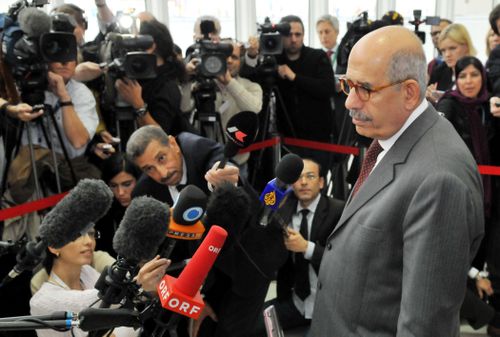
(Photo: International Atomic Energy Agency (IAEA) Director General Mohammed El Baradei gives short speech after the meeting of representatives from France, Iran, Russia and the United States at Agency's headquarters in Vienna on October 21, 2009. A draft agreement has been drawn up after talks between Iran, Russia, the United States and France on supply of enriched uranium to Tehran and sent to capitals for approval by October 23, 2009, UN watchdog Mohamed ElBaradei said. By Samuel Kubani/AFP/Getty Images).

Hoax Of The Year?

Josh Green makes his pick. From his review of fake McCain adviser Martin Eisenstadt's new book:

What’s consistently funny about the book is that for all that Martin Eisenstadt is an obvious parody, there is a striking similarity between his character and demeanor and those of many of the people you routinely encounter in green rooms and cocktail parties around Washington. This time, like the last time, the joke goes both ways. That’s why I intend it as real praise when I say that I Am Martin Eisenstadt is the best fake memoir of the campaign season.

The Military On DADT

Shauna Miller goes through the archives:

The DoD has funded studies on the impact of gay servicemembers as far back as 1957, when the Navy's Crittenden Report found "no factual data" to support the idea that they posed a greater security risk than heterosexual personnel … In 1988, the Defense Personnel Security Research Center — a DoD agency — conducted its own study on gay soldiers to determine whether their service under current policies created security risks, for instance in terms of blackmail. It also discussed, based on the military and wider social data available, whether the military's policies were sustainable. The study returned again and again to the facts of conduct: "Studies of homosexual veterans make clear that having a same gender or an opposite-gender orientation is unrelated to job performance in the same way as is being left or right-handed."

Obama As T-1000

T1000

Yesterday, a reader wrote:

Okay, I completely agree with your point about Obama, but the metaphor is killing me. "Mushy steel?" It makes my head hurt. Steel that was mushy wouldn't have the primary characteristics that you're trying to convey — sharp, deadly, unyielding.

How about the T-1000 android from Terminator 2: Judgment Day? T-1000 was made of mushy steel, and, as this un-embeddable YouTube shows, it was certainly "sharp, deadly, unyielding."

Whose Country?

One does not quite know what to say about Pat Buchanan's latest. Is it too predictable to note? Or too ugly to record? Or too stupid to ignore? Upon reflection, I'll go with stupid. Take one simple point. Notice that for Buchanan in this column, it is axiomatic that America was once defined by its whiteness. This is what he means by "tradition." America – once uniformly white – is now, for him and those he speaks for, bewilderingly multicultural and multi-confessional. Hence the anxiety. Hence the panic. Hence, in some ways, the confluence of fear and paranoia among the 20 percent of Americans who seem to feel this way and see the federal government in some way as the enabler of this destruction.

But this axiom, while useful as a myth, has a problem. It is untrue. And this "country" that white Americans are allegedly losing is not, in fact, a country. It is merely a self-serving and solipsistic illusion of a country that some white Americans feel they are losing.

From its very beginning, after all, America was a profoundly black country as well.

This took a while for an Englishman to grasp upon arriving here, because it's so easy to carry with you all the subconscious cultural baggage you grew up with. England, after all, is deeply Anglo-Saxon. It makes some sense to refer to England's roots and ethnic identity as white, its language as English, its inheritance as a deep mixture of Northern European peoples – the Angles and the Saxons and the Normans and the Celts. And superficially, English-speaking white Americans might seem in the same cultural boat as white English people, dealing with a relatively new multiculturalism in an increasingly diverse and multi-racial society. And at first blush, you almost sink into that lazy and stupid assumption, especially if you arrive in Boston, as I did, and carried all the usual European prejudices, as I did.

The English, lulled by their marination in American pop culture from infancy, and beguiled by the same language, can live out their days in this country never actually noting that it is an alien land – stranger than you might have ever imagined, crueler than you realized, but somehow also more inspiring than you ever thought possible. This is the America I am trying to make my home, after 25 years. It is not the America of Pat Buchanan's or John Derbyshire's fantasies.

It struck me almost at once, if only in the music I heard all around me – and then in so many other linguistic, cultural, rhetorical, spiritual ways: white Americans do not realize how black they are. Even their whiteness is partly scavenged from the fear of – and attraction to – its opposite. Even something as stereotypically white as American Catholicism, I discovered to my amazement, was also black from the very start. (Yes, those Maryland slaves. If you've never been to a Gospel Mass in an ancient black Catholic parish, try it some time.)

From the beginning, in its very marrow, this country was forged out of that racial and cultural interaction. It fought a brutalizing, bloody, defining civil war over that interaction. Any European student of Tocqueville swiftly opens his eyes at the three races that defined America in the classic text. Has Buchanan read Tocqueville? And that's why it seems so odd to me that the election of the son of a white mother and a black father is seen as somehow a threat to American identity for some, when, in fact, Obama is the final iteration of the American identity – the oldest one and the deepest one. This newness is, in fact, ancient – or as ancient as America can be. The very names – Ann Dunham and Barack Obama. Is not their union in some ways a faint echo of the union that actually made this country what it is?

That some cannot see Buchanan's cartoon as a travesty of history remains America's tragedy of self-forgetting.

It reminds me of the way in which Britain always defined itself as a Protestant country, even while, of course, it was deeply, deeply Catholic before it was ever Protestant – and for a much longer period of time. As a Catholic growing up in England, and having genealogical roots in both Catholic Ireland and in Domesday Book England, it took a while for me to appreciate the pied beauty of this identity. Tribalism is a powerful thing, especially for the Irish. I remember one day, as I was herded into the local Anglican church for my high school assembly, thinking: "This ancient building was once mine, ours." But that was before I realized that Anglicanism itself could not be understood without the profound inheritance of English Catholicism – and that Anglicanism was actually a hybrid of Protestant and Catholic Englishness. And that this was England – all of it. And to be truly English was to own it all.

Buchanan, of all people, should know better than these tedious recurring explosions of racial panic. And, of course, he does know better. He has read more history than most pundits. He is personally a civil and decent man. But he feels these things in such a profound and tribal way that what he knows is submerged by tribal fear and expressed as hateful hackery. But this much is true and deserves restating:

Black Americans have shed blood in every American war since the Revolution. This country, even the very Capitol building in which today's legislators now demand to see the birth certificate of the first black president, was built on the sweat and sinew of slaves. Before we were people in the eyes of the law, before we had the right to vote, before we had a black president, we were here, helping make this country as it is today. We are as American as it gets. And frankly, the time of people who think otherwise is passing. If that's the country Buchanan wants to hold onto, well, he's right, he is losing it.

And about time too.
The Assault On Human Rights Watch

That was quite an op-ed by its former head yesterday in the NYT. Robert Bernstein argued that violations of human rights were worse in closed than in open societies and that it was therefore important to focus on abuses in the former rather than the latter. That takes us back to the old moral equivalence debate. And Bernstein is obviously right that repression in countries surrounding Israel is exponentially worse than anything in the Jewish democracy. The question is whether that should lead us to ignore abuses by Israel or the US, for example, because overall, their records are far better. I don't see why we should. In some ways, because these abuses are more capable of being reversed in democratic societies, it makes pragmatic sense to include them, as long as the larger context is maintained. And that leads to Bernstein's clincher:

The region is populated by authoritarian regimes with appalling human rights records. Yet in recent years Human Rights Watch has written far more condemnations of Israel for violations of international law than of any other country in the region.

That was indeed striking to me. So I went to the HRW website, which has a list of its reports on various human rights questions over the last few years. Go check it out for yourself.

I guess "written" and "condemnations" is a vague formulation, so Bernstein may be referring to something beyond these reports. And violations of "international law" may be affected by Israel's many wars beyond its borders, compared say, with Egypt's or Jordan's. But in the Israel and Occupied Territories section, I counted several reports on both Israeli and Palestinian abuses. Here are a few Bernstein may have missed in the last two years alone:

Hezbollah’s Rocket Attacks on Israel in the 2006 War

Palestinian Rocket Attacks on Israel and Israeli Artillery Shelling in the Gaza Strip

Violence against Palestinian Women and Girls

The Perilous Situation of Palestinians in Iraq

Palestinian Abuses in Gaza and the West Bank

Hamas Political Violence in Gaza

Harm to Civilians from Palestinian Armed Groups’ Rocket Attacks

The Egypt section is as long as that devoted to Israel and Palestine; the Iran section seems to me in need of urgent updating. But although it's obvious that Israel's very openness can lead to more scrutiny than of more repressive societies, I don't see an Israel obsession or an obvious anti-Israel bias on the website. What trikes me is the really diverse groups of countries. Recent publications are striking in the range of their topics – from abuses of various kinds in countries as varied as Burundi, India, Nepal and Saudi Arabia.

What I do see is a refusal to grant democracies any leeway on these matters. I think that's a healthy thing. What's unhealthy is obsessing on Israel out of proportion to its offenses, and using the democratic nature of the West to somehow excuse its own violations of international law. After Gaza and Gitmo, that is unhealthier than ever.