Mousavi Speaks, Ctd

Here is a transcript. Enduring America's snap analysis:

Indeed, Mousavi does not see the primary role for himself (and presumably the Green movement) as part of the [National Unity] Plan. Instead, “National Unity” for him has a second meaning — it is a social movement, beyond political parties, encompassing and furthering the ideals of the Iranian nation and the Islamic Revolution. This “expression of national will”, despite all the obstacles put up by the Government, will be triumphant. All well and good, but that leaves a pretty big immediate question. Given that the Plan has now been submitted to the Supreme Leader for consideration and thus approval, does Mousavi accept it if all parties involved decide to proceed? Does he dare reject it? Or does he, as I suspect he will, stand aside from it with the declaration that “National Unity” transcends any political arrangements?

Reihan Defends Rove, Ctd

Reihan explains why he wrote that “Karl Rove never imagined that opposition to same-sex marriage would cement a permanent Republican majority. It was a distraction that I’m sure he found distasteful”: 

I think I was seriously, seriously misunderstood here. If I could write it again, I would definitely write it differently. Note that this isn’t a position that’s very flattering to Rove — it suggests that he was a hypocrite who was using this position to political advantage. And I certainly shouldn’t have said, “I’m sure,” as I don’t live inside Rove’s brain and I’ve never met the man. I was basing this, rather carelessly, on news reports concerning his warm relationship with a gay father-figure, and I thought, “Surely he can’t be a hateful goon in his personal relationships.”

More to the point, I think it really is true that Bush and Rove were, when they were setting out to win the presidency and remake the country, had in mind a domestic policy agenda focused on spreading asset ownership — Social Security reform, encouraging low-income families to buy homes, etc. It turns out that almost all of these ideas were actually pretty bad ideas, at least in the form that Bush and Rove had in mind. But that doesn’t change the fact that they cared about those issues far more than “social issues.” (The scare quotes are there because I think a lot of “economic issues” are in fact “social issues.”)

I cannot know Karl Rove’s conscience. Yes, he has no record of personal hostility toward or contempt for gay people, including openly gay people. But that makes his cynical use of homophobia all the more wretched. I’m sure he saw himself as a reformist visionary who had to stoop to fear-mongering to win power. But that’s how most people do evil; they think it’s a means of doing good.

The Palinites March On

John Ziegler, who lives in Wasilla World, is a Savonarola of far right conservatism. A Palin true-believer, he cannot see resistance to this half-cracked vice-presidential candidate as anything but treason. And so even someone as hardcore as David Keene has to be tackled. Advantage: Keene. Meanwhile, even the base appears to be wilting a little. Rasmussen is a dubious polling shop, but they do poll the GOP base very thoroughly. The results reveal a Republican voting bloc not entirely as nutso as the activists.

Hollywood’s “Don’t Ask Don’t Tell” Hypocrisy, Ctd

A reader writes:

I have to push back a little on your analogy between the military's DADT and Hollywood's DADT. First of all, the ability to serve your country in uniform is much more basic and much closer to a 'right' than the ability to star in Hollywood movies. More importantly, a person's sexuality has nothing to do with their competence as a military person. But Hollywood stars are literally selling sex on screen. For 'movie stars' in particular (as opposed to character actors), sex appeal and sexuality are the most important asset that a candidate can have. Thus, it seems a little more logical that their sexuality has to be managed, etc.

This really gets at a larger point, which is that Hollywood's decisions are based on what people will watch, and if Jake Gyllenhall (or whoever) came out of the closet, middle America would not go see Prince of Persia (or whatever). Thus, being in or out of the closet materially effects a movie star's ability to do his/her job, as opposed to a military person. I don't mean this to be a full-throated defense of the film business. It's cutthroat, at times bigoted, and always frustrating. But it's not the same as the US military, and it's certainly not something Brad Pitt or Barbara Streisand has control over.

Another writes:

First of all, as a television executive and filmmaker, I hate it when anyone refers to "Hollywood" as if it's one company, or even a cohesive group – it is not. The only thing the separate pieces have in common is that they exist to make money. Which leads to…

Secondly, it is AUDIENCES (not executives) who can't buy a known-gay actor playing a hetero romantic lead. The only exception I can think of is Neil Patrick Harris, but he's a comedian and he isn't taking on rolls where he's engaged in a serious hetero relationship. If Tom Cruise, Brad Pitt, George Clooney, etc. came out as gay, they'd never make it in a big-budget romantic film again. And it isn't just male audience members, either. Tell a young woman that Brendan Fraser is gay, and watch her shriek in denial.

As for gays in other parts of the industry, I've worked with a number of openly gay co-workers and bosses. That I could see, it hadn't hurt their careers one bit. Certainly there's nothing there even remotely resembling DADT.
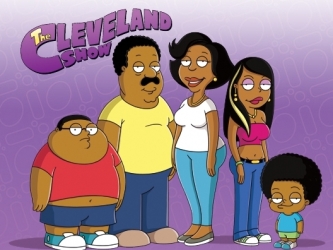
“Family Guy In Blackface”

Cleveland_show

John McWhorter – not easily offended by racial issues – is offended by Seth MacFarlane's new cartoon spinoff:

The question is: would the Family Guy people create a show where a white supporting character – say, paraplegic Joe voiced superbly by Patrick Warburton —  moves to another town and settles in with retreads of the Family Guy characters? No – it’d be seen as folly to let that get beyond a conversation over beers. The reason it felt right to pull this with The Cleveland Show is because of a sense that blackness is so much a “thing,” so diverting in itself, that painting the Family Guy people brown makes artistic and commercial sense. And there was a time when it did – but it was a time we’re all happy to be past.

That’s Entertainment! Ctd

Frum answers Scott Adams' query:

Yes of course Limbaugh and Beck express the same views in private as in public. Consistent hypocrisy demands exorbitant levels of imagination, energy, and cynicism. Much less exhausting over time simply to bring your private views into alignment with what you are paid to say in public.

Let me put the thought experiment slightly differently however. Suppose an agent arrived in the offices of Limbaugh/Beck/Hannity/O’Reilly etc. with an offer. “I can guarantee you a deal that will pay you twice as much – bring you twice as much fame – and extend your career twice as long – if you’d say the exact opposite of what you are saying now.” Which of them would sign?

My nominations: O’Reilly accepts for sure. Beck likewise almost certainly says yes. Limbaugh would want to think it over, but would ultimately say no.  Mark Levin: certainly not. Sean Hannity would need the offer explained a few times. Ann Coulter – that one puzzles me – but probably no. Roger Ailes? Do you even need to ask?

I can't grapple with Coulter either. I assume it's an act. But it could be an act that has become so internalized it has become her. Poor, lost soul.

The Liberal Beck And Limbaugh?

Mark Liberman coins a new term:

Overall, the promotion of interesting stories in preference to accurate ones is always in the immediate economic self-interest of the promoter. It's interesting stories, not accurate ones, that pump up ratings for Beck and Limbaugh.  But it's also interesting stories that bring readers to The Huffington Post and to Maureen Dowd's column, and

it's interesting stories that sell copies of Freakonomics and Super Freakonomics.  In this respect, Levitt and Dubner are exactly like Beck and Limbaugh.

We might call this the Pundit's Dilemma — a game, like the Prisoner's Dilemma, in which the player's best move always seems to be to take the low road, and in which the aggregate welfare of the community always seems fated to fall. And this isn't just a game for pundits. Scientists face similar choices every day, in deciding whether to over-sell their results, or for that matter to manufacture results for optimal appeal.

(Hat tip: Crooked Timber)