Are Videogames The New B Movies?

Peter Suderman speculates:

Absurd, mega-budget summer blockbusters like Transformers and G.I. Joe have siphoned off a lot of the energy that used to go into making moderately priced genre flicks, but recently, it’s struck me that another part of the equation is probably the emergence of scripted, action-movie style video games — everything from the Halo games to Assassin’s Creed and Half-Life. I’ve been playing a lot of Killzone 2 this week — which, by the way, I highly recommend — and, in many ways, it’s really just an interactive B-movie. The scripted bits that carry along the in-game action consist almost exclusively of tough-guy cliches pieced together from the last forty years of action movies, comic books, and war films. It’s silly, outrageous, over-the-top, and incredibly entertaining — just like a good B-movie should be.

And B-list actors are already getting the picture.

That Mushy Steel

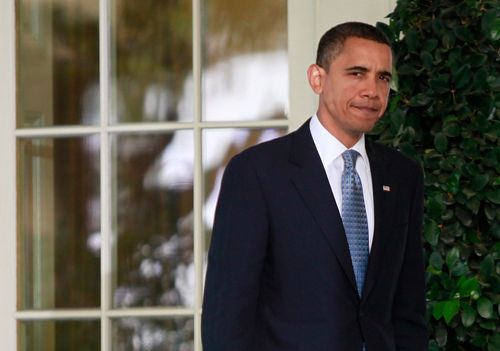
OBAMA09MarkWilson:Getty

My column this week tries to parse this president's style of pragmatism. History alone will determine if it's effective in the long run, but this is my best attempt to explain it in real time nine months in:

There is a strange quality to Barack Obama’s pragmatism. It can look like dilly-dallying, weakness, indecisiveness. But although he may seem weak at times, one of the words most applicable to him is something else entirely: ruthless. Beneath the crisp suit and easy smile there is a core of strategic steel. In this respect, Obama’s domestic strategy is rather like his foreign one — not so much weakness but the occasional appearance of weakness as a kind of strategy. 

The pattern is now almost trademarked. He carefully lays out the structural message he is trying to convey. At home, it is: we all have to fix the mess left by Bush-Cheney. Abroad, it is: we all have to fix the mess left by Bush-Cheney. And then … not much. 

The agenda may be clear. He wants an engaged Iran without nuclear weapons. He wants to be the first American president to enact universal health insurance coverage. He wants a sane two-state solution for Israel/Palestine. He wants to leave Iraq without having it blow up on him. He wants to find a way to solve the AfPak Rubik’s Cube. He wants to allow gays to serve openly in the military. But on all these things, it’s mid-October and still … nothing substantive. So obviously, he’s a total fraud and failure, right? 

Wrong. 

He sets out a goal and then he waits. He waits for the other players to show their hand. He starts a process that itself reveals that certain options are unfeasible, until he is revealed by events to have no other choice but … well, the least worst practical way forward. He always knows that things can change, and waits for the optimal moment to seize the initiative.  

On Iran, for example, he has done not much more on the surface than open up direct talks. Beneath, you see deeper shifts. His election itself and his Cairo speech laid some important groundwork for June’s Green revolution. He managed to inspire the opposition without throwing his lot in with them (playing the supreme leader, Ayatollah Khamenei, with finesse). In America, he has slowly defused the debate away from the polarising “Are you a patriot?” or “Are you with those scary Muslims?” to the more realistic: “If we want to keep Iran from having a nuclear weapon, what’s the least worst way of trying — or is it impossible after all?” By waiting, we learn. 

We now know, for example, that Russia’s president, Dmitry Medvedev, is more sympathetic to sanctions against Iran than Vladimir Putin. We learn more about divisions within the Tehran leadership. We may also discover that even with a transparent, good-faith engagement from Obama, the Chinese and Russians have no intention of shifting. That will leave him with a clearer, if narrower, set of policy options. The president can afford to do this because he has more power than anyone else. But he doesn’t have total control, especially as America’s global power is balanced by China, India and Russia. He’ll act when he knows what the options really are. And not until.

On health insurance reform, you see the same cunning.

Continued here

(Photo: Mark Wilson/Getty.)

Do You Know What I am Saying?

A reader writes:

My stepson came over to visit. He is a lifelong criminal and "num sayin" follows every sentence. We watched Butters and my stepson rolled in the floor laughing. He promised if/when he goes back to prison, he plans to change the lexicon with "do you know what I am saying."

Thank God for South Park. I am pretty sure I am my wife's bottom bitch.

Not. Going. There.

The Gain In Maine

Two critical editorials today find the campaign against marriage equality based on … nothing but fear-mongering

Arguments that same-sex marriage would inhibit religious freedom or cause a flood of lawsuits also fall flat. The same claims were made in campaigns against Maine's anti-discrimination laws and neither of them came true. Maine has strong exemptions for religious organizations in its employment and housing laws, and the marriage law would not require anyone to preside over a ceremony in violation of his or her religious beliefs. Last year, only 32 out of 1,394 civil rights complaints to the Maine Human Rights commission were based on sexual orientation, and few, if any of them, are ever likely to end up in court. The marriage statute would not provide any new grounds for lawsuits. 

Although the "Yes on One" campaign says that its opposition is not based on religious objections to homosexual behavior, that's all that's left when the other arguments are disposed of. People are entitled to their beliefs, but religious teaching alone shouldn't be the basis of our law. 

 And from Bangor

It is hard to see how allowing more people to marry will weaken marriage. Instead, it seems the strong desire of gay and lesbian couples to be married, rather than declared domestic partners, shows the value and importance of marriage. Voting no on Question 1 will reiterate Maine’s commitment to equality and acceptance of families of all types while respecting religious traditions and beliefs.

The Return Of Coughlinism

SWOONRobynBeck:AFP:Getty

I was struck by these comments from the recent Carville-Greenberg focus group study of the conservative base:

I just think that Obama was molded and I think that he is being fed what he can and can- not do and what to do next and it seems like he is a puppet in this whole game. I don't know who the people are behind him really but I don't think it is him. I think it is some- body, I think he is just the figurehead… I think it is George Soros… I do too… Is he the guy with money?… Yes… They say follow the money.

I think he has a money person behind him that has planned this long before because he has gotten pushed into a position that is unbelievable for a community organizer … I come from Chicago so I know how he got there and I don't like his tentacles into ACORN and everything else that are subsidiaries and it all goes back… He couldn't do it by himself.

These people believe there is a hidden plot to destroy America, and it has something to do with black community organizations and Jewish money. There's a powerful, lingering sense – exploited by Beck – that there's some kind of deception behind all this, some shadowy plot that even they don't quite understand, but somehow know it's there:

That is why everything is closed, because he didn't want you to know these things. He has closed his college records. You can't go through there…

The records from the hospital in Kenya and I think there are some areas in Hawaii and also something to do with his involvement in government in Illinois, but in every place that he has gone there have been areas that he has closed files. Every other president has allowed their background and who they are to be exposed, to be investigated except for this president… And why is that?…

Just everything. I mean where you were born, where you went to school, what are your school records… And how dare you ask… I mean it goes on and on and on.

The trouble for the GOP, of course, is that the critical votes they need – those of fiscally conservative independents – worry about Obama's policies and the threat of bigger government, but don't buy the hysteria, conspiracy theories or contempt for the president:

The independent voters expressed clear concerns about Obama – especially that he is doing ‘too much, too fast,’ that he is spending too much, that they do not understand his health care reforms, and that he does not have a clear plan for bringing jobs back to the US – some of which certainly touched on the conservative Republicans’ concerns. But they still fundamentally like and respect him on several levels and are very clearly rooting for him to succeed. 57 percent of these voters believe that Obama is willing to work with both parties, and 45 percent see him as a strong leader.

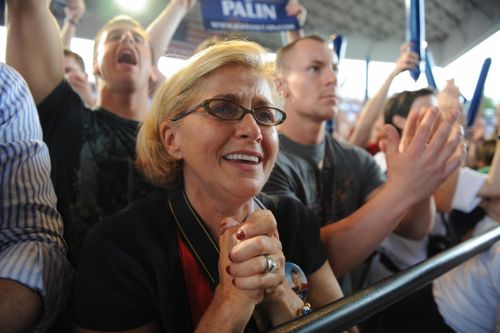
The GOP base, in other words, has created a wedge for Obama. And the more convinced the Beck-viewers get, the more estranged they become from the sane, independent voters who can bring the GOP back. The greatest emblem of this is – surprise! – Sarah Palin, who is the clear favorite of the base for the next presidential race. Again, the gap between the views of the base and the nearest group of conservative independents is vast:

When it comes to Sarah Palin, there was almost universal agreement that she could never be elected president, with most citing her inexperience and  baggage as obstacles too great to overcome.  But even more important to them, most felt she was ultimately driven by greed and ambition more than anything else and would rather use her new-found fame to enrich herself than improve the country.

But for the base, she's iconic. If I had to guess, I'd say she'll be the next nominee.
Is Faith, Or The Lack Thereof, A Choice? Ctd

A reader writes: 

My experience is different from your reader's. I grew up in a picture postcard New England Protestant church that was burnt down by the British, twice, for storing rebel arms. My mother and two of my brother are still very religious. I started out distrustful of organized religion, but with a general belief in God and Jesus, and it wasn’t until some of my wife’s friends went evangelical that I started to question my own beliefs. 

I decided I wanted to learn what was the “truth”. I read a number of books, Ehrman in particular, and came to the conclusion that the corruption of faith was much worse than I had thought, and that we really don’t know beyond bold strokes what Jesus really taught. 

From there I started reading some works by Harris, Dwakins, and others and became a 98% atheist. But I haven’t stopped there, now I’m reading about the “Evolution of God”. Who knows, maybe I’ll get more religious later in life, but at the moment I doubt it. 

So unlike your reader I did make a choice based on research and a (hopefully) rational weighing of the lack of evidence. Ehrman started out not particularly religious, became a hard line evangelical, and then became at least an agnostic if not an atheist. So I do believe that one’s religious beliefs are a choice, it maybe a choice that many people are born into and never leave their comfort zone to question, but it is a choice.

Why Cults Exist

Cracked passes along "6 bullshit facts about psychology that everyone believes." On cults:

Studies show cult members are just as intelligent, if not more so, than the general public. And around 95 percent of cult members are perfectly sane (when they join up, anyway), with no history at all of real psychological problems. They're not stupid, and they're not crazy. Of course this only serves to make cults even scarier. How in the hell do these groups get people–who are every bit as sane and smart as your best friend–to join up?

As social animals we are hard-wired to want to belong to a group. It's a need as basic and real as hunger or sex. When we get cut off from our group–say we lose a job, or move to a new city, or break up with our girlfriend–we go a little crazy. Cults are very, very good at finding people in that exact moment of weakness, and saying exactly the right things. Those pamphlets that sound so corny and transparent to you, read like a glorious breath of fresh air to somebody caught in one of those rough spots

Atheism And Antitheism

Freddie at Ordinary Gentlemen returns to an old point of tension among atheists:

[T]here is an elementary consonance between evangelist religion and evangelist antitheism that I find inarguable, that both insist that their adherents have duties and responsibilities that are a product of their theological stance. I chafed early and often against the social expectations of atheism for a simple reason: I dislike being a foot soldier. I cannot work my mind to the headspace necessary to believe that emptiness insists that we must be conscripted into a grand cultural war. I have said before that the real benefit of being an atheist is that you never have to get up early to go to church or temple. I say that only partly in jest: to me, what makes atheism attractive as a practical matter is that it requires nothing of me. It asks me to observe no sacraments. It imposes no ideology on me. It provokes me to do nothing and leaves me only to live in a way consonant with my conditional and contingent values.

And, yes, those values compel me to oppose the influence of religion on government and public policy. Those are values that are shared by many who are religious and practicing. Indeed I have found in the experience of my own life that one person more dedicated to the separation of church and state than anyone else I know is a Congregationalist minister. This is again the simplest grace of democracy: that for all of the ways it fails in this, it offers at least the prospect of commensurability that is dependent on ideas and not on identity. A belief in the egalitarian necessity and pragmatism inherent in a rigorous separation of church and state is not necessarily a product of any particular inclination towards theistic claims. It is this, in part, that inspires a belief that tends to get me in the most trouble among other atheists: I find that the existence or nonexistence of God is utterly irrelevant to the question of how atheists should treat the religious.

Map Of The Day

McAmerica

Strange Maps passes along a map showing the density of McDonald's:

There are over 13,000 McDonald’s restaurants in the US, or about 1 for every 23,000 Americans. But even market penetration this advanced doesn’t mean that McDonald’s is everywhere. Somewhere in South Dakota is the McFarthest Spot, the place in the US geographically most removed from the nearest McD’s (*). If you started out from this location, a few miles north of State Highway 20 (which runs latitudinally between Highways 73 in the west and 65 in the east), you’d have to drive 145 miles to get your Big Mac (if you could fly, however, it’d be only 107 miles).