I have faith. Faith in existence. Faith that does not believe in my self, but believes in the infinite. My self is an illusion: when you meet me, all that you are meeting is every experience that has come before this moment. I cling to my pain, my ideas, my opinions, my love, because that clinging gives me identity — but these things are not mine to have, they are only the residue that is left of my experiences. There is only one person/thing: Consciousness, though it takes many separate forms and travels many separate paths.
Arguing over religion is simply that: arguing. All is true. All is real. All is necessary.
If anything, man needs to disabuse itself of its belief in man. All that you see is time expressing itself. You and everything else are but an expression of time, no more. When you have had all of your experiences, there will be no more, but consciousness will remain.
Don’t fear death, it has already happened. The moment you were born somewhere out there in the mist of the future you were also dying.
This is the miracle. It is all around us, if only we have eyes to see it.
Richard Zenith translates poet Fernando Pessoa's notebooks. A snippet:
In its essence life is monotonous. Happiness therefore depends on a reasonably thorough adaptation to life’s monotony. By making ourselves monotonous, we make ourselves equal to life. Thus we live to the full. And living to the full is to be happy…It seems, at first glance, that new things are what give pleasure to the mind; but there aren’t many new things, and each one is new only once. Our sensibility, furthermore, is limited, and it doesn’t vibrate indefinitely. Too many new things will eventually get tiresome, since our sensibility can’t keep up with all the stimulations it receives.
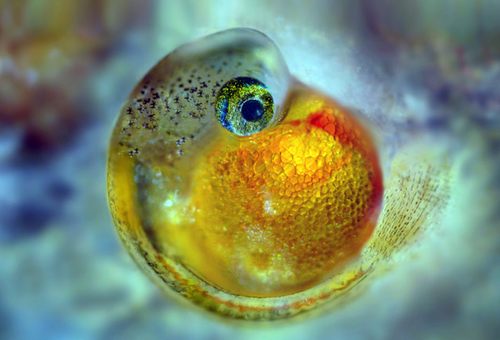
Above is a photo by Shamuel Silberman of a guppy fish Embryo forty times normal size. It was an entry in Nikon's annual Small World photomicrography competition. The winners were announced late last week. Wired shows off this year's winner and has compiled winning photographs from previous years.
One of the larger themes about the project is the sameness of the American experience, of how wherever you are in the country, you can eat the same food at the same restaurants and shop at the same stores. That for me was one of the central ideas about it. But then in the execution about it, you go and find that maybe they do serve the same steak, but in different buildings, in different neighborhoods. And all the people who work there bring their own unique experience to the place. So no two are exactly alike.
Properly understood, the first question underlying the AI debate is: Can the properties of the mind be completely described on their own terms as an algorithm?
Recall that an algorithm has a definite start and end state and consists of a set of well-defined rules for transitioning from start state to end state. As we have already seen, it was the explicit early claim of AI proponents that the answer to this question was yes: the properties of the mind, they believed, could be expressed algorithmically (or “procedurally,” to use a more general term). But the AI project has thus far failed to prove this answer, and AI researchers seem to have understood this failure without acknowledging it. The founding goal of AI has been all but rejected, a rejection that carries great significance for the central presumption of the project but that has gone largely unremarked. As an empirical hypothesis, the question of whether the mind can be completely described procedurally remains open (as all empirical hypotheses must), but it should be acknowledged that the failure thus far to achieve this goal suggests that the answer to the question is no—and the longer such a failure persists, the greater our confidence must be in that answer.
Last week ABC radio interviewed German philosopher of mind Thomas Metzinger:
The physical body certainly exists, the organism exists, but organisms are not selves. I don’t deny that there is a self-y feeling. I certainly feel like someone, but there is no such thing. There is neither a non-physical thing in a realm beyond the brain or the physical world that we could call a self, but there’s also no thing in the brain that we must necessary call a self.
Of course Buddhist philosophy had that point 2,500 years ago. So the idea that, as philosophers say, the self is not a substance, that it is something that can stay and hold itself in existence, even if the body or the brain were to perish, that’s not a very breathtaking and new idea. What I am interested in is to understand why we just cannot believe that this is so. We have the feeling there is an essence in us, a deepest, inner core. We have this feeling that there must be something that is just not right about neuro-scientific theories about self consciousness, there’s something beyond it. And I want to understand what that deepest core is because that’s the origin of the subjectivity of consciousness.
One of his more frightening thoughts:
I mean, how will our culture actually react to a naturalistic turn in our image of man, if there’s no supernatural root even in our minds anymore, and we actually have to come to terms with the fact that not only our bodies but also our minds are results of a process that had no goal, that was driven by chance events…I mean, how are we going to come to terms with this? Will we develop a culture of denial, or will we all become vulgar materialists?….I think, to put it very simply, we could do it by just thinking not only about what is a good action but what is a good state of consciousness. What states of consciousness do we want to show our children? How can neuroscience help us with optimising education? What states of consciousness are we allowed to impose, to force upon animals? Are all these experiments in, say, primate research, in consciousness research, in neuroscience ethically tenable? What states of consciousness should be illegal in our society? New drugs. What states of consciousness do we want to foster and cultivate?
It’s also a question of preserving our dignity in the face of these sometimes very sobering discussions, and in developing a cultural response to it. Can modern science help me? It’s not only about defending ourselves, it’s also about what I call riding the tiger; can all this new knowledge help us to improve our autonomy, maybe also our rationality? How can I take responsibility and charge for the way I deal with my own brain? Can it help us to die better deaths? Who knows? But I think we should all, not only philosophers and scientists but all of us, start to think about what we want to do with all these new brain/mind technologies. Just looking the other way won’t make it go away.
[A] way the Web has affected the human attention span is by allowing greater specialization of knowledge. It has never been easier to wrap yourself up in a long-term intellectual project without at the same time losing touch with the world around you. Some critics don’t see this possibility, charging that the Web is destroying a shared cultural experience by enabling us to follow only the specialized stories that pique our individual interests. But there are also those who argue that the Web is doing just the opposite—that we dabble in an endless variety of topics but never commit to a deeper pursuit of a specific interest. These two criticisms contradict each other. The reality is that the Internet both aids in knowledge specialization and helps specialists keep in touch with general trends.
He also explores how blogging accelerates learning.

 The Dish