The BBC apes The Onion.
Month: October 2009
Virtue: All The Way Down?
Jeremy Waldron studies what Aristotle intuited:
Virtue theorists believe that the disposition to act and react courageously or honestly is deeply entrenched in a person's character. As Appiah describes their position, a virtue is supposed to be something that "goes all the way down," enmeshing itself with other aspects of character, equally admirable, and affecting what a person wants out of life, her conception of happiness, and her views of other people. Are there such virtues? Well, the psychologists that Appiah has read report that character traits do not exhibit the "cross-situational stability" that virtue presupposes.
DiA summarizes Waldron's argument and applies his reasoning to politicians.
How Could A Loving God Have Done This?
In 2005, a few months after the South Asian tsunami, Rev. Tom Honey dealt with several of the issues the Dish has been wrestling with recently:
How Open Government Demoralizes
Lawrence Lessig argues against total transparency:
How could anyone be against transparency? Its virtues and its utilities seem so crushingly obvious. But I have increasingly come to worry that there is an error at the core of this unquestioned goodness. We are not thinking critically enough about where and when transparency works, and where and when it may lead to confusion, or to worse. And I fear that the inevitable success of this movement–if pursued alone, without any sensitivity to the full complexity of the idea of perfect openness–will inspire not reform, but disgust. The "naked transparency movement," as I will call it here, is not going to inspire change. It will simply push any faith in our political system over the cliff.
And this is a bad thing? Lessig again:
All the data in the world will not tell us whether a particular contribution bent a result by securing a vote or an act that otherwise would not have occurred. The most we could say–though this is still a very significant thing to say–is that the contributions are corrupting the reputation of Congress, because they raise the question of whether the member acted to track good sense or campaign dollars. Where a member of Congress acts in a way inconsistent with his principles or his constituents, but consistent with a significant contribution, that act at least raises a question about the integrity of the decision. But beyond a question, the data says little else.
The Seven Year Itch
Stefan Sagmeister on the power of time off (the first half of the video is better than the second half):
(Hat tip: Core77)
Is Faith, Or The Lack Thereof, A Choice?
A reader writes:
In a recent post, you wrote that "Even if you believe, erroneously, that homosexuality is a choice, so, obviously, is religion." I've heard that from a number of people recently, and I'm curious as to whether this is actually true. I certainly don't remember choosing to be an Atheist–as far back as I can trace, it simply fit in with what I believed and how I perceived the world around me. At what age did I choose to be an Atheist? What were my range of choices? Does the fact that both my parents were atheists decrease my choice?
I'm curious as to when you chose to be a Catholic. When you write about your belief and faith, I don't recall getting the sense of you weighing multiple options and choosing the best answer. Often, faith can be very, very difficult.
People ask me what it is like to believe in "nothing," or to not know what comes after death. I can say one thing: it isn't easy. Sometimes I get a panic attack when I find myself imagining what it's like on the other side. Sometimes, when I find myself in troubles, I wish that there was something outside of myself that would arrange the situation so that it would work out in the end. It would be very convenient for me to believe in that. And I don't blame those people who do believe that–because I don't think they chose to. I think they believe in it because, well, they believe in it. I don't believe I have the capacity to simply choose to believe in God, or in Christ's love, the way I can choose what I'm going to wear tomorrow.
That's why I detest the smugness of the New Athiests. Their scorn and anger towards the religious of the world comes from their belief that beliefs are a rational choice, taken in the cold light of day, selected from facts. They think that they chose to be enlightened, and that those who didn't choose the same enlightenment are choosing to be ignorant.
My point was a narrow one: if you only support hate crime laws for what are called "immutable" characteristics, then you cannot coherently include religion and exclude sexual orientation. Even if religion is not experientially a choice in the first place – like, say, a free-standing choice between gelato flavors – it can certainly be abandoned later. In fact, a huge number of Americans shift their faith attachments over a lifetime – far greater than the minusucle number of people who claim to have been "cured" of homosexuality. The only explanation for the far right's embrace of hate crimes for religion and not sexual orientation is animus.
The broader points my reader makes I take entirely.
The View From Your Window

Paris, France, 2 pm
Small Things
Norm Geras joins the psychologists explaining "one nagging thing they still don't understand about themselves":
I don't understand why small things – small bad things, small good things – can make me feel either down in the dumps or cheerful about life, even knowing that they're only small and don't really define the basics of well-being. You get something awkward to deal with in the post. Or someone pays you a compliment. Multiply by two or three on either side and it can take the shine off your day or give it a real lift, even though in each case it's quite trivial. I don't understand why knowing this doesn't change it. And I don't understand why if I'm feeling down in any low-level way of this sort, just doing something usually takes care of it. It can have that effect even when the original cause of the down feeling bears no relation to the thing I do in order to start feeling different.
Face Of The Day
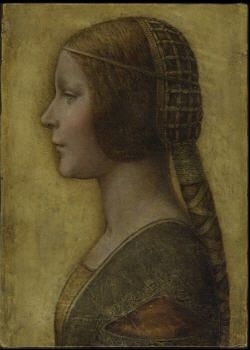
Newser captions:
A painting bought for $19,000 by a Canadian dealer two years ago has been valued at $150 million after it was determined to be a work by Leonardo Da Vinci. Carbon dating and infrared techniques convinced experts that the portrait on vellum was a genuine Da Vinci. The final proof came when analysis found a fingerprint "highly comparable” to one on the artist's painting, St. Jerome. […] The portrait is the first major Da Vinci find in more than a century.
The 401(k) Experiment
Pivoting off an anti-401(k) Time article, Doug Short worries about individual retirement accounts:
I see the IRA, 401(k) and the like as a social experiment of staggering proportions. A few decades from now history will tell us whether these plans generally succeeded or failed. Unfortunately, failure will not be limited to the households living in poverty. It will impact the entire economy. Thus, regardless of our personal values, beliefs and politics, the risk is indeed a shared risk. In my opinion the evidence so far isn't very encouraging. These voluntary savings plans may work well for us…But …we're a distinct minority…more numerous than south paws, but probably not by much.
 The Dish