Palin Polls Like Quayle

PalinAndQuayle

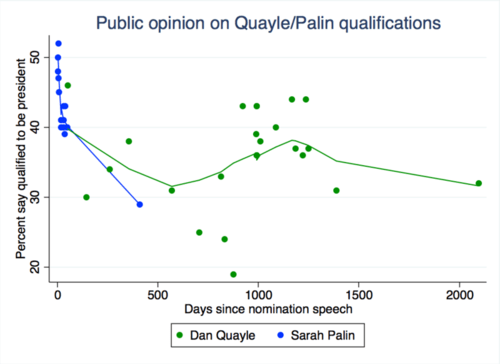
Brendan Nyhan compares:

[P]erceptions of Palin's qualifications are unprecedented among presidential/vice presidential nominees and major presidential contenders in recent years. From Joe Biden to George W. Bush, no one has been perceived as less qualified since Dan Quayle and Ross Perot. The Palin-Quayle parallel, which Jon Chait nailed soon after her nomination, is particularly striking. Each was a surprise VP pick who sparked initial enthusiasm but later became widely perceived as incompetent.

The Bush Recession

A Fox News poll finds that 58 percent believe that George W. Bush is more responsible for the current state of the economy than Barack Obama. Neither is fully responsible, of course. Presidents aren't that powerful. But the public fully understands that the roots of the crash go back a long way and it seems they are rightly patient in expecting Obama to work miracles.

“Tenacity”

I do not doubt David Brooks' formulation that fighting and winning wars requires tenacity. The question, in a case like Afghanistan, is whose tenacity? David focuses on the president. I'd focus on the American people.

Currently the country is split roughly in half on whether to escalate or de-escalate Afghanistan. That's after eight years of occupation. The time-scale of the minimal task in front of us – to prevent a second Taliban take-over – is a decade more at least. Jon Rauch helpfully elaborates:

The path to a stable Afghanistan — to a benign central government that can defend itself and control its territory — is longer than most Americans realize. "We're certainly talking years, and probably decades," Douglass North says.

"It's a daunting process, and it's troubling, because I don't think most people appreciate that you'd be getting into something very costly. You've got to be willing to devote an enormous amount of time and resources."

Obama needs to make a decision not about whether he has the tenacity, but whether the American people and future presidents will be willing to sustain a decades-long occupation of one of the least politically mature cultures in a mountainous and hard-to-reach landscape … with no guarantee of success even with the largest number of troops now envisaged. I think the question answers itself. But the institutional and political interests in sustaining this endeavor are far too great to resist. So a war with weak public support by a state already bankrupt in a country close to ungovernable will continue.

Which is how empires always collapse.

Nozette’s Motivation

Maybe there's a clue in this letter, where he seems to have a grudge against "the Clintonistas" who had not been fans of SDI and were too cozy with NASA. Here's the text:

You might want to point out that we also did Clementine as a test of the SDI Brilliant Pebbles concept, and also discovered ice on the moon, for $80 M. It had been sitting there since will before Apollo (say a few B yrs) and NASA never flew to check it out. Part of the motivation was to demonstrate that things could be done cheaply in space, also necessary for effective defense.

The entire Goldin Faster Cheaper Better mantra grew out of SDI, endorsed by the Space Council as you recall, and all of NASA’s current crop of robotic missions are being built off of what SDI developed and tested with Clementine, and the Delta series experiments. But NASA has had a mixed record in implimenting it, the only outfit that is doing it well is APL, a DoD/SDI lab, and Spectrum Astro, an SDI created company.

The threat of SDI, the validation of what Reagan achieved, and the threat of cheap space to NASA and the Clintonistas was large enough that the first use of the line item veto was to torch Clementine follow-ons and DC-X follow-ons. We had to get into space to show the Soviets we were serious and it worked on several fronts.

The lunar ice will alone be worth well more than was ever spent on SDI and its just a side benefit, the current economic benefits to the US as you know of the success of SDI is incalcuable. You might want to post this on the site to respond to our French friends, who by the way have every reason to try to subvert US military space power and use useful mouthpieces along the way.

Stu Nozette

Toward a General Theory of Democratic Disgruntlement

Nate Silver wonders why Democrats approve Democrat-controlled congresses less than Republicans approve Republican-controlled congresses:

Pollster Celinda Lake spoke to first, and perhaps most crucial point in her email reply to me. "It’s easier to unify Republicans because mostly they want to stop things. It’s harder to unify people when you want to do things." (emphasis added) Therein lies the broader asymmetry: Doing nothing is a single thing, whereas doing something implies many options. And it is easier to build consensus around a “nothing” menu of 1 than it is for a more variegated menu of limitless options of “something.”


This is, I grant, not a particularly profound observation. Indeed, the idea that the status quo ante enjoys an advantaged position is a core assumption in social choice theories–especially as they apply to American politics, what with its separation of powers and supermajority rules and other constitutional and extra-constitutional rules and strictures designed to slow progress. That reality remains true regardless of the prevailing distribution of political attitudes, their intensity, and so on: It is an ineluctable fact in American politics it’s hard to do something, but even harder to reverse or undo or change course once it’s done.

Cherry-Picking Experts

Freddie at Ordinary Gentleman argues:

Andrew Exum complains that Glenn Greenwald cherry picks which experts on the ground to listen to about the conditions in Afghanistan. Fair enough. But this is actually an argument against foreign occupation by democratic countries. As I have argued for some time, it is impossible for the members of a democratic polity to have even a rudimentary understanding of the realities on the ground in foreign countries.

That's partly why I don't think that my own sad attempts at long-distance understanding would be much enhanced by going there. A little knowledge is a dangerous thing, and the impressions one might get from, say, traveling with US forces in Iraq or Afghanistan could be highly misleading.

But Freddie's point is deeper, I suspect. Think of what Obama now has to figure out as president of the United States: what are the local politics of particular insurgencies in various parts of Afghanistan? Who among these local leaders can we trust or turn around? How many troops doing what exactly would facilitate this? And how does the Byzantine politics of Pakistan interact with this?

There's a reason this review has taken so long.

It's mind-bogglingly complicated and deeply difficult to grasp if you have not been marinated in the region – and even then, the odds are that your marination is now dated, since events have shifted so swiftly. For a president who also has to rescue the world's largest economy, fix health insurance and encourage non-carbon energy, this is a huge amount to ask.

I guess what I suspect is that much of what the US is trying to do in Iraq and Afghanistan is basically undoable. Success comes when the locals shift – like the Anbar Awakening. Perhaps there are things we can do to help such shifts. But we cannot force them or shape them very effectively. And right now, most of the underlying shifts are with our enemies.
Nozette Update

Some new details:

Prosecutor Anthony Asuncion said Nozette told the agent he had passed classified information to Israel in the past. Nozette is not charged with doing so. "He told the agent that he had indeed communicated classified information," Asuncion said. "He had admitted to the agent actual espionage."

Nozette's lawyer, John Kiyonaga, said there was no basis for that accusation, and noted the government's charges don't contain any such allegations. He also argued the video recordings were misleading because they left out significant parts of a longer conversation…

Prosecutors also say Nozette kept a stash of gold Krugerrand coins worth tens of thousands of dollars in a safe deposit box in California — more evidence, they say, of his risk of flight.

If he had already passed information, why did he also say that he assumed his sting interlocutor was from the Mossad and that he had been waiting for that day to come? Still: no more background on Nozette's political links, if any. Did he write speeches for Quayle? And if he did, is there a technical explanation, rather than a political one?

Quote For The Day

From Bill Moyers' interview with Richard Goldstone, a critical exchange:

BILL MOYERS: Give me some more examples of what you see as a pattern in the destruction of the infrastructure.

RICHARD GOLDSTONE: Right. Well, I'd start with the bulldozing of agricultural fields, apparently pretty random. It wasn't as though these farms were owned by Hamas militants. That's, I haven't seen that allegation made. The bombing of some 200 industrial factories. As I mentioned, the only flour-producing factory, the water supply facilities of Gaza, the sanitation facilities, which caused an overflow of filth and muck into well over a square kilometer of land.

BILL MOYERS: Do you know if these were targeted, or were they the consequence of actions aimed at militants?

RICHARD GOLDSTONE: Well clearly, there can be no question of militants running 200 factories. There can be no, we know, from our investigation, that the owner of the flour factory, in fact, had one of the rare documents the Israelis give which allowed the owner to go into Israel, he dealt with Israeli counterparts. He received, and it's an interesting case, he received a warning to evacuate. He evacuated his staff. Nothing happened. They went back, and he made inquiries through a friend in Israel, who contacted the Israel Defense Force and said, "Don't worry. They're not going to bomb your factory." They went back. A few days later, he gets another telephone call saying, "Evacuate." Doesn't come to him, it comes to their switchboard. He again makes inquiries. "Don't worry. We're not going to bomb." So they go back. Nothing happens. Third warning to evacuate. They evacuate and they bomb the factory. Now if there was any militants involved, firstly, the Israelis know who they're dealing with, they'd given him a document allowing him to go into Israel. It's that sort of conduct which indicates to us an intent to punish civilians in Gaza for what their leaders were complicit in doing.

BILL MOYERS: It's difficult for us, in this country, to understand this intimacy of self-destruction, you know, that you just described. A Gazan factory owner calls a friend in Israel, who calls the military, and then he calls back to the factory. I mean, that, just right across an invisible border, right?

RICHARD GOLDSTONE: It's the sort of evidence which has some credibility to it. It's not the sort of evidence that this man is going to concoct.