Chart Of The Day

GallupCrime

Ryan Sager scratches his chin:

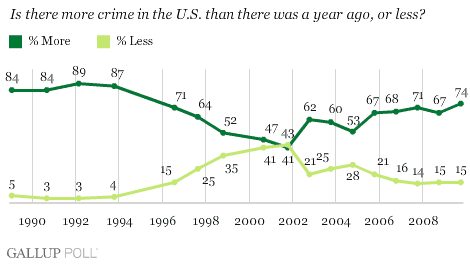
With the exception of 2001 and 2002 (9/11 effect?), between 52% and 89% of Americans every year since 1990 have thought that crime is on the rise. That’s a pretty remarkable statistic, given that crime declined steadily nationally throughout the 1990s and has remained essentially level in the 2000s. Whatever the year-to-year correspondence is, we know that people have gotten the big picture wildly wrong, year after year.

That is, people pretty much always seem to think that this year is worse than last, regardless of the actual trends.

He wonders if this is a consequence of the perennial suspicion that this "generation is so much stupider/lazier/ruder than the last; politics is so much dirtier these days; the world is going to hell in a hand basket." The trouble is: crime always makes the local news. Non-crime almost never does.

They Are The Ones They’ve Been Waiting For

A reader writes:

I just returned from a week-long trip to Tehran and wanted to share some observations. Most people I met felt strongly that the movement generated before and after the June election is badly in need of a leader.  Interestingly Mousavi is seen as too politically naive and unwilling to risk a violent backlash. Karoubi, while hugely popular is also not viewed as someone who has the charisma necessary to mobilize a cohesive opposition.  Remarkably everyone anticipates the next mass demonstration to be on November 4th, "students day" which commemorates the day the students occupied the US embassy and the start of the US hostage crisis.

They know this without any announcement from Mousavi or Karoubi.  That is, the people are anticipating when to act.  Also, there is general consensus that Ashura day (January 7) will be a landmark day in Iran.  Ashura marks the death of Imam Hussein whose martyrdome on Ashura marks the begining of Shia Islam.  The official color of Ashura is green and massive street demonstrations are common.  It would be interesting to see how Ahmadi and the Sepah will react this upcoming Ashura to people in green chanting anti-government slogans on "martyrdome day".  I heard from a few that Iran will be a different place after Ashura day, January 7th 2010.

My reader's first paragraph somewhat contradicts the second. It seems to me that the the strength of the movement is the spontaneous popular co-optation of the Revolution's own landmarks. It is that cooptation that will be more effective in the long run than a charismatic leader who could be demonized by Khamenei. Yes, they will need a broker at some point. But the green revolution was more effective for not being led by a single person but galvanized by many.

Do Americans Really Want A Public Option?

Mark Blumenthal looks at a new poll:

The Pew survey finds that a majority of adults (56%) are able to associate "public option" with health care rather than another issue. On the one hand, as the report points out, that awareness ranks toward the high end of Pew's awareness questions. On the other, as a gauge of knowledge, the bar is pretty low. Recognizing that the term "public option" has something to do with health care does not mean you can explain what the term means, how it might work or who it might cover. At least we know that nearly half of Americans (44%) have no clue that the term even involves the health care debate.

How many Americans both know what the public option is and "want"

it?

How many Americans both know what the public option is and "want" it? Unfortunately, the Pew survey includes no favor-or-oppose questions, so we have to guess, but the number probably falls far short of a majority. The Pew Report does tell us that Democrats are just as likely as Republicans to correctly answer the public option question (59% for each), so it's unlikely that the more knowledgeable are radically different in terms of their attitudes about specific reform proposals. In other words, are 65% really "begging" for a public option? Not likely.

Dissent Of The Day

A reader writes:

I am a long-time reader and admirer of The Daily Dish, and a member and financial supporter of HRC.  I attended the HRC dinner on Saturday and I marched on Sunday along with many other HRC members.  Like many (all?) HRC members, I too am frustrated that changes are not happening as fast as I had hoped.  I agree that we need activists to make noise and push Obama and congress to do what they said they would do.  But we also need an organization that can work from the inside.  So the real question is, would we be closer to equality without HRC?  I believe the answer is NO!  I will continue to support HRC because I think it is making a difference.  I will continue to read your blog because it is entertaining and informative.  And I hope your readers who disagree with HRC's tactics will continue their activism.  But those who spend energy on criticizing HRC while doing nothing constructive toward reaching equality are hurting the cause, not helping it.

It's easy to criticize HRC if you think the only thing they do is raise money and play dress up.  You know HRC was strongly represented in the march, yet you ignore that fact and pretend  that a huge gulf exists between HRC members and the people who marched on Sunday.  I think you know that HRC is doing a lot of real work behind the scenes, but your constant criticism of its fundraising efforts is misleading many of your readers into believing that HRC is useless or worse.  I know that HRC has worked to get supportive candidates elected in Iowa, New Hampshire, Maine, and other states leading the way toward marriage equality.  You and others may disagree with the tactics, but I know that HRC is following what it believes is the best strategy to get legislation through congress.  Your bias against HRC is annoying and, in my opinion, only divides us into weaker camps.  I salute those who put the effort (and money) into organizing the march because the march was needed.  I wish those who celebrate the march would recognize that some of us put effort (and money) into HRC for the same reason.

The Camo Closet

A reader writes:

I've been reading all the comments from both sides regarding abolishing DADT  and I wanted to share my two cents worth.

I am a 58 year old gay American Vietnam era veteran who served with the U.S. ARMY from April of 1970 to April 1972.  I was drafted and if I'd had my wish – I would have enlisted in the Air Force. I did my basic at Fort Ord in California where I was a squad leader with like 10-12 guys under me.  From there I was shipped to Fort Hood, Texas for the remainder of my 2 year stint. My MOS (Military Occupation Specialty) was military police. By the time I arrived at Fort Hood, Tx., most of my close buddies knew of my gayness

and were ok with it.

I had one incident when this short, very drunk kid yanked me out of my bunk and kinda pushed me and then let loose with a short burst of "faggot, etc, etc." He then stormed out of  the barracks and later that evening I was sitting on the steps and he walked up to me and apologized for being a jerk and that was the last and only time that these supposed "lower class, unsophisticated, red neck" kids ever bothered me.  If anything, I was protected and left alone.  Back then we had open showers and toilets–no privy stalls/partitions and no one seemed to mind this tall, skinny, gay guy showering alongside them.  If anything, I was hit on on a few occasions and yes I took advantage of the opportunity. 

Now some 40 years later, my nephew, a Marine drill Sargent with 3 tours in Iraq tells me that he personally knows Marines who are gay and so afraid of being found out that they are forced to do the dishonorable thing and lie about their sexuality and date girls just to fit in. iI can't imagine the stress and sadness these young men go through just to be able to serve in the Marines and serve their country.

The Conservative Case For Cutting Our Losses II

A war that lasts longer than eight years is no longer a war. It's an occupation. America is becoming a kinder, gentler empire – which inevitably generates its own self-sustaining insurgencies:

In 2001, the United States toppled the Taliban and kicked Al Qaeda out of Afghanistan with just a few thousand of its own troops, primarily through the combination of American air power and local ground forces from the Northern Alliance. Then, for the next several years, the United States and NATO modestly increased their footprint to about 20,000 troops, mainly limiting the mission to guarding Kabul, the capital. Up until 2004, there was little terrorism in Afghanistan and little sense that things were deteriorating.

Then, in 2005, the United States and NATO began to systematically extend their military presence across Afghanistan. The goals were to defeat the tiny insurgency that did exist at the time, eradicate poppy crops and encourage local support for the central government. Western forces were deployed in all major regions, including the Pashtun areas in the south and east, and today have ballooned to more than 100,000 troops.

As Western occupation grew, the use of the two most worrisome forms of terrorism in Afghanistan — suicide attacks and homemade bombs — escalated in parallel. There were no recorded suicide attacks in Afghanistan before 2001. According to data I have collected, in the immediate aftermath of America’s conquest, the nation experienced only a small number: none in 2002, two in 2003, five in 2004 and nine in

2005.

But in 2006, suicide attacks began to increase by an order of magnitude — with 97 in 2006, 142 in 2007, 148 in 2008 and more than 60 in the first half of 2009. Moreover, the overwhelming percentage of the suicide attacks (80 percent) has been against United States and allied troops or their bases rather than Afghan civilians, and nearly all (95 percent) carried out by Afghans.

The pattern for other terrorist attacks is almost the same. The most deadly involve roadside bombs that detonate on contact or are set off by remote control. Although these weapons were a relatively minor nuisance in the early years of the occupation, with 782 attacks in 2005, their use has shot up since — to 1,739 in 2006, nearly 2,000 in 2007 and more than 3,200 last year. Again, these attacks have for the most part been carried out against Western combat forces, not Afghan targets.

The picture is clear: the more Western troops we have sent to Afghanistan, the more the local residents have viewed themselves as under foreign occupation, leading to a rise in suicide bombings and other terrorist attacks. (We see this pattern pretty much any time an “outside” armed force has tried to pacify a region, from the West Bank to Kashmir to Sri Lanka.)

Why Hasn’t The NYT Given Ross A Blog?

Julian Sanchez on the transition:

I haven’t found the columns to date as interesting as I invariably did the Atlantic blog either. No doubt that’s partly that, as Freddie suggests, Ross is in the awkward position of having to reestablish his conservative bona fides in a venue where plenty of people are doubtless combing for cause to brand him a RINO, while simultaneously trying to appeal to the modal Times reader, rather than a self-selecting audience of people who’ve gone out of their way to read his blog. Which is a hell of a tightrope act. Partly I’m sure it’s just matter of a writer needing some time to adapt to a different format. Mostly, though, I suspect it’s that the format itself is something of an atavism—a holdover from a superseded information technology.

There’s just a pretty small domain of things to write that  (1) will appeal to a general audience, (2) are actually interesting, and (3) both merit and are adequately expressed in 700-800 words without hyperlinks. I’m sure I read plenty of blog posts about that length that are interesting, but they’re often at places like Volokh Conspiracy or Boing Boing, which cater to particular types of reader and wouldn’t necessarily fascinate the Man on the Clapham Omnibus. Stuff of genuinely broad appeal tends to be of the “I had this one neat thought” variety that fits into a paragraph or two, or in-depth stuff that demands feature length.  What I’d actually love to see is Ross writing regular essays for the Times Magazine or Esquire or some such.

The Conservative Case For Cutting Our Losses I

Gulliver1

My reader puts it better than I could (funny how often that happens):

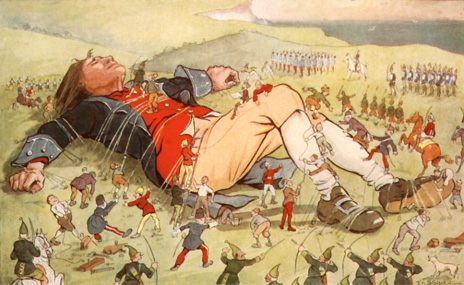
Critics of non-intervention tend to accuse their opponents of cynicism, cruelty, and brutality, as did your most recent correspondent in his caricature of John Derbyshire.  But foreign policy realism is essentially grounded in three deeply conservative concepts: first, we do not really know what makes societies successful, second, we do not know how to make these things happen, and, third, as a result we prefer some kind of stability as opposed to chaos; because conservatives will always prefer the orderly known to the disorderly unknown.
 
The invasion of Iraq was a profoundly anti-conservative project, since the purpose of the invasion — aside from disarming Iraq from weapons it did not have — was a revolutionary project meant to rebuild a nation from scratch.  At the time, supporters of the effort pointed to the examples of Germany and Japan after World War Two, ignoring the fact that both nations had evolved into fairly cohesive and democratic market economies well before we showed up.  Over time it has been shown that the neoconservative perspective — which is really a revolutionary perspective — has failed.

Now the argument is being applied to Afghanistan. 

We hold elections, we chase guerillas, we destroy opium crops: we expect the Afghanis to calm down and be nice little democrats.  No, that isn't going to work, it never works.  The only thing we accomplish by invading other countries is provide an easy target to natives who resent our presence, because as any good conservative knows the easiest way to get someone to hate you is to try to force someone to do something they are not ready to do.

 
At this point the counter-argument is reduced to a querulous "What do you expect then? That we do nothing?"  Well, there is one alternative. In historic times, when states fail, they breed chaos which spills over into other states and causes problems.  At that point, the more stable state simply takes over the failed state, either as a protectorate, a colony, or via annexation.  (I would point to numerous historical examples but that would offend many nationalists.)  We could therefore simply take over any number of Arab or Muslim or otherwise failed states, because it is clearly in our national interest to do so, however, to do so, we would have to abide by strict rules of occupation, and not attempt to force a people to be what they are not yet, and not building settlements on their land, and so on.  And our mission should be simply for keeping the peace, nothing more, and nothing less, and reducing the exposure of our people to violence.
 
The problem is that the United States nor any other country in the developed world is prepared to such a project.  Our manpower resources are stretched thin as it is — don't ask me where we're going to get the troops for Afghanistan — our financial resources are even thinner, the American people have no interest in national sacrifice in terms of a military draft, increased taxes, rationing, or any of the other associations of a broad national effort, and therefore we have to recognize that the project of colonization or quasi-colonization is simply not going to happen. 
 

However, if that's the case, there's really no more reason for us to be in either Afghanistan OR Iraq, because, again, in terms of history, these things work themselves out on their own scale.  The best we can do is support dialog, communication, trade, and other benign forms of interaction.  Anything more will simply kill people — theirs and ours — and will advance the evolution of these societies not one iota.