Iranian students are still in the streets:
Month: October 2009
Traces Of 9/11 In Pakistan
It's the kind of detail that reminds one of this Fallows formulation:
Not everything in foreign affairs can be explained by logic. But as Hoh argues, if we're serious in thinking we can now eliminate terrorist threats with our troops in Afghanistan, then logically we must also send them to Pakistan and beyond. And if we're not serious, then how can we keep them there?
Assuming Too Much
Noah Millman responds to Douthat's latest column and the criticism it has attracted:
No doubt Christianity is competing with Islam for converts – certainly in Asia and Africa. No doubt Christian communities are engaged in actual violent conflict with Islamic communities in many parts of the world – as well as being subject to more or less oppressive rule in some countries where Islam predominates. No doubt there are pastors of various denominations in Europe who fear for the future when they compare the average age and regularity of attendance of their congregations to those of the mosques down the block. But the argument that the response to this situation should be “unity under the leadership of the Pope” needs to be made, not assumed. It seems at least as plausible to me that a decentralized religious culture is more conducive to rapid growth and more likely to respond effectively to diverse challenges from without and within.
Iranian Poker
Alex Massie counters Robert Kagan:
[M]aybe Kagan’s view that sanctions could “trigger potentially explosive unrest” in Iran is correct. But I’d wager that this is, at best, attempting to hit an inside straight. It might, in desperate times, be worth trying but it’s not a bet that’s likely to pay off.
But let’s suppose we make that bet. And lose. What then? Our chip count is smaller still and we’re left with only one more card to play: military action. If and when we make that play we can expect Iran to call the bet, not least because there’s little downside to them doing so. Western strategy, essentially, consists of trying to bluff Iran into folding. But the Iranians know that we’re bluffing because they know that we don’t really want to have to resort to military action, not least because they know that we know that the odds are that any such strikes would be, at best, a temporary victory for the west that will probably only delay Iran’s final victory – that is, the acquisition of a nuclear weapon.
Which is why some kind of policy that assumes Iran’s future nuclear capacity (at some point) makes sense. Because it’s hard to believe we have any workable alternative.
Chart Of The Day
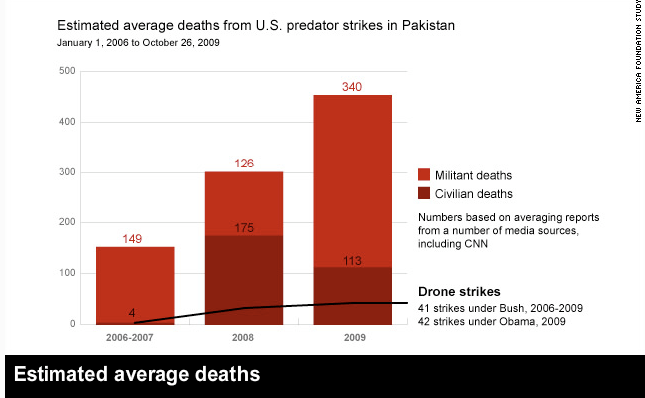
Peter Bergen and Katherine Tiedemann produce some data:
Our analysis of the drone campaign is based only on accounts from reliable media organizations with substantial reporting capabilities in Pakistan.
We restricted our analysis to reports in the New York Times, Washington Post and Wall Street Journal; accounts by major news services and networks — the Associated Press, Reuters, Agence France-Presse, CNN and the BBC — and reports in the leading English-language newspapers in Pakistan — The Daily Times, Dawn and The News — as well as those from Geo TV, the largest independent Pakistani television network. (Links to all those individual reports can be found here.)
The news organizations we relied upon collectively for our data cover the drone strikes as accurately and aggressively as possible. And though we don't pretend that our study is accurate down to the last civilian death in every drone strike, we posit that our research has generated some quite reliable data on the number of militant leaders killed, a fairly good estimate of the number of lower-level militants killed and a reliable sense of the real civilian death rate.
It would be fascinating to see a comparison with the militant/civilian ration in Gaza. But 2008 seems to me a clear case of disproportionate civilian casualties – and the ratio seems to have improved under Obama. I suspect that if we want to look at why the US is losing the war, we start with those civilian casualties in 2008. You can't stop an insurgency by murdering civilians. Neither in Gaza nor in Afghanistan.
Hard To Get, Please, Bribe, Ctd
The Obama adminstration has, I believe, some leverage at the moment, which it could use to affect the composition and behavior of the next Afghan government. As long as Afghanistan’s ruling politicians—Hamid Karzai especially—think the United States might reduce its commitment to Afghanistan, they could be willing to accede to U.S. demands on key ministerial and provincial-level appointments. Just as an Afghan government consisting mainly of those politicians thrown out by the Taliban in 1996 would spell continued insurgency and mission failure, a more inclusive and competent Afghan government would enable the success of a counterinsurgency strategy.
Keepin' hope alive.
Off A Cliff, Ctd
Jack Shafer Dan Gross doesn't think print is dead yet:
At some point in the future, newspapers may disappear. But count me in the later rather than sooner camp. And I can't help but think that many newspaper-doomsayers are conflating hope with analysis. According to many of the digerati, newspapers and other printed matter that people pay for through clunky old distribution systems (the mail, kids on bicycles, vans) can never make money and are bound to fail, while publications distributed online for free are destined to rule the world. (Of course, I could be guilty of the same impulse. I have feet in both worlds and could no more choose between print and the Web than I could choose between my two children.) But I also think this might be a case of making too much of a few numbers and ignoring some important ones.
As usual, he's not wrong. But how newspapers will be reinvented is still mysterious to me.
“Do You Think the Taliban Wants Victory More Than Obama?”
Dissent Of The Day, Ctd
A reader writes:
You wrote: "Just compare his track record of truth versus hers," talking about Levi vs. Sarah Palin. Uhhh…to what track record of truth on Levi's part are you referring? Of course, her track for truth is abysmal, mostly because her lies caught up to her, but the contrast with Levi doesn't work.
They could, of course, both be small-minded small-town "fucking rednecks" who got vaulted into the limelight and are now trying squeeze every drop of blood they can from it because they're narcissistic, love the attention, and want the money. I'm surprised that hadn't occurred to you, because that seems the very likely reality to the rest of us.
These two theories are not mutually exclusive. On Judge Judy, usually one "fucking redneck" is telling the truth. And I know one of these people has been telling lies from the minute I was made aware of her.
Halloween Parades: Community Pride Or Minstrel Show? Ctd
A reader writes:
It's somewhat baffling that you would choose not to comment on Rosen's rather appalling assumption that straight folk at a gay-focused and organized event makes it a minstrel show. Worse, you give him credence with the kind of headline you're usually ripe to point out is absurd. Forgetting the fact that the analogy holds no weight and is rather offensive to begin with — these clearly aren't gay (or straight) men mocking their own culture, but rather celebrating it — it's not clear how such a parade, regardless of the crowd, does a disservice to anyone.
Hundreds, thousands of people out peacefully enjoying themselves and showing to the larger community that being gay and flamboyant is a source of pride can only be a good thing — I would think. I would think you would think so as well. Why, if giving this dude face time, wouldn't you call him out on his ignorance and naivete? I guess it's a good thing that he realized he was being a "dick" by making the assumptions he did, but one hopes he could give us more of an about-face than he did by acknowledging that straight people don't come to these events to mock and gawk.
 The Dish