The much heralded research from a few weeks ago may be bunk.
Month: October 2009
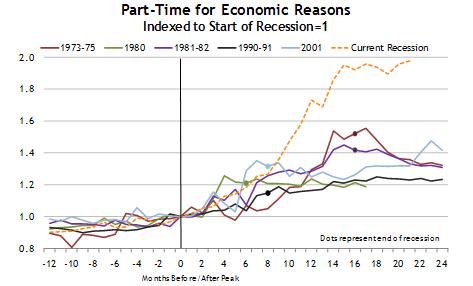
Chart Of The Day
Letter From Kabul
Over the weekend, George Packer got an e-mail from Rufus Phillips, a foriegn policy expert who has written at length about Vietnam and recently spent some time in Afghanistan. The text of the e-mail:
I’m afraid the President, who seems like a supremely rational being, is trying to find the most rational policy option on Afghanistan, without thinking about whether it is feasible given political conditions on the ground, as well as who is going to implement it and how. What seems the most rational option here could be likely unworkable over there.
This is part of what happened to President Johnson during Vietnam. He relied exclusively on policy ‘experts’ who understood military and geopolitical strategy in the light of World War II and Korea, but who had no direct experience combating a ‘people’s war,’ while underestimating the North Vietnamese and misunderstanding the importance of the South Vietnamese, who were treated as bystanders. His advisers constructed strategies whose feasibility never got tested by those who knew Vietnam first hand. Pure reliance on the chain-of-command was disastrous in Vietnam because much of the most relevant information, the nuances which counted, could not be fully described in writing and were strained out as information flowed to the top. At a minimum, [General Stanley] McChrystal and [Ambassador Karl] Eikenberry, who have that first-hand knowledge, should be sitting in these strategy sessions.
I don’t see evidence of any real political thinking about how to deal with Karzai and the local political scene, no matter what option is selected. As we swing between counterproductive table pounding and passive non-interference, we must muster the will to interfere quietly but firmly when we are on solid moral ground—standing up for the Afghan people and for principles of honest governance.
My Afghan friends tell me as soon as he is confirmed, Karzai is going to launch a big initiative on talks with the Taliban, which are not likely to go anywhere if he leads them. Are we thinking that if we cede territory to the Taliban because they promise not to let Al Qaeda back, we will be able to hold an imaginary line, including Kabul, with the Afghan and international forces we will have? What will that tell the Afghan people, except to signal ultimate abandonment? And how will that affect their support for the Taliban to avoid being killed or severely punished?
I just have an uneasy feeling that this is too similar to the policy discussions Johnson went through, except those were mainly out of public view and these are not. The whole notion that we can speed up the training of the Afghan armed forces and this will do the job is unrealistic—another numbers game. I guess not being in the meetings puncturing balloons is what is really frustrating me. That and the fact that nobody seems to factor in our moral obligation to the Afghan people. We abandoned them twice. Will this be the third time? What does that say about us? It seems more convenient to equate Karzai with the Afghan people. Maybe it will all come out for the best—but the process, and what I see from the outside being discussed so far, doesn’t pass my gut check.
The outcome of the Afghan struggle is ultimately going to be determined not by our unilateral actions or geopolitical moves, but by whom the Afghan people wind up supporting, even reluctantly. Vietnam—Lesson One.
GOP Website Fail

Ambers dusts off his David Letterman routine. Here's an opener from John Cook:
It doesn't work, of course. (It's actually called "GOP beta," which is a rich metaphorical truth.) But if you keep clicking "reload," and if you're lucky, you'll actually bring up the page and be shocked to find a tiny, adorable little Michael Steele walking across your screen and addressing you directly, in the fashion of a Princess Leia hologram, to beg for "Republican coders" to help make the site actually work, which it doesn't.
The Daily Wrap
Today on the Dish, as the need for troops grows ever greater, we corralled the debate over DADT. The Washington Post pointed the finger at Congress; Zac Morgan showed how conservatives could pick up the standard; Patrick compiled comments that are splitting the right; a civilian reader counseled caution; a former marine threw caution to the wind; and a soldier saw the glass half empty (but sparked Andrew's most eloquent post of the day).
The Dish also aired some lingering coverage of the weekend. Andrew went off on Solmonese (with cheers from readers here and here) while Jim Burroway saw the light in Obama's speech. We also screened a cheesy but cheery compilation of the march.
In other coverage, Snowe backed the Baucus bill, Palin remained hidden over email, DiA contrasted Afghanistan with Mexico, Brooks looked at our brains, and Jonah Lehrer waxed poetic on cooking. Our MHB was particularly catchy today, and we gave you a big dose of hathos and pathos.
— C.B.
Good Night And Good Luck
Qualifications here.
“Protecting” Homosexuals
A reader writes:
I used to be of the same mind as your military reader who says we cannot repeal Don't Ask Don't Tell, as it would bring homosexual men and women into danger. I had served in the Marine Corps, and still bear my marine tattoo. I believed that we had to keep homosexuals safe from the barbarous military men (the women weren't violently homophobic, in my experience) until I spoke with another former marine who told me that my good intentions were small minded.
Homosexual men and women needed to suffer publicly. They needed to be beaten and keep standing. They needed to be promoted into powerful non-commissioned officer ranks. There needed to be gay drill instructors who put recruits in awe of their abilities. There had to be openly gay marine and soldier heroes to show the homophobes that they are wrong, just as Blacks, Hispanics, and Asians, and all the rest have done.
And, as I write this, I realize that's why so much of the country fears letting homosexuals serve openly in the military, because it will show America that they are not inferior. The hardscrabble Americans in the military will learn that there are gay men who are better than themselves, that there are lesbians tougher, and smarter, and more heroic than they will ever be. That's why they must keep Don't Ask Don't Tell, in order to maintain the hideous illusion of superiority for the homophobes of all stripes.
Please keep up the fight; there is much at stake here.
Shades Of Conservatism
Yesterday Ross Douthat, Daniel Larison, Virginia Postrel, and David Frum sat on a panel and debated the future of the conservative movement. Pivoting off one of Postrel's pet peeves, Frum explains why the Bush administration banned incandescent light bulbs:
It was a characteristic Bush administration maneuver: fight to oppose any large action on climate change (carbon tax, cap-and-trade) but yield on a small symbolic act. Yielding was all the easier since almost all the relevant major industry groups quietly favored the ban. The incandescent bulb is a low-margin item, usually manufactured in China. Very nice to have government prod every factory, shop and home into converting to a more lucrative substitute!
Here's Mark Thompson's shrewd take.
Why Americans Are Getting Chubby
In 1977, Americans reported eating about 186 calories outside of mealtimes. By 1994, that had rocketed to 346 calories. It’s likely even higher now. That difference alone is enough to explain the changes in our national waistline. And it won’t go away if we begin cooking dinners but still are purchasing 20-ounce bottles of Coke at the office.
Further thoughts on home cooking and snacks from TNC, Yglesias, and James Joyner.
Face Of The Day
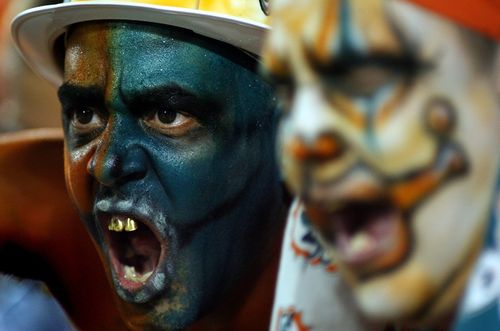
Miami Dolphins fans scream at New York Jets fans prior to their game at Land Shark Stadium on October 12, 2009 in Miami, Florida. By Marc Serota/Getty.
 The Dish