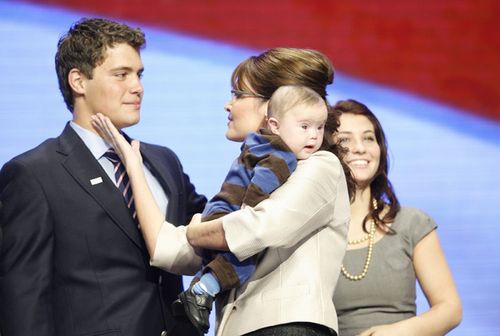
The Sarah And Levi Show

Muthainlaw

Michael Wolff tries to understand this bizarre but riveting soap-opera:

It is another element of the Palin risk-taking temperament and anarchicness—she might rightly be described as the nation’s first major anarcho-conservative politician—that she built this domestic-political fantasy around somebody her family undoubtedly had reason to believe was uncontrollable.

Or perhaps they didn’t. Maybe they saw him just for what he obviously was, some stupid, minor, local doofus, and missed the more salient point that he was a stupid, minor, local doofus who got the joke about himself.

Of course, it may not even be Levi who got the joke. He’s surrounded now by retinues of handlers and publicity strategists who are marketing the irony that is Levi—although, to be fair, such retinues are usually not known for their sense of humor, and this Levi rollout is riotous.

A pressing American political question is about how far Sarah Palin might ultimately go. As relevant is how big Levi Johnston might get.

I don’t think at this point it’s quite possible to say who, in terms of American archetypes and media success, will come out ahead.

My money is on Levi, if he truly has the goods on Palin. If not, my money is on Levi.

What Happens In NY-23 Now? Ctd

Josh Marshall hits the nail on the head:

Every non-hard-right congressional Republican will have this episode in mind going forward the next year — it will shape votes, positions on key issues. And what happened in this race will be the backdrop for every primary contest between a mainline and hard-right Republican this cycle — think particularly of the Crist/Rubio contest in Florida, which hard-right Republicans are already pointing to as the logical place to repeat the Scozzafava/Hoffman pattern.

This is the electoral equivalent of those brief moments earlier this year when prominent Republicans issued tepid criticisms of Rush Limbaugh only to be forced into craven apologies hours or days later. The hard-right of the GOP just got a much stronger lock on the institutional Republican party than it had before. And, let's face it: the lock was pretty strong to start with.

“America, stop sucking up to Israel “

Gideon Levy pulls no punches:

Israel of 2009 is a spoiled country, arrogant and condescending, convinced that it deserves everything and that it has the power to make a fool of America and the world. The United States has engendered this situation, which endangers the entire Mideast and Israel itself. That is why there needs to be a turning point in the coming year – Washington needs to finally say no to Israel and the occupation. An unambiguous, presidential no.

One question that should always be asked of an ally: what is that ally doing for the US? Since the end of the Cold War, that question has been increasingly hard to answer with respect to Israel.

Strategically, Israel is obviously a huge burden for the US, making relations with Muslim or Arab nations much harder, and undermining any attempt to portray American intervention in, say, Iraq or Afghanistan, as beneficent rather than predatory. It's a big drain on the Treasury, as Israel consumes a vast amount of military and non-military aid.

It's a big blow to any attempt by the US to restrain nuclear weaponry, since Israel has 150 nuclear weapons and threatens regional and global war if its monopoly is in any way challenged. And it means that American money is directly connected to the mass killings of civilians in Gaza last January. Despite all this, an American president's primary concern is maintaining the support of Israel! And secretary of state Clinton can actually applaud Netanyahu for telling her own president to go pull a Cheney.

Moreover, any attempt to chart a foreign policy for the region that is not subject to Jerusalem's veto is subjected to the kind of hysterical smear-mongering that the neocons have applied to AIPAC J-Street and even the NIAC head, Trita Parsi. Greenwald applauds:

I have almost nothing but good things to say about J Street — they are fighting a difficult and largely noble battle — but the fact that not even this group, devoted to orthodoxy-busting, is willing to get anywhere near what Gideon Levy advocates illustrates how constricted American debates over Israel continue to be compared to Israel's.

What Happens In NY-23 Now? Ctd

A reader writes:

Here is my own anecdotal contribution, as someone who grew up in NY 23, was once a part of the Republican establishment there.  I have both moved out of the area and am no longer a Republican, but I still have many contacts with party voters there.  What I’m hearing from friends & former neighbors the last 24 hours doesn’t sound good for Hoffman.

The North Country is a seriously economically depressed area, and some kind of healthcare reform would disproportionately benefit the local residents up there.  Like most places, it is fairly popular among the regular voters.  Over the weekend, registered voters of both parties have been INUNDATED with phone calls, mostly from Hoffman’s side, railing against the evils of the Pelosi machine and Nationalized Healthcare.  We’re talking 20+ calls/day.  I think there are more people calling registered voters in NY 23 than there ARE voters in NY 23 – it really is a very sparsely populated region. 

Combine the out-of-touch culture war rhetoric that GOP voters there are getting bombarded with, and the snide “parochial” comments from national figures about their local issues, plus Scozzafava’s endorsement of her Democratic opponent, and anything could happen. Scozzafava is now actively campaigning with Owens in the 23rd.  They had an appearance together yesterday in Canton, NY. It’s truly bizarre for me to imagine all this national bile and culture war crap being heaped on such a tiny little parochial district – you can usually number the people who turn out to vote there for these kind elections in the very low 4 figures.

I don’t know, but the Dish tries to offer as many viewpoints as possible.

The Odds In Maine

Nate Silver runs them:

A statistical analysis I conducted last month, which was based on the results from previous gay marriage referenda in other states, gave the Yes on 1 side just an 11 percent chance of prevailing, although the fraction rises to 32 percent after an ad-hoc adjustment for the fact that this is an off-year election. In spite of the PPP poll, I'm not especially persuaded to deviate substantially from those numbers: the polling average still favors the 'No' side, albeit narrowly; the 'No' side seems to have run the superior campaign, and the cellphone issue may be worth a point or two. The tight polling, certainly, should keep everybody on their toes, and gay marriage could quite easily be overturned. But I'd still put the Yes on 1 side as about a 5-to-2 underdog.

A victory for equality would be a huge boost to efforts in New York, New Jersey and Washington DC to get equal treatment under the law.

The Tea-Leaves Of Off-Year Elections

Jonah Goldberg sounds chipper:

For some time now Frank Rich, Sam Tanenhaus and countless others (including David Frum) have been arguing that the GOP is a rump party and the only way for it to survive is for it to embrace me-too Republicanism of one flavor or another. The story of all three major races (VA, NJ, and NY-23) is that this conventional wisdom was incandescently wrong and ill-advised…The GOP is an unapologetically conservative party, providing a choice not an echo, and — horror of horrors — it’s working.

This was signaled by Karl Rove last week as the way to frame Tuesday's votes. But Rove is the worst political strategist of several generations, and these three mid-mid-term races do not a long-term strategy make. They are almost tailor-made for a protest vote (and anyone watching Fox News these past few months must believe that a communist take-over designed to destroy America is worth protesting). That protest vote may even bring the GOP real gains next year. But when voters actually decide on what direction they want the country to take in 2012, and the actual policies they favor, and know they might be electing an actual government, the equation shifts.

That's why I think it's perfectly possible that many partisan Republicans like Goldberg will have a wonderful time these next two years but will be bitterly disappointed until they craft an actual policy message that appeals with leaders who seem capable of governing a divided country. Tactics will keep them going; a profound lack of strategy and policy seriousness will kill them (absent some huge intervening event or a massive Obama fuck-up.) It seems to me that that point has not yet been even marginally reached. In fact, the image of the GOP as purely obstructionist has deepened even as the "choice not an echo" meme has gained traction.

Yglesias's thoughts on party discipline work as a counterpoint:

The common sense way to behave is to try to insist on orthodoxy in places where orthodox candidates can clearly win, but to be more flexible elsewhere. Instead Democrats are dealing with a rogue senator from Connecticut, while the GOP drove Arlen Specter out of the party for being an occasional deviationist in a state that’s consistently backed Democratic presidential candidates for 20 years.

So do James Joyner's:

 While I’m a Big Tent guy who thinks the Republican Party needs to accept the fact that winning seats in the Northeast will require backing candidates who would be considered “liberal” in Mississippi, I fully understand the thinking of people like Malkin who prefer an ideological party.  At some point, having an “R” after a candidates name doesn’t mean much if they’re going to work against your leadership.   But you can’t have it both ways.  Either the GOP accepts people like Scozzafava as candidates in liberal districts or it runs them off to become Democrats.

What Happens In NY-23 Now? Ctd

John Cole:

You know the thing that I find most amusing about the NY race is that what they are basically telling every moderate Republican across the country is that it doesn’t matter if you’ve been a loyal Republican for decades, it doesn’t matter if you know the district and the people, it doesn’t matter if you fit the district, and it doesn’t matter that you have given decades to the party.

What matters is orthodoxy, or obedience to principles of fiscal responsibility the GOP hasn't actually lived up to in a generation and fealty to discrimination against gay couples and banning all abortion.

This is effective as a rallying cry, but someone open to persuasion is confronted by some uncomfortable facts. The first is that these conservatives have yet to tell us what spending they would specifically cut.

By spending, I mean entitlements and defense, the only two areas where any serious effort to cut the debt will be found. Which entitlements does the GOP propose slashing? (Yes, slashing really is the only option to get us back to fiscal sanity.) Which war does the GOP propose ending? Which troops does it believe should be brought back to the US or laid off? How will Medicare by saved?

On the social issues, the practical questions are just as salient. We know that the GOP is horrified by gay people and our relationships. So what rights does the GOP believe gay couples should have? Civil unions? Domestic partnerships? Or nothing but psychiatric treatment? Which specific rights that straight couples have should gay couples be denied?

And on abortion: does the GOP favor making abortion illegal in all cases if Roe is overturned? Or legal in some respects? Again: I have no idea what the actual policy is. Until these proposals are actually fleshed out, we should regard this upsurge as therapy, not politics. But we should also encourage the practical policies to be spelled out.