What Happens In NY-23 Now?

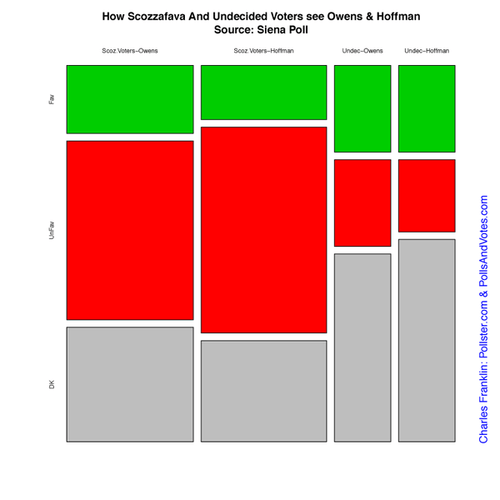
[Re-posted] Charles Franklin looks through the cross-tabs to see where Scozzafava's voters might end up. Her voters have quite highly unfavorable views of Hoffman:

NY23b-thumb-600x600
But the deeper you look, the closer it gets:

Here is some bad news for Owens. He's losing 25% of the Democratic voters, versus only a 13% defection rate among Republicans. Fully 14% of Dems say they will vote for the Conservative Hoffman. Another 11% were going for Scozzafava. Even if you think all those Scozzafava Dems come back to Owens, the party is not as unified as it needs to be. Independents are also leaning Hoffman by 40-35, with only 15% supporting Scozzafava up for grabs.

What Owens has going for him are very high ratings for Obama in NY-23. Franklin's advice to both campaigns:

Perhaps the best move Owens can make in the last three days is to drape himself in the cloak of Obama, hoping to bring home those wavering 25% of Dems, and use this favorable view of Obama among Scozzafava and undecided to bring in the margin of victory.  

Conversely, if Hoffman wants to win the Scozzafava and undecided, he should probably push Republican  loyalty more, and opposition (especially angry opposition) to the president less. He's already won over the voters with pitchforks and tea bags. He needs a strategy to close the deal with Reps and others who don't actually despise the president. (Recall the district went 52-47 for Obama.)

So after all that, it still looks like a tossup on the two simplest most direct measures: current vote choice and favorability. When we try to parse the Scozzafava voters, they mostly look like a tossup, with at most a sliver of extra support for Owens. But at most a sliver.

Being There, Being With

David Wolpe:

To the extent that the Internet and the proliferation of long distance learning deprive us of being in the presence of charismatic, kind, scholarly people, it will be a tremendous loss. When a Hasid said that he traveled miles just to see how his master tied his shoes, he was expressing this beautiful idea. What we learn from a great teacher cannot be put into a book, because it is in a look, an inflection, a quirk of personality or a tossed off comment. The greatest human lessons are found in the power of presence.

From Scozzafava To Owens

The local paper, The Watertown Daily Times, switches its allegiance. The trouble with the Hoffman candidacy, a man who doesn’t even live in the district and had no responses to local questions when grilled by the WDT, is that it cannot be described as grass-roots. Hoffman did not come up from the ground of this district; he was flown in as a candidate to represent the party of Palin in a national, ideological struggle. The WDT editorial:

Mr. Hoffman is running as an ideologue. If he carries out his pledges on earmarks, taxation, labor law reform and other inflexible positions, Northern New York will suffer.

This rural district depends on the federal government for an investment in Fort Drum and its soldiers, environmental protection of our international waterway and the Adirondack Park, and the livelihood of all our dairy farmers across the district, among other support. Our representative cannot be locked into rigid promises and policies that would jeopardize these critical sectors of our economy.

For a member of Congress, there may be a time to promote reform in Washington, but there is also a time to work within a system that best serves the people you represent.

It is frightening that Mr. Hoffman is so beholden to right-wing ideologues who dismiss Northern New Yorkers as parochial when people here simply want to know how Mr. Hoffman will protect their interests in Washington.

Yes: they want their pork and their federal money. I wonder how the voters will actually feel next Tuesday. They do have the last word, you know.
When Creationism Was Fringe

P.Z. Meyers says creationism isn't as old as we assume:

The mainstreaming of literalist creationism occurred in the 1960s, when John Whitcomb and Henry Morris wrote The Genesis Flood. It's basically the same nonsense he Seventh Day Adventists were peddling, but Whitcomb and Morris were not SDAs, making it possible for conservative Christians, who regarded Seventh Day Adventism as a freaky cult, to coalesce in the formation of the Creation Research Society. These people had no ambition to convert the research community, but instead wanted to wean bible-believers away from what they considered the compromises of day-age and gap theory.

When Hellfire And Hospitality Collide

Hitch talks about debating religious people:

Usually, when I ask some Calvinist whether he is really a Calvinist (in the sense, say, of believing that I will end up in hell), there is a slight reluctance to say yes, and a slight wince from his congregation. I have come to the conclusion that this has something to do with the justly famed tradition of Southern hospitality: You can't very easily invite somebody to your church and then to supper and inform him that he's marked for perdition.

More to the point, though, you soon discover that many of those attending are not so sure about all the doctrines, either, just as you very swiftly find out that a vast number of Catholics don't truly believe more than about half of what their church instructs them to think. Every now and then I read reports of polls that tell me that more Americans believe in the virgin birth or the devil than believe in Darwinism: I'd be pretty sure that at least some of these are unwilling to confess their doubts to someone who calls them up on their kitchen phone.

Is Atheism Scientific?

Massimo Pigliucci argues that atheism is philosophical, not scientific. Jerry Coyne differs:

I’ll call “weak sense atheism” the position that, I think, most atheists hold.  It is this:  “There is no convincing evidence for God, so I withhold belief.”…Now I don’t know anyone who is a strong-sense atheist.  Even Dawkins, as I recall, is a “70% probability” man — he thinks it pretty improbable that God exists, but adds that he can’t disprove the existence of some kinds of gods. I’m pretty much on board with him. You’d be a fool to say that you know absolutely that there is no being up there at all, including one that doesn’t interfere in the workings of the universe.

So let’s take weak-sense atheism (WSA) as the default stance.  In its very weakest, “no-evidence-for-God” sense, WSA is absolutely scientific.  After all, what is science but the claim that one needs empirical evidence before accepting something as a reality? When one says, “I see no evidence for a god, and therefore refuse to accept his/her/its reality,” one is saying nothing different from, “I see no evidence for the view that plants have feelings, and therefore I don’t accept the idea that they do.”