The Most Important Issue?

Kerry Howley knocks Bill Bennett:

“Is there anything more important than the issue of terrorism?” Bennett asks in his post. It’s meant as a rhetorical question; the obvious answer is supposed to be no. And that’s absurd. Lots of things, like hernias, are more “important,” or at least more deadly, than terrorism in the United States. But you see where Bennett is going: Hasan’s atrocity was terrorism. Nothing is more important than terrorism. Any rights abridged along the way to prevent another act of terrorism must be justified, because … nothing’s more important than terrorism. There is a kind of bright, shining clarity in that, an invitation not to muddy the waters with too much thinking.

The Globe’s Policeman

E.D. Kain wants to cut defense:

America is not imperial in the traditional sense, of course. We are not colonists. We have little interest in actually conquering territory. But we do have an overabundance of faith in the ability of our military to insure our security and our economic interests across the globe. Our military foots the bill for the defense of Europe and our Asian allies, allowing those countries to spend their own tax revenues on lavish safety nets and top-notch education programs. Meanwhile, Americans pay for Leviathan. Or at least the Leviathan with the guns.

Without serious cuts in our defense budget, it becomes almost certain that we’ll be unable to afford programs like those the Europeans have, or to even maximize the potential of our private-sector economy and innovation. One trillion dollars a year is a lot of money that could have gone to innovation in the markets. We can’t have it both ways, of course, even though everyone in Washington will tell you that we can. Indeed, it is the European governments which are freed from this military spending which are spending the most on butter, while Americans find themselves more and more mired in debt. You can have guns or you can have butter, but you can’t have both.

A Liberal Reagan?

ObamaByHiroko MasuikeGetty
Massie gets into the weeds of the parallel:

[H]istorical comparisons are never exact. Nonetheless, assuming the economy recovers then you can bet that Democrats will argue that it was the stimulus what done it and you can further bet that plenty of voters will be happy to nod and agree with this proposition. And if health insurance reform passes and if Afghanistan looks less problematic in a year's time, well, you can see where a second term is coming from, can't you?

Sure, there remains the deficit and I'm skeptical that Congressional Democrats are really terribly interested in tackling that but economic recovery will create some greater room for tackling the deficit in a second term. Equally, if the economy recovers, voters may be less concerned by aspects of the liberal agenda that, at present, they find disconcerting.

Granted, there are plenty of ifs there. But that's always the case. Like Reagan a generation ago, one sense that Obama realises that he has the opportunity to redraw the map. He can be a consequential President whose legacy is such that it defines or shapes the parameters within which his successors must operate. He may not succeed, but the scale of the Republican crisis and the depth of the hole he found himself in at the beginning of his presidency give him a chance to be the heir to LBJ liberals have been waiting for.

The Dish wrote about this comparison in January 2008.

(Image: By Hiroko Masuike/Getty Images.)
Fear ≠ Power

TNC:

Palin's base confuses "liberal fear" with some kind of populist power, by ignoring the fact that a lot of people who want nothing to do with us pinkos, are afraid of Palin too. People misunderstand fear. It doesn't always cause your foes to cower in a corner. Sometimes it causes them to beat the crap out of you with a bag of rusty nails.

The Outlook In Afghanistan

Paul Staniland is pessimistic:

Insurgencies can be militarily defeated, but at a high cost that may be greater than U.S. interests require. It is deeply doubtful that the U.S. should want to replicate in Afghanistan the experiences of counterinsurgency in Kashmir, Pakistani Baluchistan, or Sri Lanka. The Obama administration needs to decide if a similar strategy is worth the likely trail of American and Afghan blood.

A cheaper and more efficient policy for the United States in Afghanistan instead involves following the second pathway outlined above — ugly stability. There is evidence that this approach has at least minimally succeeded in South Asia and Iraq. This strategy requires understanding and dealing with the real and existing social sources of power on the ground, mixing accommodation, coercion, and bribery, and being willing to accept imperfect and morally ambiguous outcomes. The U.S. may be able to satisfy its basic interests in Afghanistan without trying to build a simultaneously strong and legitimate central state.

The Daily Wrap

Today on the Dish we discovered that Bill Sparkman's death was actually a suicide staged as murder. Malkin pounced on our prior coverage of the bizarre event. Also, Britain tortured.

In Palin drama, she accused the commander-in-chief of ignoring those in his command, brandished her foreign policy acumen, and read a bedtime story on the bus. Another victim of her fabrication spoke out, Chris Orr can't understand why she's going after a teenager, a female reader sized up her sex appeal, and Weigel explained why she is a better celebrity than public servant.

In other commentary, Andrew fisked the GOP's Ten Commandments, Friedersdorf lampooned Beck's latest insanity, Peter Beinart singled out Lieberman for a partisan tantrum, Larison followed up, and Tyler Cowen tackled our thinking over debt.

Lastly, don't forget: Barack Obama gave you homework.

— C.B.

Wanted: Republican Egghead

Douthat counters Matt Yglesias and Isaac Chotiner:

[T]he example of [Newt] Gingrich — the way that he’s sought after as a wise man by Republicans, and the way that both the right-wing media and the mainstream press tend to give him more credit as a thinker than he deserves — suggests that precisely because the G.O.P. currently has a reputation for being anti-intellectual, there’s a huge upside for a Republican politician in being identified as that rarest of species — a “conservative with domestic policy ideas.” (For a small-bore example of how this works, look at Paul Ryan, who’s made a substantial name for himself by being one of the few House Republicans willing to get into the weeds on health care reform.) Of course identity politics and symbolic appeals will always matter more than substance, and political careers will never be made on wonkery alone. But even — or especially — in today’s Republican Party, being known as a thoughtful politician seems much more likely to help you than to hurt you.

Face Of The Day

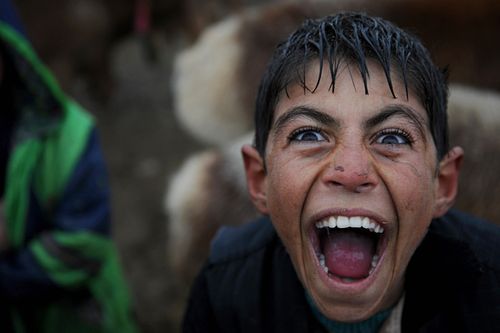
AfghanBoyShahMaraiGetty

An Afghan boy reacts with a laugh as he waits for customers at an animal market on a rainy day in the outskirts of Kabul on November 23, 2009, ahead of the Muslim feast of Eid al-Adha. Eid al-Adha (the Festival of Sacrifice) is celebrated throughout the Muslim world as a commemoration of Abraham's willingness to sacrifice his son for God. The festival falls on the tenth day of Zulhijjah, the final month of the Muslim Calendar. Cows, camels, goats and sheep are traditionally slaughtered on the holiest day. By Shah Marai/AFP/Getty.

“Victory”

Joe Klein notes that Max Boot acknowledges some U.S. forces appear "a bit worn down and pessimistic" in conversations regarding Afghanistan. Klein sighs:

[Boot] thinks morale would improve markedly if the President uses the word "victory" in his Afghanistan rollout next week. But "victory" is a word that was never used by David Petraeus in Iraq–it was only used by unsophisticated bully-raggers like John McCain–and it is a word that would be laughable if applied to Afghanistan (just as it remains fairly implausible when applied to Iraq). Success is a better word than "victory," less bellicose, more in keeping with the spirit of counter-insurgency doctrine.