What To Do About The Deficit

Inside-The-Tube

The Economist looks at the politics and economics of reducing the deficit:

Historically, politicians are most likely to tackle deficits when prodded by markets. Denmark in 1982, Ireland in 1987 and Canada in 1995 all embarked on ambitious programmes after spiralling debts had driven up interest rates. In the same way, American deficit-reduction deals in 1985, 1990 and 1993 were nudged along by nervous markets. Such concerns are notably absent now. “Until the bond-market vigilantes form a posse again, it’s just too easy to ignore this issue,” says Alan Blinder, a Princeton University professor and former adviser to Bill Clinton.

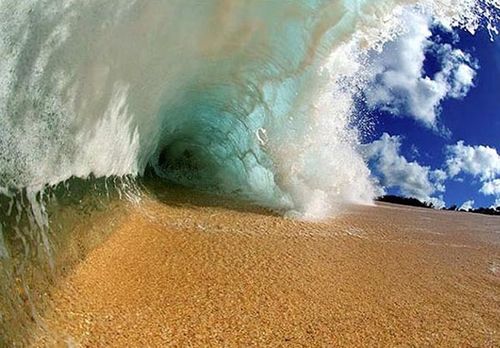
(Photo by Clark Little. More incredible images here.)

The View From Your Recession

A reader writes:

I'm a college grad who has been unemployed for several months now.  I'm scraping by living and doing volunteer work at a hostel while searching for work, and living off a bare-bones unemployment check (which pays for food, that's about it) that is about to expire.  In applying to several entry-level positions in recent months in fields that are strong (social media and video game production), in the area that they are strongest (i.e., the Bay Area), I've noticed a disturbing trend:  In places I applied to, rather than being rejected outright or just not hearing from them, I'm getting responses saying that the job is "on hold," or that the position was "closed" without any hires.  They often note that I was certainly qualified for the position, they just can't afford to hire anyone right now.

I think the question has to be asked now, concerning unemployment:  If our economy is in "recovery," then what is preventing companies from actually hiring people?  I hate saying this, but this is feeling like another "Mission Accomplished" to people, especially me.

This Blogging Life

Andy Towle and Rex Wockner capture the minute-by-minute insistence of running any kind of blog:

Rex: How many hours a day do you work?

Andy: Generally from like 6:15 in the morning till 7, 8, 9 at night.

Rex: Is your boyfriend OK with that?

Andy: Not really. He’d like me to work probably about six hours less than that but, you know, it pays the rent and it’s what I need to do to sort of keep the site going, so, you know, he understands.

Rex: How do we keep up with the flow of information? You and I have similar kinds of jobs. I feel overwhelmed regularly. Do you?

Andy: I feel overwhelmed right now because I’m not reading and I’m doing this interview instead, but, you know, it’s how I regularly feel if I’m out or whatever.

It’s like there is always a constant barrage of news and things happening, so the struggle to keep on top of it is a constant challenge and I think anybody who’s in news these days understands the same thing — that it’s just, you know, like a 24-hour thing and to stay on top of it, you just have to constantly keep reading.

Rex: I left to get on the subway in Queens four hours ago and we went to dinner three hours ago, so I’ve been offline four hours and you’ve been offline three hours. That’s a long time for us, isn’t it?

I haven’t had more than a few hours off – barring vacations – in ten years.

“Most Educated Alaskans Are Aware Of All This”

800px-Alaska_Purchase_(hi-res)

History professor and Alaskan David Noon corrects Palin for repeating the myth of "Seward's Folly" – the purchase of Alaska in 1867 by Secretary of State William Seward. From Going Rogue:

Critics ridiculed Seward for spending so much on a remote chunk of earth that some thought of as just a frozen, inhospitable wilderness that was dark half the year. The $7.2 million purchase became known as “Seward’s Folly” or “Seward’ Icebox.” Seward withstood the mocking and disdain because of his vision for Alaska. He knew her potential to help secure the nation with her resources and strategic position on the globe. . . . [D]ecades later, he was posthumously vindicated, as purveyors of unpopular common sense often are.

From the historian:

So far as public opinion was concerned, most newspapers actually supported the purchase. The major exception was the New York Tribune, which was owned by Horace Greeley, a Republican who was nevertheless one of William Seward’s avowed enemies.  (Greeley believed Seward had been too radical on the slavery issue, among other things).  Even Democratically-aligned papers in the North — while not missing the opportunity to crack wise about polar bears and walruses — tended to support the purchase, mainly because there was no compelling reason to oppose it.  And at the end of the day, the treaty with Russia passed the US Senate by a vote of 37-2, with no significant expressions of opposition during the floor debate.

[M]ost educated Alaskans are aware of all this, at least in its broad outline.  It’s taught in the schools, and the few textbooks that have been written about Alaskan history all incorporate Wright’s findings into their treatment of the Alaskan purchase.  Certainly someone who claims to know and love the state as much as the abdicated governor does should know that the “Seward’s Folly” myth survives because most people outside the state know very little about Alaska and are perfectly comfortable substituting fable for fact when thinking about its history, culture and geography.  But since Sarah Palin’s entire schtick requires an audience that believes the myth — that believes, for example, that we can drill the shit out of the state without wrecking its ecology — I’m not surprised that she believes it as well.

(Photo: The document United States government used to purchase Alaska from Russia in the 19th century. 30 March 1867)

Face Of The Day

WOLFJohnMoore:Getty

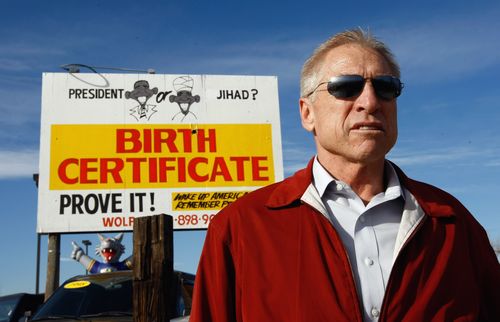
Phil Wolf, owner of Wolf Automotive used car dealership, stands in front of a billboard on his auto lot on November 21, 2009 in Wheat Ridge, Colorado. Wolf paid $2,500 to have the billboard painted, and it has sparked controversy since it was put up the day before. Wolf, 57, said the dealership received more than a thousand calls from throughout the U.S. and Canada in a single day, both in support and against the sign. 'We've had death threats. We had people call and say they were going to firebomb the place last night,' he said, adding that local police provided overnight security outside the dealership because of the threats. Wolf, a supporter of the 'birther' movement, questions President Obama's citizenship. 'We've got to recall our country, the election,' he said. This guy (Obama), is illegal.' He also blamed the President for the massacre at Ft. Hood. 'The cavalier attitude taken by Mr. Obama towards the enemy within us is absolutely horrible. If I had a snake in the house, I would kill it,' Wolf said. Several left-leaning advocacy groups have called on the public to boycott the auto dealership. By John Moore/Getty Images.

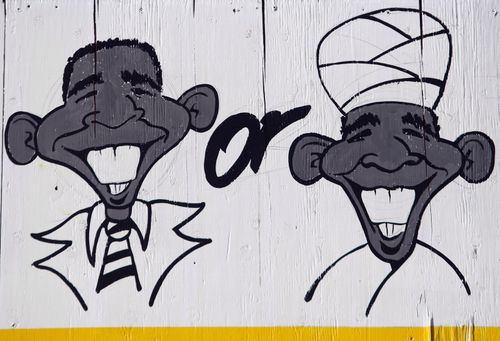
Detail of the cartoons of Obama as Muslim terrorist after the jump:

OBAMATERRORISTJohnMoore:Getty

Document Of The Day

Lincoln-note

Ed Pilkington tells the story:

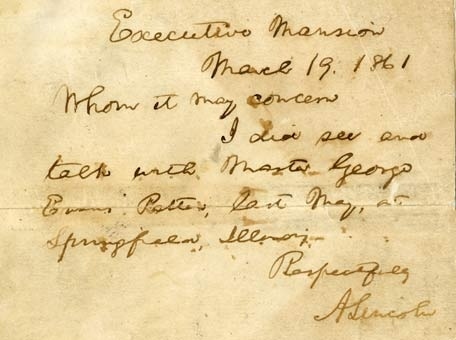
George Patten, aged eight, […] boasted at school about having met Abraham Lincoln, having been introduced to the then presidential candidate with his journalist father. The boy's friends thought he had made the story up, and bullied him. To settle the matter, Patten's teacher wrote to the White House asking for clarification about whether there was any truth to the anecdote. On 19 March 1861, two weeks after his inauguration and despite being preoccupied with forming an administration and the early slide into civil war, Lincoln took the trouble to reply: "To whom it may concern: I did see and talk with Master George Evans Patten, last May, at Springfield, Illinois. Respectfully, A. Lincoln."

Following The Evidence

Jonah Lehrer posits:

[T]he only way we're ever going to reduce medical costs is to restrict procedures that haven't passed evidence-based efficacy tests. Maybe that means 40 year old women don't get mammograms, or that we treat prostrate cancer less aggressively, or that we stop performing spinal fusion surgeries. Although there's solid evidence to question all of these medical options, such changes provoke intense debate. Why? Because our emotions don't understand statistics. Because when we have back pain we want an MRI. Because when it's our father with prostate cancer we want the most aggressive possible treatments. And so on. The point is that there's often an indefatigable gap between the rigors of cost-benefit analyses and the emotional hunches that drive our decisions. We say we want to follow the evidence, but then the evidence rubs against a bias like loss aversion, and so we make an exception. We'll follow the evidence next time.