Parsi And The Regime, Ctd

Larison's reaction to the story:

Lake does not produce anything that clearly puts NIAC in violation of any laws. Everyone who seems to be in a position to judge such matters appears to have concluded that there are no violations. Indeed, the documents used as sources for the article come from the defendant in a defamation suit that NIAC initiated against him because he made this same claim of lobbying for Tehran. It would be very strange behavior for an organization engaged in lobbying for Tehran to invite legal scrutiny of whether or not it was lobbying for Tehran. So the story doesn’t really show that NIAC lobbies for the Iranian government, and it doesn’t really show any evidence of lawbreaking, but other than that it’s definitely “groundbreaking.”

But it does reveal a classic neoconservative move. They are essentially trying to accuse Iranian-Americans who disagree with them of dual loyalty. Even as they rightly scream blue murder if that is ever applied to them. You realize after a while that they have no principles but the maintenance of their own power and the destruction of their perceived enemies. War for ever indeed – within American and outside it. At any cost. Whatever it takes.

What Is Jonathan Foer For?

One joy of the Internet: fearless, skewering reviews of otherwise well-received books. Money quote:

[Foer] doesn’t have time to mention [Peter] Singer, but he compares himself to Kafka, quotes Derrida (more than once), and mistakes graphic design for profundity. One chapter begins with the boldfaced words “Speechlessness / Influence / Speechlessness / Influence” densely repeated for five whole pages. There are times when you can almost hear Foer thinking: Yes, these arguments have been made dozens of times before, but they’ve never been made in this font.

The Jihadists Who Have Recanted II

A critical insight from Johann's piece on Western Jihadists:

Once they had made that leap to identify with the Umma – the global Muslim community – they got angrier the more abusive our foreign policy came. Every one of them said the Bush TAHRIRLeonNeal:AFP:Getty administration's response to 9/11 – from Guantanamo to Iraq – made jihadism seem more like an accurate description of the world. Hadiya Masieh, a tiny female former HT organiser, tells me: "You'd see Bush on the television building torture camps and bombing Muslims and you think – anything is justified to stop this. What are we meant to do, just stand still and let him cut our throats?"

But the converse was – they stressed – also true. When they saw ordinary Westerners trying to uphold human rights, their jihadism began to stutter. Almost all of them said that they doubted their Islamism when they saw a million non-Muslims march in London to oppose the Iraq War: "How could we demonise people who obviously opposed aggression against Muslims?" asks Hadiya.

Britain's foreign policy also helped tug them towards Islamism in another way. Once these teenagers decided to go looking for a harder, tougher Islamist identity, they found a well-oiled state machine waiting to feed it. Usman Raja says: "Saudi literature is everywhere in Britain, and it's free. When I started exploring my Muslim identity, when I was looking for something more, all the books were Saudi. In the bookshops, in the libraries. All of them. Back when I was fighting, I could go and get a car, open the boot up, and get it filled up with free literature from the Saudis, saying exactly what I believed. Who can compete with that?"

He says the Saudi message is particularly comforting to disorientated young Muslims in the West. "It tells you – you're in this state of sin. But the sin doesn't belong to you, it's not your fault – it's Western society's fault. It isn't your fault that you're sinning, because the girl had the miniskirt on. It wasn't you. It's not your fault that you're drug dealing. The music, your peers, the people around you – it's their fault."

Guantanamo Bay was the biggest victory for Jihadism since 9/11. In fact, Cheney's war crimes have endangered our civilization more profoundly than 9/11. That disgraced and disgraceful vice-president gave Jihadism the symbol of Western evil it desperately needed to recruit and grow. Abu Ghraib and the vast web of the torture regime both destroyed our ability to prosecute Jihadists, destroyed the possibility for truly accurate intelligence and gave al Qaeda the critical oxygen it needed to flourish.

And the corollary is true. The more the West lives up to its values the more lethal an enemy we are.

This does not mean giving Islamism the slightest quarter; it does not mean avoiding an aggressive and persistent attempt to identify and monitor Jihadist groups and individuals; it does not mean softening a global campaign to find and target and if necessary kill Islamist enemies bent on our destruction. And it does not mean denying the real murderous intent of these people, or their vile anti-Semitism or their religious inspiration. It does mean using our strengths as a Western civilization to defang a corruption of true religious faith:

All of them said doubt began to seep in because they couldn't shake certain basic realities from their minds. The first and plainest was that ordinary Westerners were not the evil, Muslim-hating cardboard kaffir presented by the Wahabis.

Usman, for one, finally stopped wanting to be a suicide bomber because of the kindness of an old white man.

Usman's mother had moved in next door to an elderly man called Tony, who was known in the neighbourhood as a spiteful, nasty grump. One day, Usman was teaching his little brother to box in the garden when he noticed the old man watching him from across the fence. "I used to box when I was in the Navy," he said. He started to give them tips and before long, he was building a boxing ring in their shed.

Tony died not long before 9/11, and Usman was sent to help clear out his belongings. In Tony's closet, he found a present wrapped and ready for his little brother's birthday: a pair of boxing gloves. "And I thought – that is humanity right there. That's an aspect of the divine that's in every human being. How can I want to kill people like him? How can I call him kaffir?"

(Photo: Supporters of Hizb-Ut-Tahrir, the Islamic political party, march from Paddington Green to the American Embassy in London to protest against the recent US decision to deploy 20,000 further troops into Iraq, 20 January 2007. By Leon Neal/AFP/Getty.)

Crappy Bootlegged DVD Covers

Pepe-likes-tacos

MetaFilter sorts through a vast collection of them on Flickr:

Here, you will find Tom Cruise's hit movie, Pepe Likes Tacos. In this universe, Star Wars features Arnold Schwarzenegger, Dustin Hoffman stars in Lost in Translation; witches, pirates, and hobbits inhabit the same world. Titles are improved upon. Reviews are refreshingly frank (if they make any sense at all). Your DVD may also contain subtitles in French, Chinese, Spamsoc, or Martian.

Actual DVD cover for "Pepe Likes Tacos" after the jump:

Cocktail

Also starring not Sandra Bullock.

Postmodern Palin

A reader writes:

I certainly understand your impulse to draw Sarah, the bull in the GOP china shop, into your ring so you can wave the red flag in front of her and perhaps pierce her with a few banderillas. But really, what is the upside for her in telling the truth?

She has constructed a perfect dynamic for herself with the media: she says whatever she wants, scripts herself into her own fantastical world where she is the heroine, and then, after thorough coverage on every network, is rightly

called on it.

That just feeds the fire of her "victimization" and is more red meat for her witless followers. The very serious Republican pols and pundits may groan, but were she to rally enough of a following and show herself to be a viable candidate, would they not fall in line? It's always a win-win for Sarah.

She has taken to heart the most egregious of the Bush era theories: "when we act we create our own reality."

You have as much chance of bringing her to account as you do Sauron or Darth Vader. Fictional characters are beyond the reach of your "reality-based" critique.

This is true. But the alternative is actually to acquiesce in this circus of faux journalism, faux politics and faux news. Direct accountability matters. It seems to me that one of the advantages of the web is that it gives anyone the chance to swim against this tide a little, without all the usual groupthink and economic pressures to maintain magical thinking. Getting in her face and demanding answers seems to me the point of the Fourth Estate.

I also believe this kind of acquiescence to fantasy, especially when it is directly connected to a political movement is extremely dangerous. It is part of what enabled Bush and Cheney to maintain the fiction that they were acting legally and within constitutional norms as they did what they did in the last eight years. The creation of reality has to be challenged somewhere. And if a blog cannot do it, who can?

The Jihadists Who Have Recanted I

NAWAZJohnMcHugh:Getty

As so often, Johann Hari goes where others don't:

A wave of young British Islamists who trained to fight – who cheered as their friends bombed this country – have recanted. Now they are using everything they learned on the inside, to stop the jihad.

Seventeen former radical Islamists have "come out" in the past 12 months and have begun to fight back. Would they be able to tell me the reasons that pulled them into jihadism, and out again? Could they be the key to understanding – and defusing – Western jihadism? I have spent three months exploring their world and befriending their leading figures. Their story sprawls from forgotten English seaside towns to the jails of Egypt's dictatorship and the icy mountains of Afghanistan – and back again.

Read the whole, gripping, brilliant, beautifully written piece.

The first story Johann recounts is that of the well-educated English Jihadist Usama Hassan, who was indoctrinated in Wahabbist Islam and spent the 1990s guiding other Muslims toward Jihad in Afghanistan and Bosnia. He claims to have converted Omar Sheikh, the beheader of Daniel Pearl. But Hassan's fanaticism began to waver as he witnessed his fellow Jihadists killing one another. The 7/7 bombings in London shook him. The discrepancy between the world he had constructed in his head and the world his eyes and ears saw around him began to lead to the classic moment that many revolutionaries face as they contemplate the horror they have unleashed:

As he watched the news of the Luxor massacre in Egypt or Hamas suicide-bombings of pizzerias in Tel Aviv, "It just became more and more difficult to justify that." He found himself thinking about the Jewish friends he had made at school. "They were just like me – human beings. And we had a lot in common. The dietary laws, and the identity issues, and the fear of racism." As he heard the growing Islamist chants at demonstrations – "The Jews are the enemy of God," they yelled – something, he says, began to sag inside him.

It would be foolish to take too much solace from this development. Plenty of Jihadists still live fully in the fundamentalist, neurotic psyche and use to to commit murder, as Nidal Hasan in the US just proved. But that thinking Jihadists, Western-educated, can find a way to see the ashes of the fire they lit is encouraging.

It is also a very old story – the chastened revolutionary. The totalist identities that fundamentalists attach to are always fragile, because they are based on lies. And lies collapse suddenly. If we truly believe what we say we believe in the West – that these fundamentalist claims are lies and will be dispelled on day – then we need to remain confident that the West is right, and will prevail. 

The more I witness this global struggle for freedom and meaning in the face of fundamentalism and denial, the more it seems to me that containment is the best strategy. Alongside this, we need a robust commitment to our own values, and a refusal to give in to the cant that treats evil as culture and fundamentalism as faith.

Of course this is hard. But there is no other way. And in this struggle the fate of our civilization lies.

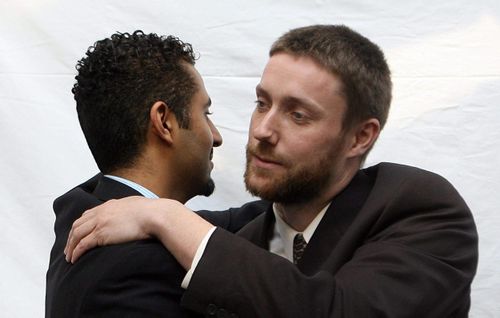
(Photo: British muslims Maajid Nawaz (L) and Ian Nisbet, embrace after addressing a news conference in London, 03 March 2006. The two men and a third man Reza Pankhurst, arrived back in London on Wednesday after being released nearly four years after being arrested in Egypt. The three men, all in their late 20s, had been arrested in Egypt on charges of alleged membership of the Islamic fundamentalist group 'Hizb ut-Tahrir,' (Liberation Party) which was banned by the Egyptian government in 1974. By John D McHugh/AFP/Getty.)
The Weekend Wrap

Over the weekend we saw reported proof that former Alaska governor Sarah Palin can't get enough of the Dish. McCain staffers already shot back at Palin's falsehoods – 32 of which are reiterated here – and Palin already accused the AP of "making things up." To see who is lying and who is not, the Dish issued an open challenge to the former VP nominee.

In other Palin-like news, Liz Cheney leveled cant against the president, a reader went after Hannity's dishonesty, and Bill Kristol showed his fascist side.

On the spiritual beat, Andrew responded the Dreher's latest questioning of gay Catholics and reflected on a religious moment he shared with a shoe shiner at the Waco airport. A reader offered some perspective on Catholic loyalty while another cringed at the Church's charity-withholding threat in DC.

The Dish continued to look back at the first decade of the 21st century here, here, and here. We also featured a fantastic MHB here.

— C.B.

“Pro-Israel”

Norm Geras defines it:

Thinking, now, about the meaning of 'pro-Israel', I'd say that not much more is needed as a basis for describing oneself in this way than some combination of supporting Israel's right to exist, having the interests of the country and its people at heart, liking features of the country and its traditions, taking exception to the special vilification of it common amongst its enemies (both regional and worldwide) and which go beyond normal political criticism, resisting, more generally, the idea that Israel is to be singled out and judged, or treated, according to standards that don't apply to other countries, and so on.

The trouble is: Israel is a rare example of a nation-state that is only a few decades old in a long-inhabited and civilized part of the world, where most of its neighboring states dispute its right to exist at all.

More to the point, overwhelming numbers of the inhabitants of its neighboring states would like to see it disappear from the map altogether. (Of how many other states can that be said?) To add to the complications, Israel isn't even now – geographically – what it was at its inception. Its territory has changed sporadically, making the concept of being "pro-Israel" a somewhat complicated one. And its demography as a predominantly Jewish state is also in flux.

My own definition of pro-Israel would simply be, I think: support for the existence of a secure Jewish state in Palestine. That's my position, and it is as deeply held as it is open to all sorts of arguments about what is best for its security and the interests of the US. I think it should easily be enough to earn one's credentials as a Zionist, as I proudly and passionately remain.