When you shoot video of water drops falling into a puddle in super slow motion, it turns out that they bounce in really interesting ways.
Mary Bates explains:
In essence, when blind people hear the actions of others, they use the same network of cortical brain areas that sighted people use when they observe such actions. This fits into what we already know about how some regions of the brain are recruited for different uses by blind people. For example, congenitally blind individuals rely on areas in the visual cortex to acquire information about an object’s shape and movement through other senses like touch and hearing. As Ricciardi, Pietrini and colleagues point out, the recruitment of visual brain areas for nonvisual recognition in congenitally blind individuals indicates that neither visual experience nor visual imagery is required to form an abstract representation of objects.
Dreher follows up on his former post and wants to know why gay Catholics remain in the church:
I could be wrong, but I very much doubt Andrew Sullivan ever has to hear a word spoken against homosexuality at his parish in Washington, DC. If he did, it's not hard to find parishes that don't hassle him about it, and to live one's life as an openly gay Catholic without having any kind of in-your-face conflict. In most ways dealing with the church's hard teachings (hard for our culture to take, I mean), most American Catholic parishes are functionally AWOL. It's Moralistic Therapeutic Deism all the way down.
Rod is right that most priests do not want to use the Mass a means to directly hurt or abuse or berate gay parishioners. And he's right that rhetorical fulminations against gay people are very rare in my experience in the Catholic church. But he's wrong that many of us who stay try to make an issue of it in the services we attend or even harangue fellow Catholics. I sure don't. I wore an ACT-UP t-shirt to communion once, but that was the limit of my daring. I am not a gay Catholic at Mass. I am a Catholic. The issue of eros is trivial in the face of consecration, prayer and meditation.
I write about it because I feel a need to bear witness as a gay Christian in a painful time, but mainly because I want to argue for a civil change in civil society. But it is in no ways central to my faith. It is peripheral to the Gospels, is unmentioned in the mass, and I try to focus on the liturgy and prayer and to take in as much of the sermon as is safe for my intellectual composure. And this is not strange or, I suspect, rare for gay and non-gay Catholics alike.
We all have aspects of ourselves that the church considers inadequate or wrong. They come as a package. In my own accounting of my sins, sex does not feature much at all. Sometimes I seek a space in St Francis' chapel, a saint I have long loved. And I try to listen to God, and pray the Lord's prayer and meditate for a while to center myself before or after mass. I go much less frequently than I used to, which is the main expression of my alienation, I suppose. In the summers I barely go at all. For me the dunes are the sacraments and the water and air the incense, and the reeds the vestments, and the tides a remembrance of the change that persists. I grew up in a rural woodland and always associated it with religion and the presence of God.
So my faith life is less formal than before, less regimented, as I try to find ways of bring it more fully alive. I write these things in case people might think that the life of a gay Catholic is somehow tortured and deeply conflicted. it is conflicted, but from those conflicts can come a deeper appreciation of the truth we seek and the charity we try (and fail) to live up to.
But it also true that absence from the sacrament of communion is for me an unbearable thing after too long. Perhaps this answers something unanswerable and helps explain how many of us actually do try to live faith rather than merely assert it.
Slate marks the death of the DC Sniper by studying final food requests of prisoners about to be executed:
The last meals of death row inmates are often quite memorable. Karla Faye Tucker requested a fruit plate but didn't eat it. John Wayne Gacy asked for shrimp, fried chicken, French fries, and a pound of strawberries. Timothy McVeigh ate two pints of mint chocolate chip ice cream. Instead of a last meal, Tennessee convict Philip Workman requested that pizza be distributed to the homeless in Nashville. (Prison officials denied his request, but local groups passed out pizza in his honor.) Before his execution in 2000, convicted rapist and murderer Odell Barnes requested a last meal of "Justice, Equality, World Peace." In 1992, Arkansas convict Ricky Ray Rector, who had brain damage from shooting himself in the head after killing a police officer, ate a final meal of steak, fried chicken, and cherry Kool-Aid, but famously said he wanted to save his pecan pie for later.
A reader writes:
This week I reread the Garry Wills book: Why I Am A Catholic. Wills writes intelligently and candidly about his own disagreements with the hierarchy of the Catholic Church. As he explains, the church is not only the hierarchy. The Church – the mystical body of Christ – is all of the people and the priests and the hierarchy. To leave the church, he says, would be to abandon those who have been nothing but good to him simply because he objects to positions held by a few in the hierarchy. And of the hierarchy he says:
We do not leave a father whenever he proves wrong on something. That is when he needs us ….
The true lover of a country does not leave it in its time of peril. The patriot is not one who thinks a country must be perfect in order to deserve his allegiance. Patriots are often critics of their country, since they feel so deeply that it is worth protections.
It is for similar reasons that I remain in the
Catholic church.
If one truly believes that the church is all of the people, then to leave is rather like cutting off one's nose to spite one's face. To leave would be to abandon those who have nurtured and cherished me. To leave would be abandoning them to the powerful and misguided few who are themselves in need of my willingness to challenge.
A Protestant friend recently confided that she was thinking about leaving her church. She was raised as an Episcopalian, but decided that the Episcopal church was too liberal, so she joined an Evangelical congregation. Now she says she misses the more liturgical aspects of worship, so she is thinking about becoming a Catholic. But she thinks the preaching in the Catholic church is of a poor quality (it often is) and she said that she would not long tolerate a parish if it had bad preaching.
What I realized as I was listening to her is that she is giving no thought to the idea of a church being the people. For her, it seems to be about the smells and bells, or the preaching, but not about the embodiment of Christ in the people. As I listened to her, I realized that she sounded more like a fickle lover than a faithful spouse or a loving family member.
Returning to Wills's argument, marriages and family relationships sometimes hit rocky ground, but when we are committed in love, we don't abandon the beloved.
We stay, we fight, we challenge, we live with compromises and we try to work things out.
Tara McKelvey argues that the religiosity of Bush-era appointees had a detrimental effect on soldiers with PTSD:
[Paul] Sullivan was working as an analyst at the Veterans Benefits Administration in Washington in early 2005 when he was called to a meeting with a top political appointee at the VA, Deputy Assistant Secretary for Policy Michael McLendon. McLendon, an intensely focused man in a neatly pressed suit, kept a Bible on his desk at the office. Sullivan explained to McLendon and the other attendees that the rise in benefits claims the VA was noticing was caused partly by Iraq and Afghanistan veterans who were suffering from PTSD. “That’s too many,” McLendon said, then hit his hand on the table. “They are too young” to be filing claims, and they are doing it “too soon.” He hit the table again. The claims, he said, are “costing us too much money,” and if the veterans “believed in God and country . . . they would not come home with PTSD.”
At that point, he slammed his palm against the table a final time, making a loud smack. Everyone in the room fell silent.
“I was a little bit surprised,” Sullivan said, recalling the incident. “In that one comment, he appeared to be a religious fundamentalist.” For Sullivan, McLendon’s remarks reflected the views of many political appointees in the VA and revealed what was behind their efforts to reduce costs by restricting claims. The backlog of claims was immense, and veterans, often suffering extreme psychological stress, had to wait an average of five months for decisions on their requests.
A reader writes:
I watched with dismay (as a gay Catholic myself) the utterly cringe-inducing Intelligence Squared debate recently linked on your website between Ann Widdecombe and Archbishop Onaiyekan (as the Catholics) and Christopher Hitchens and Stephen Fry (as the non-Catholics) on the other. With news of the threat from the Archdiocese of Washington to withdraw support for social services should the DC City Council legalize same-sex marriage (another cringe-inducing moment, but this time far more grievous), something struck me about an apparent inconsistency in the Church's understandings of charity and justice.
If you listen to Archbishop Onaiyekan, he states that the Catholic Church does not discriminate when it comes to providing relief to those in need. Indeed, he's probably generally right about that–I've heard evangelical Protestants criticize the Church on exactly this issue, namely, the practice of performing corporal works of mercy without directly proselytizing the beneficiaries. I think this is the result of the Church's understanding that charity is the highest of theological virtues, and I think it's praiseworthy. Moreover, as St. Thomas would have noted, the goods of the earth belong to all, so it is a matter of justice that they be distributed accordingly (however problematic this is in practice). In this sense charity and justice do not conflict.But this gets thrown into question with the Washington, DC, Archdiocese's recent actions. Let's put aside the legitimate outrage that many are feeling that the Church is holding the homeless and needy hostage in order to get its way on same-sex marriage, though this in itself is a huge issue. Instead, look at the glaring inconsistency of the Church's position with regard to gays and lesbians themselves: The Church claims that justice actually demands discrimination against gays and lesbians in certain matters: for example, the granting of civil and economic rights associated with marriage, housing (landlords shouldn't be forced to violate their consciences and rent to gay co-habitators, for example), employment in certain professions, etc.
So let's grant that justice is indeed served by discriminating against gays and lesbians on certain issues. The upshot is that gays and lesbians potentially are left without various primary goods: homes, jobs, food, medical care, health insurance, etc. What though does charity demand? If we follow the Church's traditional practice, as articulated by Onaiyekan, charity would demand that the Church provide for needy gays and lesbians–regardless of their life-choices/faith/
orientation, etc.–all those aforementioned primary goods without condition. In other words, we have a situation where charity and justice conflict, something that is supposed to be impossible according to JPII's Veritatis Splendor or Benedict's Caritas in Veritate.
I fear that what we have is a hierarchy so fixated on an abstract fundamentalism that it has decided to forgo concrete charity. It is far more preoccupied with a Pharisaical orthodoxy that it has forgotten Jesus' message. It grieves me, but I am sad to say it does not surprise me any more.

On the eve of Palin's latest version of reality, the Dish offers a recap of all the demonstrable lies she has told in the public record. We reprint the list as a public service and invite readers to run the new "book" through exactly the same empirical wringer, so we can compile an up-to-date and comprehensive list of the fantasies, delusions, lies and non-facts that Palin is so pathologically and unalterably attached to. Remember: we are not including contested stories that we cannot prove definitively one way or another or the usual spin that politicians use, or even hypocrisy or shading of facts. We are merely including things she has said or written that can be definitively proven as untrue, by incontestable evidence in the public record.
After you have read these, ask yourself: what wouldn't Sarah Palin lie about if she felt she had to?
Palin lied when she said the dismissal of her public safety commissioner, Walt Monegan, had nothing to do with his refusal to fire state trooper Mike Wooten; in fact, the Branchflower Report concluded that she repeatedly abused her power when dealing with both men.
Palin lied when she repeatedly claimed to have said, "Thanks, but no thanks" to the Bridge to Nowhere; in fact, she openly campaigned for the federal project when running for governor.
Palin lied when she denied that Wasilla's police chief and librarian had been fired; in fact, both were given letters of termination the previous day.
Palin lied when she wrote in the NYT that a comprehensive review by Alaska wildlife officials showed that polar bears were not endangered; in fact, email correspondence between those scientists showed the opposite.
Palin lied when she claimed in her convention speech that an oil gas pipeline "began" under her guidance; in fact, the pipeline was years from breaking ground, if at all.
Palin lied when she told Charlie Gibson that she does not pass judgment on gay people; in fact, she opposes all rights between gay spouses and belongs to a church that promotes conversion therapy.
Palin lied when she denied having said that humans do not contribute to climate change; in fact, she had previously proclaimed that human activity was not to blame.
Palin lied when she claimed that Alaska produces 20 percent of the country's domestic energy supply; in fact, the actual figures, based on any interpretation of her words, are much, much lower.
Palin lied when she told voters she improvised her convention speech when her teleprompter stopped working properly; in fact, all reports showed that the machine had functioned perfectly and that her speech had closely followed the script.
Palin lied when she recalled asking her daughters to vote on whether she should accept the VP offer; in fact, her story contradicts details given by her husband, the McCain campaign, and even Palin herself. (She later added another version.)
Palin lied when she claimed to have taken a voluntary pay cut as mayor; in fact, as councilmember she had voted against a raise for the mayor, but subsequent raises had taken effect by the time she was mayor.
Palin lied when she insisted that Wooten's divorce proceedings had caused his confidential records to become public; in fact, court officials confirmed they released no such records.
Palin lied when she suggested to Katie Couric that she was involved in trade missions with Russia; in fact, she has never even met with Russian officials.
Palin lied when she told Shimon Peres that the only flag in her office was the Israeli flag; in fact, she has several flags.
Palin lied when she claimed to have tried to divest government funds from Sudan; in fact, her administration openly opposed a bill that would have done just that.
Palin lied when she repeatedly claimed that troop levels in Iraq were back to pre-surge levels; in fact, even she acknowledged her "misstatements," though she refused to retract or apologize.
Palin lied when she insisted that the Branchflower Report "showed there was no unlawful or unethical activity on my part"; in fact, that report prominently stated, "Palin abused her power by violating Alaska Statute 39.52.110(a) of the Alaska Executive Branch Ethics Act."
Palin lied when she claimed to have voiced concerns over Wooten fearing he would harm her family; in fact, she actually decreased her security detail during that period.
Palin lied when asked about the $150,000 worth of clothes provided by the RNC; in fact, solid reporting contradicted several parts of her statement.
Palin lied when she suggested that she had offered the media proof of her pregnancy with Trig to "correct the record"; in fact, no reports of her medical records were ever published; and the letter from her doctor testifying to her good health only emerged hours before polling ended on election day, even though there was nothing in it that couldn't have been released two months earlier.
Palin lied when she said that "reported" allegations of her banning Harry Potter as mayor was easily refutable because it had not even been written yet; in fact, the first book in that series was published in 1998 – two years into her first term – and such rumors were never reported by the media, only circulated as emails.
Palin lied when she denied having participated in a clothes audit with campaign laywers; in fact, the Washington Times later confirmed those details.
Palin lied when asked about Couric's question regarding her reading habits; in fact, Couric's words were not, "What do you read up there in Alaska?" or anything close to condescension.
Palin lied when she mischaracterized the "$1200 check" given to Alaskans as the permanent fund dividend check; in fact, that fund had yielded $2,069 per person, and she claimed otherwise to obscure the fact that Alaskans also received a $1200 rebate check from a windfall profits tax on oil companies – a tax widely criticized by Republicans.
Palin lied when she claimed to be unaware of a turkey being slaughtered behind her during a filmed interview; in fact, the cameraman said she had picked the spot herself, while the slaughter was underway.
Palin lied when she denied having rejected federal stimulus money; in fact, she continued to accept and reject the funds several times.
Palin lied when she claimed that legislative leaders had canceled a meeting with her to hold their own press conference; in fact, they only canceled it after being told she would not participate, and the purpose of the press conference was very different from the meeting's.
Palin lied when she announced on the news that she never holds closed-door meetings; in fact, she had just attended a closed-door meeting with the legislature earlier that day.
Palin lied when she said that former aide John Bitney's "amicable" departure was for "personal" reasons; in fact, Bitney said he was fired because of his relationship with the wife of Palin's friend, plus a Palin spokesperson later claimed "poor job performance" for his firing – without elaborating.
Palin lied when she said she kept her running injury a secret on the campaign trail; in fact, her bandaged hand was clearly visible in photographs and the story was widely talked about.
Palin lied when she claimed that Alaska has spent "millions of dollars" on litigation related to her ethics complaints; in fact, that figure is much, much lower, and she had initiated the most expensive inquiry.
Palin lied when she denied that the Alaska Independence Party supports secession and denied that her husband had been a member; in fact, even the McCain campaign noted that the party's very existence is based on secession and that Todd was a member for seven years.
(Photo: Eric Engman/Getty).
The Dish is going to wait for the actual "book" "by" Sarah Palin before analyzing its factual accuracy. The excerpts are so far incomplete and context is missing. The odd lies compiled by the Dish were strictly limited to statements she has made that are directly contradicted by clear and available evidence that she simply refuses to acknowledge. But the first pushback from the McCain campaign does not, shall we say, surprise me. Check this out as an hors d'oeuvre.
As this blog persistently demonstrated in last year's campaign, Palin is a delusional fantasist, existing in a world of her own imagination, asserting fact after fact that are demonstrably untrue, and unable to adjust to the actual reality after it has been demonstrated beyond any empirical doubt. The campaign's media strategy of making sure she was never in a position to be asked anything in an uncontrolled setting, and of never holding an open press conference (unprecedented in the history of presidential campaigns) were a response to this. The only interview that dared stray even a little from this fawning celebrity-deference, Katie Couric's, revealed Palin to be an astonishingly inept know-nothing, camouflaged by incessant victimology.
She is a deeply disturbed individual whose grip on reality is very weak, and whose self-awareness is close to nil. This much is not a leap, let alone unfair. It is simply unavoidable if one examines her surreal invention of reality – even when she must surely know that the evidence exists out there to contradict her.
As I have long noted, this is not the usual political mendacity and spin. It is far weirder and more disturbing than that. She creates her own reality. And the fact-indifferent, editor-free marketing company, HarperCollins, is only too willing to make some money off it.
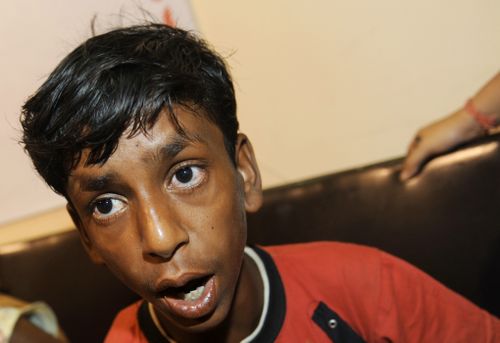
Indian child labourer All Amin who works in a brick field, speaks during a press conference in Kolkata on November 13, 2009 on the eve of Children's Day. In India, Children's Day is commemerated on November 14, the date which marks the birth anniversary of independent India's first Prime Minister, Jawaharlal Nehru while November 20 is celebrated as Children's Day globally. By Deshakalyan Chowdhury/AFP/Getty.
 The Dish