“A Fundamental Disconnect,” Ctd

Yglesias partially defends the public's entitlement hypocrisy:

What we really see with the entitlement situation is a public refusal to think seriously about the future—a kind of myopia more than a refusal to pay the tab. What actually happens when the tab comes do [sic]? We’ll have to see. But I don’t think we really know what the public’s view of the coming crisis will be when it actually arrives.  

Distracted By Troop Levels

Fred Kaplan explains why the Afghanistan decision has taken so long:

[C]ontrary to the media's incessant focus on numbers, this has never been a decision primarily about troop levels. Last summer, retired Gen. Colin Powell advised Obama that the key question was not how many troops to send but what those troops should do—and that this was primarily his decision, not some general's. Obama seems to be following that advice.

[…]That's what the drawn-out discussions have been about, that's (in part) why it's taken so much time. According to some officials, after each of the eight sessions, Obama has been dissatisfied with the answers at some level and has hammered them to bring back more detail the next time—on the state of the Afghan army, on the impact that various deployments would have on the state of the U.S. Army, on a province-by-province breakdown of Afghan politics and security. All these questions directly, even crucially, affect calculations of acceptable risk or clear futility—the chances of success or failure.

Should The Democrats Panic?

Maybe a little says Nate Silver:

My 30,000-foot view is that between the pressures of the jobs situation and the health care debate, the Democrats are in fairly bad shape. But, there's a long way to go before next year, and

their situation does not seem to be quite as bad as it was in August.

Certainly, if I were the Democrats, I'd be adopting a fairly defensive posture, putting money into defending seats — especially those held by non-Blue Dog incumbents — rather than getting cute and trying to pick off more than a handful of potentially vulnerable Republican seats. I'd also be thinking about policies — like a jobs package and financial regulation — that tap a little bit into the populist spirit and might result in somewhat awkward Republican positioning. 

When will people realize that Obama is a strategist, not a tactician? If you cannot see the long-term game here, and the fact that the Republicans are merrily laying the foundation for their own potential implosion, you're not watching closely enough.

Obama, Deficit Hawk

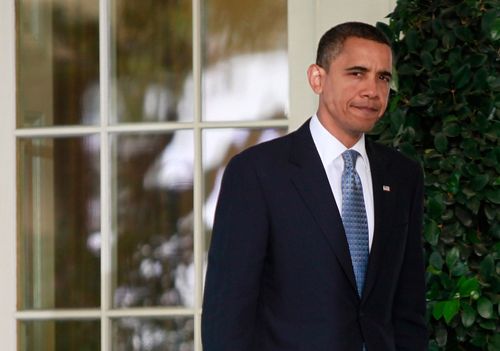
OBAMA09MarkWilson:Getty

For much of this year, I've been arguing that the Obama administration needs to pivot swiftly from health insurance reform to fiscal responsibility in the coming months. The recession made deficit cutting in the here and now imprudent in his first year; but now addressing the long-term debt is itself necessary for stabilizing the economy – and reassuring independent voters that he, unlike his predecessor, gives a damn about fiscal health. Well: the good news is that he's going to do exactly that:

President Barack Obama plans to announce in next year's State of the Union address that he wants to focus extensively on cutting the federal deficit in 2010 – and will downplay other new domestic spending beyond jobs programs, according to top aides involved in the planning. The president's plan, which the officials said was under discussion before this month’s Democratic election setbacks, represents both a practical and a political calculation by this White House. On the practical side, Obama has spent more money on new programs in nine months than Bill Clinton did in eight years, pushing the annual deficit to $1.4 trillion. This leaves little room for big spending initiatives. On the political side, Obama can help moderate Democrats avoid some tough votes in an election year and, perhaps more importantly, calm the nerves of independent voters who are voicing big concerns with the big spending and deficits.

This classic Politico piece – in as much as it regurgitates almost comically process-oriented Beltway wisdom – fails to mention a few things about Obama's spending in his first year.

Item one: the recession.

To treat the stimulus package as if it were something he just felt like doing – because he's a big government maniac – is a lie, a piece of propaganda that has seeped into the lazy Beltway desire to describe everything – even now – into the big government/small government, red-blue paradigm.

Item two: The health insurance reform almost painfully tries to pay for itself – something that Bush's Medicare entitlement didn't even pretend to do. 

Item three: there's a big big difference between spending on green and infrastructure investment and slashing taxes or increasing Medicare entitlements.

The way in which cynical and amnesiac Republicans have tried to portray this as classic big government liberalism is a lie. You can debate the merits of each initiative, but this is obviously not an administration as fiscally reckless as the last one. Mercifully, they have a chance to show it in earnest next year. And to call the bluff of those Republicans yelling about spending while having absolutely no plans or ideas for cutting it.

(Photo: Mark Wilson/Getty.)

“A Fundamental Disconnect”

The CBO tells us what we already knew:

I concluded the talk by emphasizing that fiscal policy is on an unsustainable path to an extent that cannot be solved by minor tinkering. The country faces a fundamental disconnect between the services the people expect the government to provide, particularly in the form of benefits for older Americans, and the tax revenues that people are willing to send to the government to finance those services. That fundamental disconnect will have to be addressed in some way if the budget is to be placed on a sustainable course.

Are Too Many Students Going To College?

The Chronicle hosts a debate. As usual, Charles Murray bucks the conventional wisdom:

It has been empirically demonstrated that doing well (B average or better) in a traditional college major in the arts and sciences requires levels of linguistic and logical/mathematical ability that only 10 to 15 percent of the nation's youth possess. That doesn't mean that only 10 to 15 percent should get more than a high-school education. It does mean that the four-year residential program leading to a B.A. is the wrong model for a large majority of young people.

Two Decades Later

Pivoting off a Pew report, Joshua Tucker checks in on public opinion in nine post-communist countries:

We can see that in eight of the nine post-communist countries, a majority of the population continues to approve of the change to democracy; in four of these countries at least 70% of respondents approved. Ukraine is the clear outlier here, with support having dropped by 42% to only 30%. Particularly interesting in these findings is the fact that a greater proportion of Russians than Ukrainians continue to approve of the change to a multiparty system, despite the fact that the latter actually has functioning multiparty politics while one would be hard pressed to claim anything of the sort exists in the former.

Don’t Let The Gays Marry, Or The Homeless Get It

A reader writes:

I'm truly at a loss for words at this story. I was raised Catholic my whole life, but was between parishes when it came time to make confirmation in middle school. I took charge of my religious life in high school and college and decided to finally be confirmed earlier this year because I cannot live my life any other way except by the tenants of the Gospel. This "threat" is so contrary to everything I've learned about service through the Church that I'm just completely numb