Hard to parody.
Month: November 2009
Lest We Forget Them
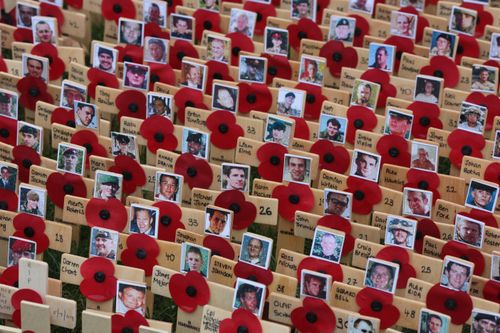
Remembrance crosses for servicemen killed in the current conflict in Afghanistan sit outside Westminster Abbey after the Remembrance Sunday service at the Cenotaph on November 8, 2009 in London, England. This year marks the 70th anniversary of the start of the Second World War and on Remembrance Sunday the country honours its veterans with the commemorations paying particular focus to the troops who have lost their lives in current conflicts. A British soldier from 2nd Battalion The Rifles, became the 200th British soldier to lose his life in combat in Afghanistan November 7, bringing the total number of British losses, including accidents and illnesses, to 231. By Dan Kitwood/Getty Images.
The View From Your Sickbed
A reader writes:
A personal story: my girlfriend has a tumor on her ovary and no health insurance. She’s taking her last class for her nursing degree, but since she’s not going to school full-time, she’s not elligible for insurance through the school. She has two jobs bartending, neither of which offer health benefits, working nights so she can spend her days studying and taking care of her six year old daughter (who thankfully is on her father’s insurance).
I don’t know a person who works harder than her and who gives so much of herself to others.
It is a travesty that the country she lives in–the richest in the world–can’t provide her and people like her decent affordable health insurance. Arguments over funding abortion are trivial in comparison to the magnitude of health care problems facing millions of people every day in this country. As a supporter of reproductive rights, I’ll happily cede that ground to the anti-abortion zealots and fight another day, if it means people in the same boat as my girlfriend are able to have access to the care they need.
The Church In The Castro
There is one, of course, The Holy Redeemer, smack bang in the gay district in San Francisco, and unmolested, respected, admired. Rod Dreher's conflicts are a fantasy of his own creation. The truth is that gays have long been amazingly tolerant of the churches that seek to strip us of civil rights. One ghastly exception was Act-Up's assault on St Patrick's Cathedral, but that proves the rule. If anything, gay men actually do more to support the church than attack it. A reader writes:
I am a non-Christian gay man dating a Catholic priest, and am struck by the Catholic Church's reliance on gays as priests. Many come from places and homes in which being a priest has been the only acceptable path for a devout gay Catholic boy. In answer to your question asking if it is bizarre that the Catholic Church finances a campaign to tell gay kids they cannot have a relationship like their parents: If those kids knew they could have happy, loving, same sex relationships, would they still choose to be priests?
There is something deeply, sadly sick about the whole enterprise: a nest of dysfunction and dishonesty and hypocrisy. I am peppered with emails asking me why I don't just leave or at least disassociate – especially since the anger on this blog is not contrived. It engulfs me at times – to my shame.
I do find it increasingly hard to attend mass after campaigns as in Maine that feel like an assault on my soul and others'; and a sense of exile – spiritually and psychologically – has marked my faith life since the sex abuse scandal broke.
Maybe I am too weak to leave and be done with it. But in my prayer life, I detect no vocation to do so. In fact, in so far as I can glean a vocation, it is to stay and bear witness, to be a thorn in the side, even if the thorn turns inward so often, and hurts and wounds me too.
I stay because I believe. And I stay because I hope. What I find hard is the third essential part: to love. So I stay away when the anger eclipses that. But the love for this church remains through the anger and despair: the goodness of so many in it, the truth of its sacraments, the knowledge that nothing is perfect and nothing is improved if you are not there to help it.
The Limits Of Hoffmanization, Ctd
Christopher Orr's thoughts on that Snowe poll:
Under normal circumstances, this is the kind of insurgent candidacy that would quickly be squelched by the party establishment in the name of holding onto a GOP seat in inhospitable terrain. And perhaps that's still what would happen. But the establishment's clout contra the conservative insurgents is at a historic low, and it wouldn't take much–a Palin endorsement here, a Beck crusade there–to scramble the usual political assumptions.
The real question, of course, is what Olympia Snowe thinks when she sees this poll: that she's probably finished with today's GOP and should keep her independent streak alive by voting for health care reform (or, at least, cloture); or that she badly needs to shore up her right flank by voting against?
Ezra Klein's take on whether Snowe would switch parties:
[Snowe] has deep personal connections to the Republican Party: Her first husband was a Republican legislator in Maine's House of Representatives, and her current husband is the former Republican governor of Maine. Becoming an independent seems a lot likelier than becoming a Democrat.
Mental Health Break
A DADT Timeline
Barney Frank sets one:
Repealing “don’t ask, don’t tell” will likely be included as part of next year’s Department of Defense authorization bill in both chambers of Congress, Congressman Barney Frank (D-Mass.) said Wednesday.
“Military issues are always done as part of the overall authorization bill,” Frank said, insisting that this has been the strategy for overturning the policy all along. “'Don’t ask, don’t tell' was always going to be part of the military authorization.”
In Palin We Trust? Ctd
A reader writes:
Looks like some audience member went rogue with a recording device.
The Case Against Representatives Reading The Bill, Ctd
A reader writes:
Bartlett's point about reading bills being a waste of time is exactly right. As a computer programmer, reading that section of legislation felt EXACTLY like reading a "snippet" of code. I worked until very recently at a bank that has a large (> 3000 headcount) IT department. The idea of managers reading every line of code that goes into a release is absurd – in fact, many senior managers who grew up programming mainframes in COBOL are effectively illiterate in the VB, Java and .Net paradigm that's taken over.
The analogy between computer code and federal legislation isn't spurious, either. The similarities run quite deep because both are formal languages. They give precise and unambiguous instructions on how a program (whether the computer or government variety) should behave for any given scenario, whereas natural languages are more vague but less opaque in expressing intent.
In fact, the comparison between congressman and IT manager runs even deeper than at first blush. The snippet is not merely a standalone piece of legislation, but an amendment to one that already exists. That is akin to the situation quite common in IT where the behavior of a large, existing piece of software needs to be patched. At a code level, that might entail injecting just a handful of blocks of code at various points in a 50,000 line code base.
Reading the text of the amendment without the context into which it was inserted would be not so much losing the forest for the trees as losing it for the molecules.
“I Just Know”
K-Lo gets an email:
Your article about marriage struck a chord with me, mainly when you wrote about the brutal tactics employed against defenders of traditional marriage. I'm 26 years old and my generation holds very strong views on this topic… in my experience, mostly in support of same-sex marriage. Personally, I'm on the fence about it. But for most people my age, that is not good enough. The peer pressure to support gay marriage is enormous. Which is precisely why I refuse to give my (socially mandatory in many circles) full-throated support to it. When friends tell me it's a civil right and denying gays their "universal right to marriage" is the same as forbidding whites and blacks to marry, it makes my skin crawl . . . but I don't know how to argue against these points. I just know deep down there's something fishy about the arguments.
In K-Lo's piece, Robert P. George continues his argument that those of us who want to be full members of our own families and societies are working for "the abolition of the conjugal conception of marriage as the union of husband and wife." This is untrue. I completely support the conjugal conception of marriage as the union of husband and wife. I cherish marriage as an institution between husband and wife. It remains a bedrock of society, critical to rearing children, central to teaching mutual responsibility and a miraculous place for the creation of new life. You can pore through every word I have ever written (and they have) to find a scintilla of hostility to this.
And when my own mum and dad were there at my wedding, and my husband's mum and dad were there at my wedding, they did not even begin to see how our marriage invalidated, let alone abolished, theirs'. In some ways, our marriage completed theirs'. We are their sons. They want us to be happy. They are thrilled we found each other. And this civil rite knitted us together in a way nothing else could.
Yes, it was painful not to marry in church. But we had mass the day before together. When I look back on that day, and the weddings of so many others, all I can see in George and Lopez is a simple blank refusal to accept our existence and our dignity, an inability to see that expanding marriage to include everyone does not destroy it – it just brings in those previously left outside.
These are the blinders of abstraction and fear; they need to be dropped to see the reality and the love. One day, they will. And that I just know.
 The Dish