
HQ European Command, Stuttgart, Germany, 9 am
HQ European Command, Stuttgart, Germany, 9 am
Ezra asks of the suddenly conscience-stricken Democrat:
What's the mechanism by which the public option increases the national deficit?
A reader writes:
Like you, I don't like abortion. And I really don't like federal funding for it. But the Stupak/Pitts amendment adopted in health reform by the House of Representatives went beyond the status quo of today's abortion landscape.
The original bill made an important distinction — no federal funds for abortion procedures. Stupak's amendment — "codifying Hyde" in this context — means no federal funds for plans that cover abortions. It's a critical distinction. It's one thing when Hyde affected federal funding for Medicare which is mostly for seniors, FEHBP which is a condition of employment, or even Medicaid as 17 states use their own funds for paying for abortions. It's another thing when the bill affects a huge portion of the population and impacts their ability to pick private plans.
Today, taxpayers allow for the deduction of employer-based coverage. More than half of America are covered in plans that cover abortions.
In order to make coverage in the Exchange affordable, credits are paid to the person's choice of plans. The Bishops and opponents of health reform use this consumer-friendly feature of health reform (after all a tax deduction wouldn't help until the year after the policy is purchased) to seek to end abortion coverage in anyone's insurance.
Roughly 85% of people buying in the exchange are expected to receive some amount of affordability credit. If Stupak becomes law, no person will be able to buy a plan in the Exchange that covers abortion. It will force millions in the middle class to have their plans be deemed ineligible if they currently include abortion coverage – whether or not they qualify for subsidies.
Few women and even fewer men will sign their family plan up for coverage if it requires a rider. Or they'll forget that it's available after signing up for a plan years before their daughters are teenagers. As the Bishops and their representatives in Congress told many members of Congress last week, few women use insurance coverage for abortions. That's probably right. But that won't help the thousands of women each year whose ethics tell them that they need an abortion for their health, or for their other fetus's health. The agonizing stories you posted earlier this year — many of them were expensive hospital procedures, not clinic-based ones - are expensive. And many will be out of pocket if Stupak becomes law.
The base text as amended in the Energy and Commerce Committee prevented federal dollars from paying for abortion procedures beyond a woman's life, or due to rape or incest. The President asked Congress not to allow federal funds for abortions, and the unamended bill did that by segregating funds. The Catholic Church, and many others, are intimately familiar with this because they routinely receive federal, state, or local funds so long as they don't proselytize. Basically only private premium dollars could be used. And because people had choice of a variety of plans in the Exchange, if they didn't want their money going to abortions at all, they could choose another plan.
Many pro-life members of Congress saw the virtues in this and worked to strengthen that concept. And the Bishops's representatives wrote angry letter after angry letter, screamed at members and staff and refused to come up with meaningful alternatives other than slight variations on their plan to restrict a person's right to pick the plan of their choice. Instead of trying to seek common ground, they demonized others who sought to keep the status quo intact as much as possible while still supporting health reform.
And when all was said and done, after no less than 10 Bishop's staffers roamed the halls of Congress, claiming to speak for the Lord, they sent to only a small handful of members of Congress a letter blandly talking about some virtues of the health reform, while explaining they couldn't support the bill because they didn't have any experts in the area.
In short, they used leftover goodwill from their 1940s and 1960s efforts to support health reform to convince Members to work with them on abortion — meanwhile, they worked hand in hand with extreme right wing groups like Concerned Women, Family Research Council and National Right to Life.
I hope to God that the Senate has more understanding of the issue.
“I’m glad she’s getting the props — I know I’m not nearly as attractive,”- Mike Huckabee on Sarah Palin.
"Maybe Scientology has some good intentions for its members; many religions and spiritual orientations do, whether you call it a cult or otherwise. But one thing keeps getting clearer and clearer: the draconian culture of celebrity worship and the despotic bureaucracy and culture of fear keeps making Scientology look worse, and worse, and worse," – Foster Kamer.
Depressions can bring out the worst in people. And the racism percolating in the London Spectator's comments sections caused Clive Davis to take a stand:
The problem, I think, is that some Speccie-ites seem to believe that generating “mischief” is all that matters. That’s a dangerous game to play when the subject is race. I hesitated before writing this post, partly because the people I dealt with at the Spectator were always considerate and helpful, and didn’t complain about my steady drift away from neocon orthodoxy. It’s also partly because it’s simply not the done thing for journalists to talk shop. I did cling to the faint hope that the web site would somehow clean up its act. It doesn’t seem to have happened so far.
Massie is also worried by paranoia and conspiracy theories that are on the rise in Britain as well as America.
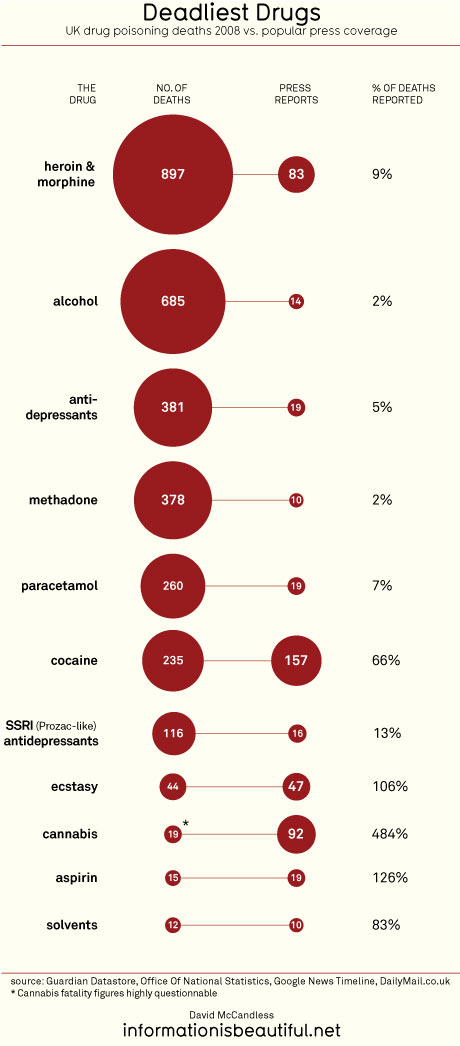
I don't for a minute buy cannabis "fatalities". It's impossible to kill yourself with pot. The press reports "cannabis-related" deaths which is surreal. David McCandless, who devised the graph and runs Informationisbeautiful, adds:
There has never been a single documented case of fatal cannabis overdose. Also, the government's own figures don't tally. While drug figures from the Office Of National Statistics register 19 cannabis related deaths, the mortality stats from the same office log only 1 death.
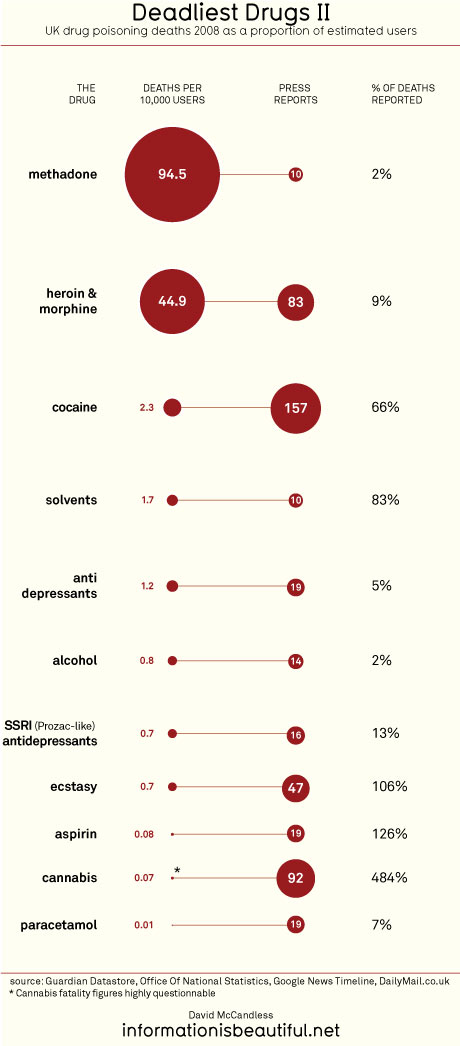
But even granted that, you can see how the media irrationally focuses on what isn't the biggest problem by any objective assessment. And this focus can distort public policy. What would this graphic look like if the death-rate were assessed per user of each drug? Marijuana would appear as less toxic than aspirin. Below the fold:
A long hard look at re-tooling the message now for marriage equality is vital.
It's on now.
 The Dish