When Muslims Commit Violence

I want to broadly second Goldblog on this point:

Elite makers of opinion in this country try very hard to ignore the larger meaning of violent acts when they happen to be perpetrated by Muslims. Here's a simple test: If Nidal Malik Hasan had been a devout Christian with pronounced anti-abortion views, and had he attacked, say, a Planned Parenthood office, would his religion have been considered relevant as we tried to understand the motivation and meaning of the attack?

Of course. Elite opinion makers do not, as a rule, try to protect Christians and Christian belief from investigation and criticism. Quite the opposite. It would be useful to apply the same standards of inquiry and criticism to all religions.

I did not leap to that conclusion in this case as the primary reason for the attack because we didn't fully know the entire picture – and still don't. But as the pieces fall into place, it seems increasingly clear that Nidal Hasan's faith – and the conflicts it presented in the context of the war on Islamist terror – was absolutely relevant in this horrifying massacre of servicemembers. It may well have been combined with individual stress, exposure to others with PTSD, fear of deployment, psychological disturbance, etc. But that it was a critical factor seems to me important to note.

But every case is unique.

If the man is not part of any wider conspiracy or terror group, it is silly to treat him the way we would a Qaeda cell, for example, as Lieberman seems to want to do. And the random murder spree was not designed to wound the US militarily in any strategic way. But religion is poisonous when it fuses with politics and deploys violence to control or punish others – and Hasan's increasingly Wahabbist version of Islam is about as crude a conflation of religion, certainty and violence as one can imagine.

This applies to the extremes of Christianity and Judaism as well, of course. I do not think you can understand the assassination of abortion doctor George Tiller without grasping the religious motivation of his killer, just as I think a brutal gay-bashing by a thug with Leviticus tattooed on his arm gives you a good idea of the religious motivation for the beat-down. Ditto, I might add, when we discover that it was a fanatical Jewish settler – transposed from America – who gunned down people at a gay walk-in center in Jerusalem. Religious fanaticism – in Texas or the West Bank or in Gaza – is a dangerous, dangerous impulse in an increasingly fundamentalist age. We should not balk at saying that as plainly as we can and demanding that religious leaders condemn the violent and extremist members of their respective flocks. And we should try much harder to find such extremists in the military and do a better job at monitoring them or throwing them out.
Consistency Revisited II

Now to turn the tables a little on today’s Tea Party right. How inconsistent are they? I simply do not recall their loud protests as the Bush administration very clearly embarked on a program of fiscal recklessness from 2001 on. Sure, like the Obama administration, the Bushies did have to worry about a recession after 9/11; but their profligacy pre-dated it and continued well past recovery. Partisan bloggers kept mum at the time out of deference to the GOP. So did National Review and the Weekly Standard – the very organs now fulminating against spending when it’s done by a Democrat in his first year in the teeth of the worst recession since the 1930s. But the Dish’s record is in plain view. Here I am in March 2003 on the problem of spending:

I’ve been trying to give [Bush] the benefit of the doubt, but his latest budget removes any. He’s the most fiscally profligate president since Nixon. He’s worse than Reagan, since he’s ratcheting up discretionary spending like Ted Kennedy and shows no signs whatever of adjusting to meet the hole he and the Republican Congress are putting in the national debt.

I’m also staggered that the budget does not contain any mention of the looming war. I guess you could make a semantic point about its not being inevitable – but not even as a possible contingency? Is that how an ordinary citizen plans his own budget?

You’re the government, Mr President. And your party controls all of Congress. There’s no way you can pass the buck for plunging the next generation into debt through excessive spending while blaming someone else. His final option is to say: I’m a big government conservative. I want to spend gobs of money on the military and defense, cut taxes, and splurge on social discretionary spending to prove my compassionate credentials. Deficits don’t matter. Debt doesn’t matter. Governments – at least while I’m president – know better how to spend money than individuals do. That would be the honest message. And it might even be a winning one. So why the flim-flam? Maybe because actual fiscal conservatives like me might wail. Well, sorry to disappoint you, Mr President, but I’m going to wail anyway.

Who among the tea-partiers was saying this? Almost none (although Dick Armey gets a pass). Certainly not Malkin at the time or Reynolds, whose only spending question was always the trivial red herring of pork. Where was the Weekly Standard? Or National Review? When I challenged Rove personally on this, he reiterated that “deficits don’t matter,” even as he is now preening as a fiscal conservative. The nakedness of their opportunism doesn’t make it any the less repellent.

Maybe one day, the Republicans can regain some credibility by accounting for their past failures in ways that actually implicate themselves or president Bush and vice-president Cheney. Maybe, at some point, they will propose some serious, constructive reform – on taxes, entitlements, war, and civil rights.

When they do, I’ll take the tea party movement seriously – and even support its message. But right now its message is a farrago of fear, fanaticism and fantasy.

Palin And Amniocentesis: The Story Evolves

Muthainlaw

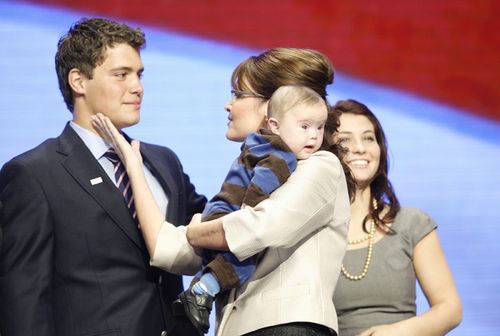
In the Friday Wisconsin speech, we were reminded again of how central the Trig pregnancy remains to the Palin phenomenon. McCain, in the three minutes he spent thinking about it, saw Palin as some kind of "reformer". In fact, she was carefully marketing herself in 2008 as the uber-Christianist, and her carrying to term a Down Syndrome baby was the single most important fact about her for the base (and still is). This is what Kristol saw in her: a walking embodiment of the pro-life movement, but also usable to launch further warfare in Iraq, Iran, Afghanistan or wherever the next neoconservative adventure can be found.

So what did we learn on Friday?

We learned for the first time that the Dish's appalling interest in her odd amniocentesis was onto something. In September 2008, I asked:

Why would a pro-life woman choose the procedure that could lead to the death of her unborn child rather than the safe, less invasive procedure? I don't know. It's one of many mystifying weirdnesses in Palin's own account of her pregnancy.

You'd think I'd accused her of manslaughter. But it now turns out that Palin did have an early ultrasound before the amnio – at least according to her latest version of the one-month-long public pregnancy and  miraculous airplane labor across several time zones and continents. And it was the ultrasound, and not the amniocentesis, that revealed the Down Syndrome:

Palin spoke movingly of her youngest son, Trig, who has Down syndrome. She recalled that when she was pregnant, she underwent an ultrasound and the technician told her, "I see boy parts." Later, the technician told her that the baby's neck "is a little bit thicker," an indication that there might be an extra chromosome. A few days later, Down syndrome was confirmed.

Presumably, the confirmation came by amniocentesis, a procedure that posed a small but real threat to the baby's life. So the Dish wasn't crazy to ask this obvious question. Palin might have finessed this story last year because she didn't want to answer the question of why, as a pro-life woman, she would risk the life of her unborn child merely to confirm a diagnosis that had already been made. It could also be explained by a simple compression of the pregnancy story – but that's a little convenient given her acute control of the message at the time. There's one other aspect of her current story that's a bit strange as well.

The story, as we knew it from before (from the book, "Trailblazer", and a recent speech in Indiana), was that Palin found out she was pregnant "while out of state first, at an oil and gas conference." (It's unclear if she had had a pregnancy test at her doctor's and had the results confirmed to her over the phone or if she did a test herself, or just realized she must be pregnant.) Before she knew anything about the condition of the child, she said Friday she contemplated an abortion:

While out of state, there just for a fleeting moment, wow, I knew, nobody knows me here, nobody would ever know. I thought, wow, it is easy, could be easy to think, maybe, of trying to change the circumstances. No one would know. No one would ever know.

By her account, she resisted that temptation but lapsed back into conflict after the Down Syndrome confirmation:

Then when my amniocentesis results came back, showing what they called abnormalities. Oh, dear God, I knew, I had instantly an understanding for that fleeting moment why someone would believe it could seem possible to change those circumstances. Just make it all go away and get some normalcy back in life. Just take care of it. Because at the time only my doctor knew the results, Todd didn't even know. No one would know. But I would know.

Some remaining questions: When exactly did Todd find out about the pregnancy? And when did he discover that his son had Down Syndrome? Or were those two pieces of news delivered simultaneously? Why did the Palins make no attempt to prepare their other children for Trig's special needs when they had so long to do so? Why on earth did Palin believe that the mere fact of her pregnancy would elicit criticism and disdain – "Oh, the criticism that I knew was coming" – when it would obviously actually redound to her credit as a working mom and governor?

Maybe her "book" will resolve these and other empirical questions about the logic and detail of her pregnancy and labor stories. Maybe someone will even ask her to clarify the chronology of the critical reason for her enduring appeal. It would, you know, be relevant, if not deferent.

Benedict’s Intellectual Warriors

You can forgive the pro-Catholic side for losing the debate in Britain on whether the Catholic church is a force for good in the world. Ann Widdecombe and Archbishop John Onaiyekan were up against Hitch and Fry. What you cannot forgive is the sheer intellectual shallowness of the defense. Just listen to the small speech above, I mean: really, this is the best we’ve got? In Onaiyekan, you have a classic Benedict/JP II Archbishop: dumb as a post, sheltered from the actual debate in the West, incapable of argument, and pathetic as a spokesman. The problem with the theoconservative take-over in the Catholic priesthood is not so much its extremism as its mediocrity. And it is mediocre because it has been trained not to think, not to argue, and not to engage the modern world. It has been trained solely for obedience – blind, dumb, unquestioning, intellectually moribund obedience. Hitch’s continued riposte is below. It was not a fair fight, and, for some reason, I still want my church to make a case that is actually intellectually and morally defensible. Under Benedict’s weak, reactionary leadership, it is losing the battle of ideas in the West more swiftly than any of us could have predicted:

Consistency Revisited I

I’ve noticed a few right-of-center blogs complaining of double standards on the left, in the denunciations of extremist rhetoric and imagery of the Tea Party marches. Ed Driscoll has a good point. The extremes of the anti-war left before Iraq were every bit as inflammatory and loopy as the Tea Partiers today. Now, they were opposing a war that turned out to be a catastrophe for all involved, while the Tea Partiers are just opposing the working poor having a chance to buy health insurance. But if Godwin’s Law is the point, many (but not all) on the left currently do not have a leg to stand on. I get a lot of criticism for changing my mind on Iraq in the face of the evidence that there were no WMDs, that the war was conducted in violation of the Geneva Conventions, and the occupation was insufficiently planned, under-resourced, etc. But my position on the anti-war marches then was the same as mine on the Tea Party excesses today. From the Dish in March 2003:

Notice also the constant harping on the tired old notion that Bush is an idiot – “Brains Not Bombs,” “Bush Is a Moron,” “Smart Bombs Don’t Justify Dumb Leaders.” Notice the personal attacks – “Draft the Bush Twins,” “Sorry, Dubya, Have a Pretzel Instead.” Notice the idiotic moral equivalence: “Who’s The Unelected Tyrant With The Bomb?” It’s hard not to feel demoralized by a culture that can throw up such things as genuine pieces of protest. It’s as if an entire generation or more has forgotten what an argument is.

I was appalled by the anti-Semitism buried within ANSWER – the left-wing equivalent of the Tea Party peeps – their paranoia and their ad Hitlerum daffiness. I railed against “the intolerant, extremist and reactionary forces behind an unhealthy amount of the anti-war movement.” I argued that they were not offering any serious proposals to address the actual problem – Saddam’s WMDs. In many ways, my critique of the far left then is identical to my critique of the far right today. And the critiques both come from a small-c conservative perspective.

Marriage, Sex And Christianism

A reader writes:

As someone with a Christianist upbringing, I agree completely with your reader's take on marriage being about sex. (My husband and I, happily married — really — for 40 years, married at 21 because of it.)

That, combined with the Christianist belief that homosexuality is a choice because the God they believe in could not possibly create a homosexual, makes it unacceptable at its core and in the extreme. 

A couple of days ago you wrote: "So the right has a choice. They either double down and wage a war to strip gay couples of existing marriage rights, and use that reversal of rights to try to increase the stigma of homosexual orientation among the young. Or they can coopt the movement and use it to teach the virtues of marriage and family all round, inclusive of gay people."

As much as I long for them to choose the latter, I believe they cannot. All they CAN do, in their worldview is "humiliate, browbeat and stigmatize those of us building our relationships and families."

But, as you say, that is all they can do. And all the rest of us can do is hope their numbers decrease and that those on the fringe pull away from their intolerance and hatred. Because the core of them cannot change.

The reduction of marriage to sex and the reduction of sex to procreation does explain a huge amount of Christianist panic about marriage equality. Their bigotry is a function of their inability to see nuance of any kind and of their white–knuckled fear that their worldview is wrong, and therefore needs extreme reassertion.

Iraq, Powder Keg

Joost Hilterman in the NY Review of Books thinks 2010 could be a very bad year:

[J]ust as Odierno will be pulling out his first combat brigades, starting in March, Iraq will be entering into a period of fractious wrangling over the formation of a new government. If Iraqi national forces fail to impose their control, an absence of political leadership could thus coincide with a collapse in security; if politicians and their allied militias resort to violence, the state, including its intelligence apparatus so critical for maintaining internal stability, could fracture along political, ethnic, and sectarian lines.

It's coming: the final proof that the surge failed. (And yes, the Iraqi parliament still hasn't come up with an election law because of sectarian divisions).

(Hat tip: Ricks)

“Elie Should Stop Her Whining,” Ctd

A reader writes:

I don't know why the bone deep and deliberate ignorance of some people still shocks me, but it does.

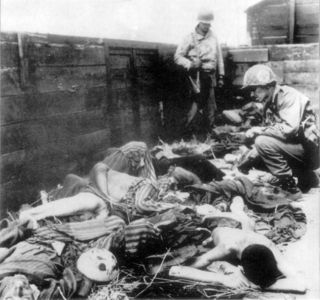
I've been to Dachau. I have walked through the gates with the words "Arbeit Macht Boxcar-dachau Frei" and looked at the showers and the cramped bunks and the ovens. I have seen the dusty yard where prisoners mustered every morning.  I now know that a place can retain horror and despair in its soil.  You can feel the evil in the air even fifty years later.  I have no idea how anyone survived with their sanity. 
 
There are things for which there are no comparison, things like the Holocaust, rape, the death of one's child, and yet they are used with frightening regularity.  'This is like the holocaust'. 'He is like a Nazi'.  'This is akin to rape'.  No. No. And no. There is no like or akin to these things and using them as political hyperbole shows a breathtaking lack of humanity. Not to mention an inability or disinclination to formulate a reasonable argument.
 
So the Dems' health insurance reform plan is equivalent to the poor, tortured souls who lost their lives in Dachau and the survivor who protests the comparison is the "Newest, most current tool of the sick, perverted, racist, anti-semetic Democrap party". 
 
There are no words.

Indeed there aren't. And the GOP leadership, with the sole exception of Eric Cantor, says nothing.