The Nature Of Sin

Jonah Lehrer muddles it:

A new paper demonstrates, once again, that the human brain is the ultimate category buster, blurring the lines of good and bad, black and white, until everything is gray. The reason is that our behavior is deeply contextual, profoundly influenced by our surroundings and immediate situations. Whether or not we're able to resist sin, then, might depend more on the details of the sin – and whether or not it triggers our automatic urges – then on the strength of our moral fiber.

That, at least, is the tentative conclusion of a clever new fMRI study by Joshua Greene and Joe Paxton at Harvard University, who argue that sometimes we do the right thing because the wrong thing simply isn't tempting, even if it leaves us better off. Consider a hypothetical wallet, stuffed full of cash, which you find on the subway. Our moral intuitions (influenced by Genesis) tell us that everyone wants to take the money and run, that we're all attracted by the possibility of unearned cash. But this latest study suggests that, at least for the people who take the wallet to the police, there is no temptation to resist. They don't steal because they don't want to steal; telling the truth isn't hard work. They are living, in other words, in a state of moral grace, at least when it comes to the wallet. (Interestingly, Greene and Paxton found that people who behaved dishonestly in the experiment exhibited more activity in brain areas, such as the prefrontal cortex, associated with self-control. In other words, they might be trying harder to resist, but it's doing no good.)

Beyond Reason

Some think of faith as a simple matter – you have it or you don’t. For these people, further inquiry is unnecessary. Faith is not accessible to reason. Kierkegaard agrees, a little bit. He never thought that faith could be understood through logic or rational thought. Faith, for him, had to have an element of the absurd or it wouldn’t be something special, something outside the normal rules. But he did not think of faith as simple. He saw it as the hardest thing, the greatest challenge, the center of the grand torture we call life. He once said, “If I am capable of grasping God objectively, I do not believe, but precisely because I cannot do this I must believe.”

As The Onslaught Continues, Ctd

A reader writes:

Why are you still a Roman Catholic? Why have you not started attending an Episcopal church? Familiar liturgy, similar theology, radically different morality. The US Episcopal church has committed itself to being a community where all people are members, where all people can be married and blessed and become priests and bishops. We in the US are paying a high price for our commitment to equality–a schism in the worldwide Anglican communion–but we are standing firm. We've got Anglican African bishops and Pope Benedict himself trying to poach Episcopal parishes. We're tiny, we're beleaguered, and we are standing up to the entire world and the entire Christian community to do the right thing.

I know that an Englishman named Sullivan is genetically indisposed to ever imagine attending a branch of the Church of England, but, man, we could use your help. This is where you belong.

Another writes:

As a former Catholic, I read "As The Onslaught Continues" and feel really bad for you.  On the one hand, I appreciate that you do not abandon your faith. But on the other hand, I look at my own situation and have hope that one day you will truly send the right message and stop supporting a faith that does not support you.

I know that you are an intelligent and thoughtful person and you hope that one day your church will come around.  I thought that way for decades and as a child, I knew I would live to see the day when my church would see the light on many issues.  I finally stopped waiting 5 years ago and decided that I needed to stop supporting (with my time, talents and treasure) a church that was not supporting all people equally.
 
I joined the Episcopal church and I could not be happier with my decision. The church is not perfect either, but at least they are moving on the tough questions and struggling with them every day. As a white and straight male, I can not imagine what it must feel like to have people consider you as less than equal.   Keep up the good work and I hope this does not come across in a bad way.  I just ache for your situation.  I still love the Catholic church, but I had to love it enough to walk away.

Another:

Thank you for such a wonderful post. I left the Catholic Church some 30 years ago, when they refused to marry my fiancé and I. We were straight, but he was divorced. I remember being just shocked that they would toss me out. Who were they serving, I wondered? I spent a long time in the spiritual ether-world before I finally settled in as a Buddhist practitioner. But my family are long-time Catholics; I find myself back in those churches now, mostly for funerals. And am struck by how empty they feel. They are protecting the principle (what principle was that anyway?) and sacrificing their people. It’s tragic, a pyrrhic victory for an imagined morality.

How Habitable Is The Earth?

If you are time-traveling, not very:

So here's the upshot: of the 4.6 Gy of Earth's known history, there's only been enough oxygen in the atmosphere for us to survive for about 0.5 Gy. For roughly 90% of the Earth's history we couldn't even breathe the air. And about 10-25% of the time, there have been ice ages so savagely fierce that the glaciers reached the tropics: odds are good that any meat probe landing on solid ground during these periods would rapidly die of exposure. So historically, Earth has only been inhabitable about 8% of the time — assuming you are lucky enough to find some solid ground. Once you factor in the random surface distribution, we're down to about 2% survivability.

Misreading The Pope?

A reader writes:

The mainstream media and the blogosphere are alike in misunderstanding the Church’s teaching and the nuance taken by Benedict XVI as chief teacher. Please note that you, like the rest who report the stories about Church teaching and gay Catholics, leave out three big pieces of the puzzle.

1. It is about straight people, not gay people.

The Catechism of the Catholic Church, the document that contains the “intrinsic disorder” and “objective disorder” judgments against non-procreation, is equally clear about straight people. Every straight couple who uses birth control or whose play time is inclusive of anything apart from the missionary position is condemned with the same brush as we are as gay people. The upshot? If you read Benedict himself (as opposed to the Palin-esque US bishops), he never really talks about gay people – he applies the Catechism to straight culture.

2. Gay couples are, in fact, living holy lives. That same Catechism encourages gay people to pair off. Unfortunately, the English translation is “disinterested friends,” but the original Latin is “graced help-mates.” And the Catechism is clear that we exist and that “becoming straight” is not the answer for us. The upshot? The Church should be speaking out quite vocally for legal protections for gay couples. Marriage? No. Civil unions? Some other term? Yes, in the interest of promoting chastity for gay people.

3. There is no prohibition on gay priests. There is a prohibition on gay seminarians who are overtly active within the “gay culture” that is dying in any case. This is a temporary measure to address the fact that the priesthood itself is in crisis, and the presence of overwhelming numbers of gay guys with issues was complicating priestly formation. Right move? Probably not. Nonetheless, it was done as a practical matter, not a theological one. The upshot? One more reminder from the Vatican that gay men can (and should!) investigate life options apart from priesthood, and remain good Catholics. So, don’t be so hard on Benedict! Some day, his Catechism and his reign could be remembered as our ecclesial emancipation!

Well this is the most positive way to interpret the Pope's actions. But the ban on gay seminarians is obviously a way to purge all gays from the priesthood and the ugly descriptions of gay men's psyches accompanying the move goes far beyond any pragmatic needs towards entrenching the notion that gay 41Sn+8tFmZL._SL500_AA240_ people are "intrinsically disordered", a term coined by this Pope to call gay men sick in the head and thereby ineligible to be priests. 
As for the church's alleged support for gay couples, show me a single statement from Benedict or the bishops that supports civic recognition for gay relationships. I wish it were true, but it isn't. And while the proscription on non-reproductive sexual acts applies to gays and straights alike, the straights have the option of reproductive sexual acts, while gays simply don't. And where the straights don't have the option, as in post-menopausal or infertile relationships, the church gives them a pass. The church uniquely singles out gay people in not giving us a pass on the same humane grounds. So the unique insistence on total celibacy as a condition for being accepted even as a member of the Church remains exclusively reserved for gay people. Celibacy may be defensible in terms of the priesthood (although I disagree), but pastorally indefensible in guiding lay gays to productive and healthy lives.

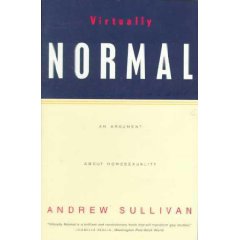
Buried within the Catholic teaching, as I exhaustively explored in Virtually Normal, there is a kernel for expanding God's grace and the church's institutions and even sacraments to include all God's people. But Benedict has clearly made a decision not to let that kernel grow and blossom, but to snuff it out not only within the church but outside as well. He remains the enemy of gay people and our dignity. And, of course, of his own.

The Children Of Soldiers, Ctd

A reader writes:

Three generations of my family have endured a family member going to war. As a Marine, I've left my family to go to war (Afghanistan, Iraq). It was the toughest thing I've ever done. And when my Dad went to war (Desert Storm) it was tough on me (probably tougher on him). Both my Mom and Dad remembered vividly their fathers leaving during WWII, even though they were both only six. This video, and the young girl's reaction, captures all of the extreme emotions a family endures in such circumstances.

I can see my parents as young children in her. That memory never leaves you. But now it is worse, when the deployments repeat over and over again, and weigh so heavily on one small part of our population, it is traumatizing beyond description. It makes it worse that the rest of the country goes on as if nothing is happening.

The price of war can be seen all over that young girl's face. Can you imagine if she were finding out not that her father had come home early, but that he would never come home again?

This is what must be considered when we ask, about any particular war, "Is it worth it?

I think we should have listened more closely to those who had seen more war than most, people like Gen Anthony Zinni and LGEN Hal Moore (of We Were Soldiers fame), who said that Iraq was not worth one American life. It was also was not worth breaking one young American girl's heart.

If I have to go back again, my greatest fear will be for my children. I will be hoping they don't have to endure the loss that so many other American children have already had to endure in this war. This little girl's emotional outpouring brings that possibility immediately home to me. God bless her and her father.

Let's hope we can find a way out of this madness soon.