The Development Cure

DiA is skeptical of John Nagl's prescription for Afghanistan:

Mr Nagl writes that the world's greatest security threats in this century come not from states that are too strong, but from states that are too weak to control their territory. That's true, and it is probably the single fundamental thing that the Bush administration failed to get. He writes that the most important responses to the challenge of such instability are economic and political-diplomatic, not military. And that's right too. But he then wants to build a massive organisational capacity to solve the problems of global underdevelopment and instability through heroic expeditions. At that point, you need to stop and ask yourself whether that $60 billion a year might buy a lot more successful development, and hence a lot more stability, somewhere else in the world, where nobody would shoot at your Nebraska agricultural expert while he tried out a few types of bioengineered seed stock that might work in the local climate.

Aren't here many places in the US that could do with a bit of economic-political development? Like the Deep South or parts of rural America that have been left behind by the global economy? We understand those places a teensy bit better than we do Afghanistan.
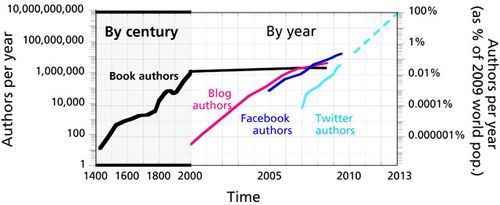
We Are All Authors Now (And Publishers Too)

Chart-authors-per-year_inline_640x262

Seed magazine:

By 2000, there were 1 million book authors per year. One million authors is a lot, but they are only a tiny fraction, 0.01 percent, of the nearly 7 billion people on Earth. Since 1400, book authorship has grown nearly tenfold in each century. Currently, authorship, including books and new media, is growing nearly tenfold each year. That’s 100 times faster. Authors, once a select minority, will soon be a majority.

Today, at 0.1 percent authorship, many people are trading privacy for influence. What will it mean when we hit nearly 1 percent next year and nearly 10 percent the year after as the current growth predicts? Governments, businesses, and organizations must adapt to a population that wields increasing individual power. Protestors used Twitter to discredit the election in Iran. When United Airlines refused to reimburse a musician for damaging his guitar, the offended customer posted a song online—“United Breaks Guitars”—and United’s stock dropped 10 percent.

Norm Geras nit picks the analysis.

The Daily Wrap

Today on the Dish we focused on Fort Hood. We found footage here and here and first-hand accounts here and here. Major reax here. Bruce Bawer addressed the Muslim factor, Andrew warned against targeting Muslims, Greenwald grew frustrated over the media coverage, and Mark Noonan called for torture. We looked back at the other major massacre to hit Killeen, Texas, and there was another shooting today, in Orlando.

Andrew took a look at the unfortunately timed right-wing rally held in DC. One reader worried about the protestors and another pointed the finger at GOP leaders, such as Cantor.

Today's best email recounted a reader's experience growing up with a gay father. We also watched amazing montages of returning vets and movie titles.

— C.B.

Nuclear Socialism?, Ctd

Yglesias responds to Frum:

Even though carbon pricing ought to make nuclear power profitable on an operating cost basis, it would be prohibitively expensive to raise the capital necessary to construct nuclear plants. I think you could resolve this by having the state step in and do the financing. He thinks, I guess, that some counterfactual private utility could do it if it were far larger than any existing utility. But how would you make these mergers happen? That sounds to me like you need an active state.

Under The Rightwing Rock

If you don't think Bush's and Cheney's embrace of torture-as-policy has not had a profound effect, check out this instant response to Fort Hood from Mark Noonan in the neocon camp:

A terrible event – but I don’t want anyone to call it an “act of violence” or “a terrible tragedy”. It was an attack – one or more men decided with malice to attack a US military base. We need to get right down to the bottom of this – and, liberals, if the stories of accomplices in custody are true, this is where harsh interrogation might be needed: whoever was involved in this most emphatically does not have a right to remain silent.

So we go from torturing a foreign terror suspect who may know the whereabouts of a WMD that is about to go off imminently (the original Krauthammer position) to torturing American suspects in a shooting spree (suspect, I might add, that subsequently turned out to be mirages).

This is not a slippery slope; it's a well-greased waterslide to throwing out the entire American system of government.

The Internet Doesn’t Make You Lonely

Don Reisinger sums up a Pew report:

According to a Pew Internet Personal Networks and Community survey, which polled 2,512 adults, the dawn of new technology and the Internet has not caused people to withdraw from society. In fact, the study found that "the extent of social isolation has hardly changed since 1985, contrary to concerns that the prevalence of severe isolation has tripled since then." Pew said that 6 percent of the entire U.S. adult population currently has "no one with whom they can discuss important matters or who they consider to be 'especially significant' in their life."

That said, Pew did find that Americans' "discussion networks"–a measure of people's "most important social ties"–have shrunk "by about a third since 1985" from three people to two. However, Pew found no evidence to suggest that it had anything to do with mobile phones or the Internet. In fact, the organization's study found that mobile-phone use and active Web participation yields "larger and more diverse core discussion networks."

The Coverage Of Fort Hood

Greenwald asks a question after reading Allahpundit's live-blogging of the news reports from Fort Hood yesterday:

Isn't it clear that anyone following all of that as it unfolded would have been more misinformed than informed?

The scale of the errors and misinformation was unusually high. The number of shooters and the actual fate of the prime suspect were both wrongly reported. Like Glenn I can see the benefits of live-blogging breaking news. We do it here all the time. But it seems to me that live-blogging speculation about news we don't yet know is a bit of a mug's game. I'm glad we took a breather and waited to see what actually happened.

How Bad Will It Get?

Economix rounds up reaction to the unemployment numbers. Nigel Gault, IHS Global Insight:

We expect job declines to continue to ease, since we expect that productivity gains will slow, and firms will find that they must bring in new workers to keep output growing. The extra boost provided by the hiring of Census workers should probably be enough to turn employment growth positive by March.

Dean Baker makes a prediction:

The unemployment rate will probably not peak until the spring of next year, at close to 11.0 percent.

The Dish’s prediction: politically what will matter is not the absolute number but the direction. If they’re going down, the Dems can breathe more easily (but not by much); if they plateau for a long time, things are going to get rough for whoever is an incumbent in any race near and far. But remember that Thatcher and Reagan were re-elected despite increasing unemployment quite dramatically in their first term. Because they had a strategy and were able to explain it.