
Telluride, Colorado, 9.50 am
Telluride, Colorado, 9.50 am
A reader writes:
Just last week I finished teaching the Lincoln-Douglas debates, and when I read the Rod Dreher post you linked to, I immediately thought of Stephen Douglas's arguments for "popular sovereignty" — the notion that states, especially former territories entering the Union, could vote slavery "up" or "down" as they saw fit.
Lincoln saw what a fatuous argument "popular sovereignty" was — that it really is the destruction of self-government to allow fundamental rights to be determined by the whims of a majority. The Declaration precedes the Constitution. "All men are created equal" is the necessary preface to "We the People."
Equal rights and the consent of the governed are the principles that make self-government intelligible in the first place. Without them, of course, there are no real limits to what majorities can enact, including doing away with democratic rule. This is why Lincoln repeatedly said that lurking in Douglas's doctrine of popular sovereignty were the same arguments used to justify the divine right of kings. Once "all men are created equal" is dispensed with, once it is no longer held to apply to a certain group of people, what might limit the arbitrary rule of a few, or one, over other groups without their consent?
I understand, of course, the "legitimacy" victories in the democratic process confer on any movement. But for me, the legitimacy of the love and relationships of gay couples already is there. It's a right, grounded in our basic equality. And no majority should be able to take that away. So there's a real ambivalence here.
Here's one of my favorite Lincoln quotes, from an 1855 letter to Joshua Speed:
"I am not a Know-Nothing. That is certain. How could I be? How can any one who abhors the oppression of negroes, be in favor or degrading classes of white people? Our progress in degeneracy appears to me to be pretty rapid. As a nation, we began by declaring that 'all men are created equal.' We now practically read it "all men are created equal, except negroes." When the Know-Nothings get control, it will read 'all men are created equal, except negroes, and foreigners, and Catholics.' When it comes to this I should prefer emigrating to some country where they make no pretence of loving liberty — to Russia, for instance, where despotism can be taken pure, and without the base alloy of hypocrisy."
Insert "gay" for "negroes" in the above and my point is made. His logic resonates still.
No historical analogies are perfect, of course. But this is a great irony, no? The Party of Lincoln is now aping the discredited arguments of Stephen Douglas (and for that matter, John C. Calhoun).
In many ways, it's helpful and clarifying. The biggest news, it seems to me, is that the CBO judges medical malpractice reform to be capable of saving $41 billion over ten years – not exactly a fiscal life-saver but a measurable idea to control costs a little better. I see no reason why it should not be in the final bill. The bill also claims to prevent insurance company discrimination against pre-existing conditions, and sets up high-risk insurance pools. The result would be around a 3 percent reduction in premiums for most people in big company plans. It will cut close to $70 billion off the deficit in the next ten years.
Does it actually tackle the question of covering the 40 million or so people without access to insurance? No, it does not. It could insure an extra 3 million tops. Vast numbers of people would be shut out of access to insurance because they just cannot afford it. The GOP's response to this is: we cannot afford to help right now. Which is honest enough. But it doesn't exactly counter the fact that, according to the same CBO, the Democrats bill would save $104 billion off the deficit in the same time period. So, if affordability is what's at stake, why not back the Dems?
The honest answer to that would be: those CBO numbers won't reflect the final cost and the risks of such an ambitious scheme are too great for this moment of fiscal crisis.
And that's why this counter-proposal is helpful. It frames the core question here sharply: do we want to risk more fiscal imbalance by dramatically increasing the number of people with access to health insurance? Given everything else the federal government spends money on, my answer is: yes. With the proviso that real attempts to cut spending elsewhere – by raising Medicare premiums for the wealthier, by gutting corporate welfare, by deleveraging two unending wars – it's a good thing to do.
But that means that the flipside to this new endeavor must be a serious and persistent attempt to tackle the fiscal crisis after health insurance passes. If Obama wants to reassure independents that he is not another borrow-and-spend president, he will have to pivot off health insurance to steep entitlement and defense budget reform.
A reader writes:
I read the dissent of the day about a reader's fatigue with the Palin soap opera. I agree with the reader on the subject of Palin obsession, but disagree with his threat to stop reading. The Dish covers a whole host of subjects and if I find one that doesn't interest me, like Palin drama, I skip it. We are not obligated as readers to read every post, are we? Of course not.
That's why I prefer the blogsophere to talk radio. If a talk show host goes off on a subject that I have no interest in, I'm stuck. Sure I can put on some music but my political fix is left unfulfilled. With blogs, especially this one, there is plenty to sink your mind into – at your own pace.
That is part of what we've been trying to do here. Since coming to the Atlantic, I've had the chance to get the input of interns to bring their generation's perspective to the Dish. Two of them have gone on to become under-bloggers who, with the active insistence of readers, have helped expand dramatically the number of posts and the variety of subjects. The Dish, I think, is now very different than the one-man blog it started out as.
It's a clearing house for views and ideas and videos and art and argument and anecdote and reporting that create a community of discourse. It's as much your blog now as mine. The posts from readers are just as informative and often more enlightening than my own. Yes, I'm still writing or editing or approving almost every post, but the flow of conversation increasingly leads me, rather than my directing it. As I've noted before, I'm more of a DJ now than a traditional writer. The Dish is always sampling, re-mixing and generating its own music in the interaction with others.
I don't think about this much as I do it because I just follow my nose and pursue the intimations of this medium. But every now and again, one looks up and realizes how different the landscape is and how evolved the Dish has become. I am now just one voice among many here – a voice around which others can gather and contribute, but no more than that.
And that's much more exciting than anything one blogger can pontificate about in a vacuum.
Ana Marie Cox and Jason Linkins are having too much fun.

A reader writes:
Something really caught me today while reading your blog — this clip from the Iranian protests.All of our media coverage today seems to be focused on spinning election results from last night, and what they mean for our "big two" political parties. Doesn't anyone else see the deeper meaning of what last year meant? You don't need to look any further than how Iran was united against the U.S. during the Bush administration, to now a splinter revolution taking place that is drawing a line in the sand against its government. I don't mean to imply that Obama waved some magic wand here; all of the credit goes to Iranians willing to stand up to the thugs patrolling their streets.
But would it be happening this way if the Middle East still viewed the United States the way it did during the Bush
years?
Would the Green Revolution exist if its members still felt an obligation for their nationalism to arise in response to an empire's consistent sabre rattling? Would they ask for an American President to stand by their side?
I kinda doubt it. This isn't meant as cheer leading for Obama; his only achievement thus far has been to step back from the cliff's edge. But the view is so much better from our current position.Obama may not live up to the wildest hopes of his supporters, but this is exactly the type of "change" I thought possible when Ohio was called last year. I don't have the same chills and sense of awe as then, but this will do.
I feel the same way, as I said on Colbert. But equally, I see real signs that those who are threatened by this change at home and abroad are redoubling their efforts to kill this window of promise, because they are far more comfortable in the easy polarization of the past.
What we are about to see is if Obama has the mettle to overcome them. What I do believe is that the stakes are extremely high – in terms of core global security and national cohesion – if he fails. And what I also believe is that without us pushing, fighting, arguing, supporting and constructively criticizing, success will be impossible.
Fariba, a twenty-nine year old journalist who may have voted for Mir Hossein Mousavi, was arrested on August 22, the first day of Ramadan near Iftar time at her father's home. According to her father, Reza Pajooh, a former officer in the Air Force, she spent the entire month of Ramadan in solitary confinement. […] Her parents, who had only heard rumors of her hunger
strike, were allowed to pay her a visit at Evin. According to their account, her mental and physical state was very troubling. They had previously declared that she had been subjected to severe mental and physical pressure to make confessions.
Her father claims that on the occasion of his previous visit to see his daughter in jail she had been so angry that she made a scene yelling about the way her prison guard and interrogators were treating her. She had submitted to a very 'vulgar' body search that had apparently traumatized her and complained of her interrogators accusing her of moral misconduct and leading an immoral personal life, an accusation that is routinely made towards female political prisoners. She has thus far been denied access to her lawyer.
Fariba Pajooh is a child of the Islamic Revolution. She was born a year after the Revolution to a mother who is a medical doctor and an Air Force officer father who served sixty-eight months at the Iran-Iraq front and sustained lasting injuries. […] Fariba's only apparent crime was to support a carefully vetted reformist candidate. The Islamic Republic is indeed devouring her own children.
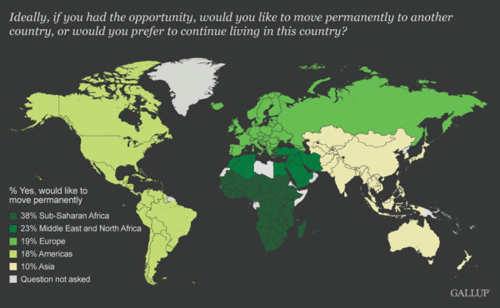
About 16% of the world's adult population would like to emigrate permanently:
The United States is the top desired destination country for the 700 million adults who would like to relocate permanently to another country. Nearly one-quarter (24%) of these respondents, which translates to more than 165 million adults worldwide, name the United States as their desired future residence. With an additional estimated 45 million saying they would like to move to Canada, Northern America is one of the two most desired regions.
The man who pioneered policies that bankrupted the America government is now allegedly concerned about the cost of the health insurance reform.
He forced the massive and truly crippling Medicare prescriptions drug benefit through the Congress, backed two hugely expensive wars, refused to raise any taxes, and presided over an unprecedented rise in domestic discretionary spending. He took a surplus and gave us back a recession and a trillion dollar deficit. He believed that the executive branch had total authority to ignore the laws on torture, and possessed war-powers within the United States with respect to American citizens captured without due process.
But he is now intent on restraining "runaway spending and government expansion."
The great thing about shamelessness is that in an amnesiac culture, it works.
If your primary motive is winning and keeping power, and you have few principles you wouldn't shelve for a tactical win, shamelessness can be temporarily attractive. It is in the long run self-defeating, as the ruins of the post-Rove GOP reveal. But one can never under-estimate the shamelessness of it all. I mean: does Rove actually believe that he is in a position to criticize Obama for spending in a steep recession when Rove broke the budget in a boom? Does he think we have simply wiped clean our memory of the last decade? Is he seriously posing as a limited government, balanced budget conservative nine months after his model presidency left the stage?
Look: I've said many times before, if Obama and the Dems do not follow health insurance reform with a serious, credible bid to cut entitlement and defense spending in the medium and long-term, they will deserve their comeuppance next year. Claiming that the bend-the-curve healthcare provisions will do it won't wash. Politically, it makes sense as well: ask the GOP what they'd like to cut.
Hank Steuver was a first-hand witness.
 The Dish